5.5.1(a)-(f) - Star formation and evolution
Stars are not permanent objects: they form when gravity collapses interstellar gas and dust, spend most of their lives balancing gravity with pressure, and end in different ways depending mainly on mass. In this lesson you will learn the OCR vocabulary for astronomical objects, then follow the physical story from star birth to white dwarfs, neutron stars and black holes. The central thread is simple but powerful: gravity pulls inward, pressure pushes outward, and the available pressure support decides the final remnant.
Astronomical objects
Before the life cycle of a star makes sense, the scale words need to be clean. A planet is a natural body that orbits a star and is much smaller than the star. It does not produce its own light by nuclear fusion.
A planetary satellite is a natural body orbiting a planet. The Moon is Earth's planetary satellite. Artificial satellites are useful spacecraft, but OCR's phrase here means natural satellites.
A comet is a small icy and dusty body that orbits a star, often on a very elongated path. When a comet comes near the Sun, heating can produce a cloud of gas and dust and tails directed away from the Sun. That tail detail is useful recognition, but the essential idea is orbiting icy/dusty body, not "a star with a tail".
Solar System
A solar system is a star together with the planets, planetary satellites, comets and other smaller bodies gravitationally bound to it. Our Solar System is the system centred on the Sun.
Galaxy
A galaxy is a very large gravitationally bound collection of stars, gas and dust. Our Solar System is part of the Milky Way galaxy.
Universe
The universe is all of space and everything in it, including galaxies, stars, planets, radiation and matter.
The nesting is worth remembering:
planetary satellite → planet → solar system → galaxy → universe
That line is not a distance scale; it is a "belongs inside" scale. A comet belongs to a solar system, but it is not a satellite of a planet unless it orbits that planet.
Star formation
Stars form inside clouds of interstellar gas and dust. The gas is mostly hydrogen, with some helium and traces of heavier material. A cloud will not collapse just because it exists: gas pressure from the moving particles tends to spread it out, while gravity tends to pull matter together.
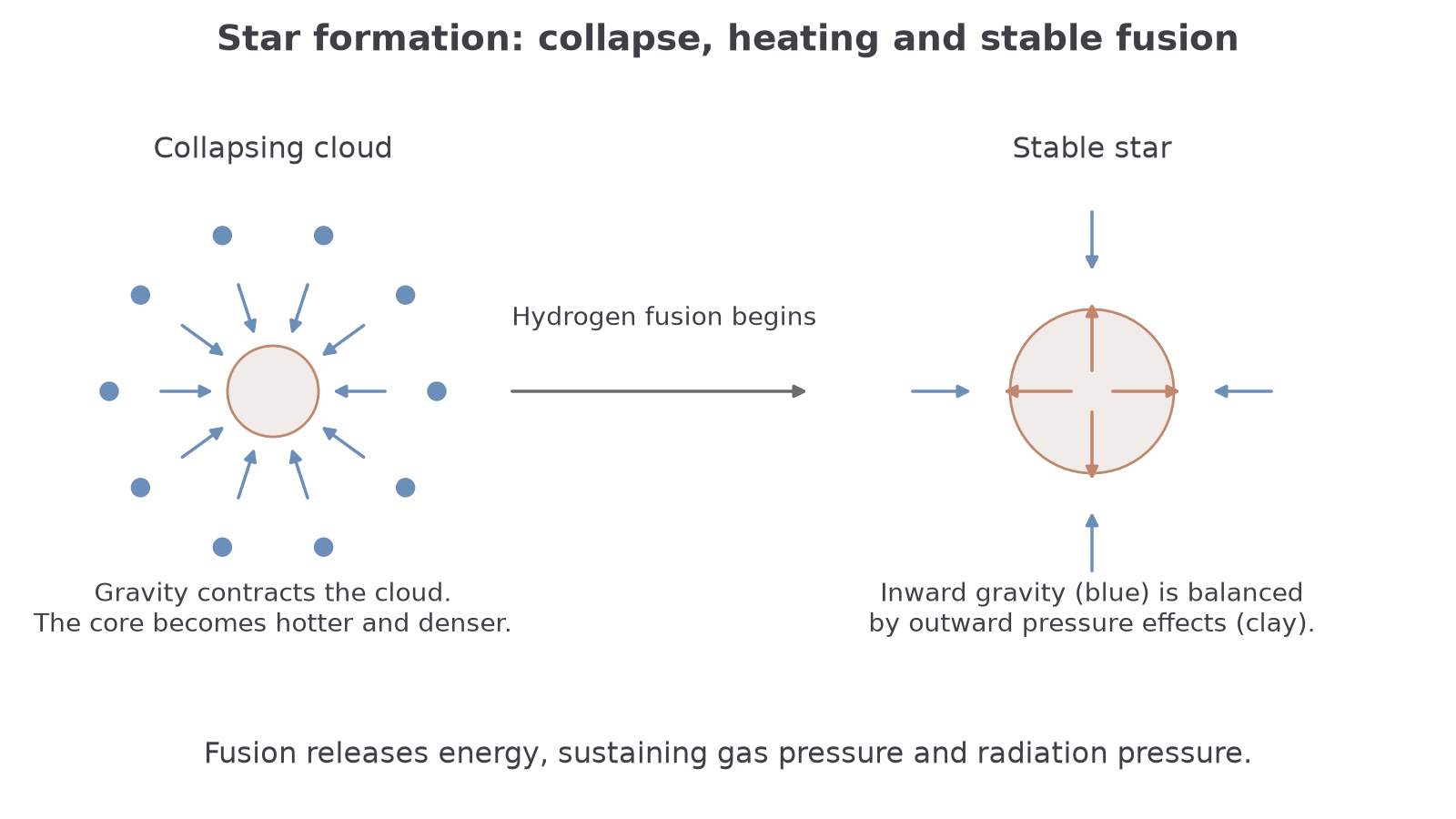
If a region of the cloud becomes dense enough, its self-gravity becomes more important than the opposing pressure. The region collapses inward. As material falls inward, gravitational potential energy is transferred to internal energy, so the central region gets hotter and denser. This hot, dense object before stable fusion is usually called a protostar.
When the core becomes hot and dense enough, hydrogen nuclei fuse to form helium. Fusion releases energy. That energy raises the pressure of the hot gas and produces outward radiation pressure. A stable star is reached when inward gravitational collapse is balanced by outward gas pressure and radiation pressure.
Fusion in a forming star
This lesson does not require a nuclear equation for the fusion chain. OCR's key point is the physical sequence: interstellar dust and gas, gravitational collapse, hydrogen fusion into helium, and pressure balancing gravity.
Misconception to avoid: pressure does not "turn gravity off". Gravity is still acting inward. A stable star is stable because the inward and outward effects balance.
[DIAGRAM: asset_slug: 5_05_1a_star_formation_and_evolution__diagram_01; description: Gravitational collapse heats a protostar; stable fusion sustains pressure that balances gravity.; caption: Gravitational collapse heats a protostar. Stable fusion sustains pressure that balances gravity.]
Low-mass star evolution
A low-mass star like the Sun spends a long time fusing hydrogen into helium. Eventually the hydrogen fuel in the central region is reduced. The balance between inward gravity and outward pressure changes, so the core contracts and heats while the outer layers expand.
The star becomes a red giant. The word "red" tells you the expanded outer layers have a lower surface temperature than before; the word "giant" tells you the radius has increased greatly. OCR does not need the full nuclear-fusion chain here, only the evolutionary route.
Continue this lesson.
You’re previewing NovaLearn without an account. Create a free account to read the rest.
Create free account