5.4.4 - Gravitational potential, energy and escape velocity
Gravitational fields store energy in a way that feels strange at first: the natural zero is not the ground, but infinity. In this lesson you will learn why gravitational potential and gravitational potential energy are negative near a planet, how force-distance graphs represent work done, and how the idea of total energy gives escape velocity. The final application is atmospheric escape: why some planets hold on to gases better than others.
Potential starts at infinity
Near Earth's surface you have often used . That formula is useful only for small height changes where is almost constant and where you have chosen a convenient local zero. For a planet-scale gravitational field, OCR uses a different and more powerful zero:
Gravitational potential
The gravitational potential at a point is the work done by an external agent per unit mass in bringing a small test mass slowly from infinity to that point. Gravitational potential is defined to be zero at infinity.
The unit of gravitational potential is joule per kilogram, . It is a scalar, even though the gravitational field strength is a vector quantity. Potential tells you about energy per kilogram, not force per kilogram.
For a point mass, or outside a spherical mass, the data booklet relationship is:
Gravitational potential outside a spherical mass
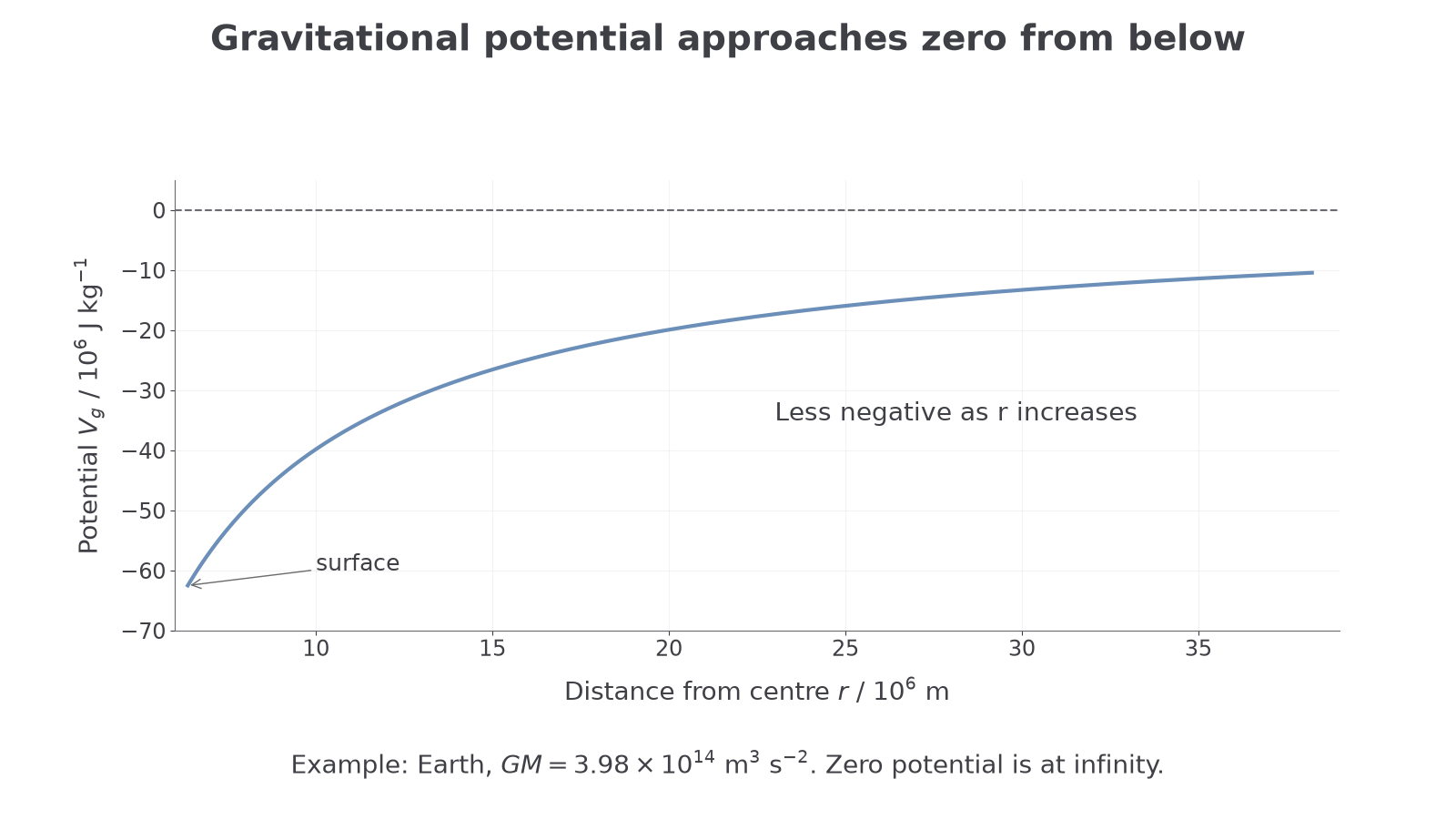
Here is the gravitational constant, is the mass producing the field, and is the distance from the centre of that mass. The minus sign is not decoration. It says that, compared with infinity, a mass near a planet is in a bound state. As the mass moves further away, increases towards zero.
Worked example: gravitational potential at Earth's surface
Take , , and .
That is about . The negative sign means each kilogram at Earth's surface would need about added to reach infinity with no kinetic energy left.
[DIAGRAM: asset_slug: 5_04_4_gravitational_potential_energy_and_escape_velocity__diagram_01; description: Gravitational potential is negative outside an attracting mass and approaches zero at infinity.; caption: Gravitational potential is negative outside an attracting mass and approaches zero at infinity.]
Changes in potential and energy
OCR questions often give two values of gravitational potential and ask what energy change follows. The safest route is:
Then multiply by the moving mass:
Gravitational potential energy
Here is the object placed in the field. is energy per kilogram; is energy for the whole object.
Suppose a satellite moves from a position where to a higher orbit where .
The potential has increased. It is still negative, but it is less negative than before. For a satellite:
So of gravitational potential energy has been gained. If the satellite also needs to be moving fast enough for an orbit, the kinetic energy is an additional part of the total energy calculation; do not hide it inside .
Common sign trap: moving away from Earth increases gravitational potential energy even though the final value may still be negative. Increasing from to is a positive change.
Work from a force-distance graph
The gravitational force changes with distance, so with one constant is not enough for large movements. For a point mass or outside a spherical mass, the magnitude of the gravitational force is:
On a graph of force magnitude against distance , the area under the curve gives the work done against gravity by an external force when the object is moved slowly outward. If the object moves from to , that positive work is equal to the increase in gravitational potential energy.
For the inverse-square curve:
That matches the change in potential energy:
Worked example: moving a spacecraft outward
A spacecraft is moved slowly from to from Earth's centre. Use .
Continue this lesson.
You’re previewing NovaLearn without an account. Create a free account to read the rest.
Create free account