4.2.2 - E.m.f., p.d. and energy transfer
Circuits are easier to understand when you track energy as well as charge. In this lesson you will define potential difference and e.m.f. using energy transferred per unit charge, use the volt as , and calculate energy transfers with and . You will then apply the same idea to charged particles, where electrical energy can become kinetic energy.
Potential difference and the volt
Potential difference, usually shortened to p.d., tells you how much energy is transferred for each coulomb of charge passing between two points or through a component.
Potential difference
The potential difference between two points is the energy transferred from electrical energy to other forms per unit charge passing between those points.
If a lamp has a p.d. of across it, each coulomb of charge passing through the lamp transfers of energy to the lamp and its surroundings. The charge is not "used up"; the energy carried by each coulomb is reduced.
Volt
One volt is one joule per coulomb: .
The unit statement is not separate from the definition. Since p.d. is energy per unit charge,
Potential difference
Here is potential difference in volts, is energy transferred or work done in joules, and is charge in coulombs.
Worked example: energy transferred in a lamp
A charge of passes through a lamp with a p.d. of across it. Calculate the energy transferred to the lamp.
Use:
Substitute:
So of energy is transferred from electrical energy to the lamp.
More generally, the p.d. between two points is the work transferred per unit charge between those points. For a resistor, electrical energy is transferred to thermal energy. Across a source, charge gains electrical energy. The sign of a measured p.d. depends on which point is used as the reference; it does not make the amount of energy transferred negative.
E.m.f. as source energy per charge
Electromotive force, e.m.f., is also measured in volts, but it describes a source rather than a component using energy.
Electromotive force
The e.m.f. of a source is the energy transferred from another form into electrical energy per unit charge passing through the source.
Despite its name, e.m.f. is not a force and is not measured in newtons. A cell with e.m.f. transfers of chemical energy into electrical energy for each coulomb of charge passing through the cell.
OCR commonly denotes e.m.f. by , and some textbooks use . In this lesson, means e.m.f. so that it is not confused with , the energy transferred.
E.m.f.
The key distinction is the direction of energy transfer:
| Quantity | Where it is usually considered | Energy transfer per unit charge |
|---|---|---|
| e.m.f. | source, such as a cell or power supply | from chemical, mechanical or other energy into electrical energy |
| p.d. | component or pair of points in a circuit | from electrical energy into thermal, light, kinetic or other energy |
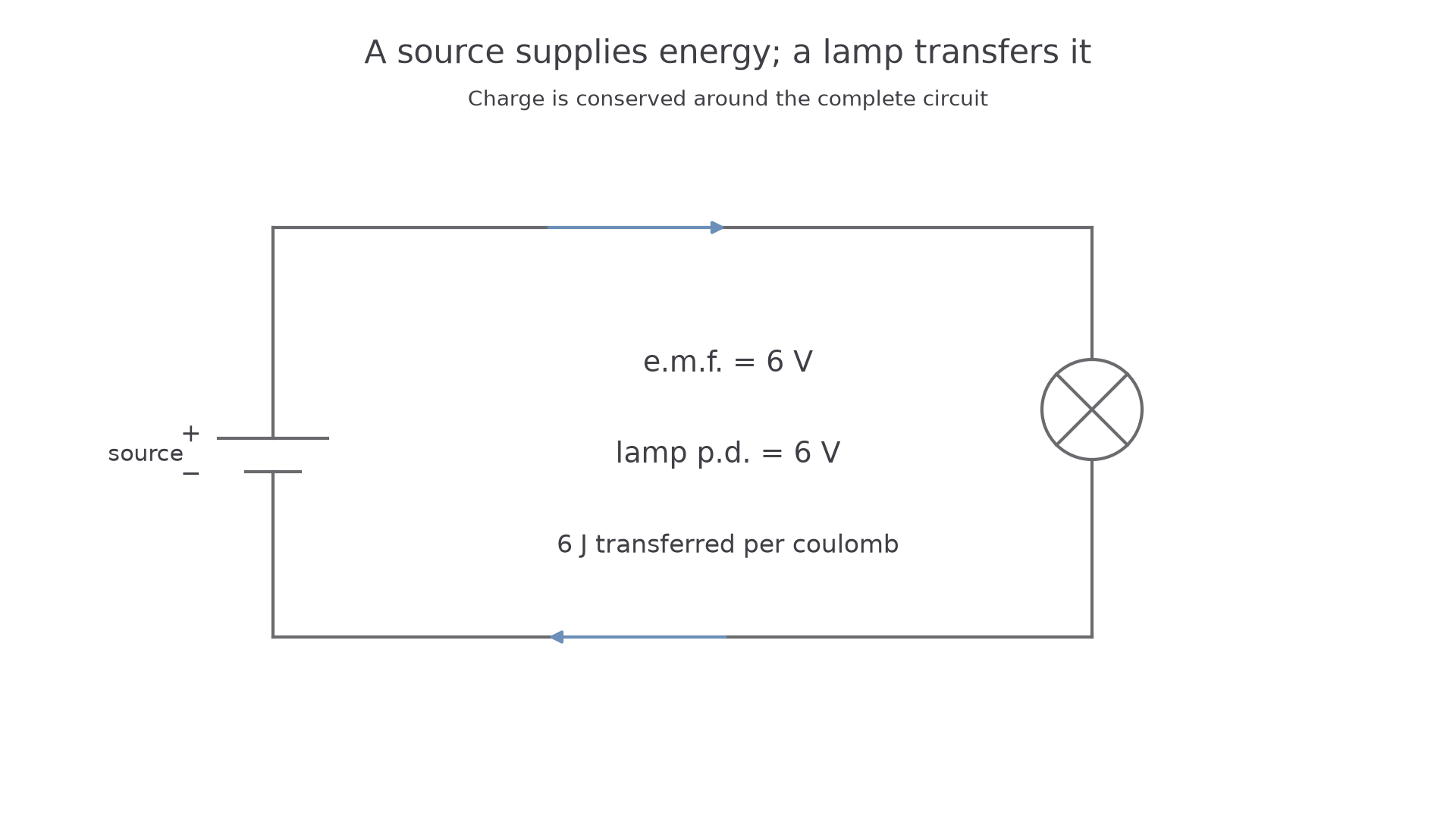
In an ideal circuit with one external component and negligible losses, the p.d. across the component can have the same numerical value as the source e.m.f. That does not make the meanings identical: the source supplies energy per coulomb, while the component transfers energy per coulomb out of the electrical store.
[DIAGRAM: asset_slug: 4_02_2_emf_pd_and_energy_transfer__diagram_01; description: A source supplies energy per coulomb and a lamp transfers that energy while charge is conserved.; caption: A source supplies energy per coulomb and a lamp transfers that energy.]
Energy transfer calculations
The formula rearranges to the most useful calculation form:
Energy transfer by potential difference
For a source, the same energy-per-charge idea gives:
Energy supplied by e.m.f.
In OCR notation this may be written as , where means e.m.f. Be careful: is the energy transferred, not .
Worked example: energy supplied by a power supply
A power supply has e.m.f. . A total charge of passes through the supply. Calculate the energy transferred into electrical energy.
The supply transfers into electrical energy.
Worked example: using current to find charge first
A component has a p.d. of across it. A steady current of flows for . Calculate the energy transferred in the component.
First find the charge using :
Then use :
This link uses the earlier current definition, . The main energy relationship in this lesson remains ; power relationships are treated separately later.
Continue this lesson.
You’re previewing NovaLearn without an account. Create a free account to read the rest.
Create free account