5.3.1 - Simple harmonic motion
Simple harmonic motion, or SHM, is the clean mathematical model behind many oscillations: a mass on a spring, a small-amplitude pendulum, a vibrating atom, or a carefully isolated air-track glider. In this lesson you will learn the kinematics OCR expects: the defining acceleration equation, the timing and phase quantities, the displacement and velocity equations, practical period measurement, and the graph relationships between displacement, velocity and acceleration.
Defining SHM
An oscillation is repeated motion about an equilibrium position. For SHM, the word "simple" has a strict meaning: the acceleration is always towards equilibrium and its magnitude is directly proportional to the displacement from equilibrium.
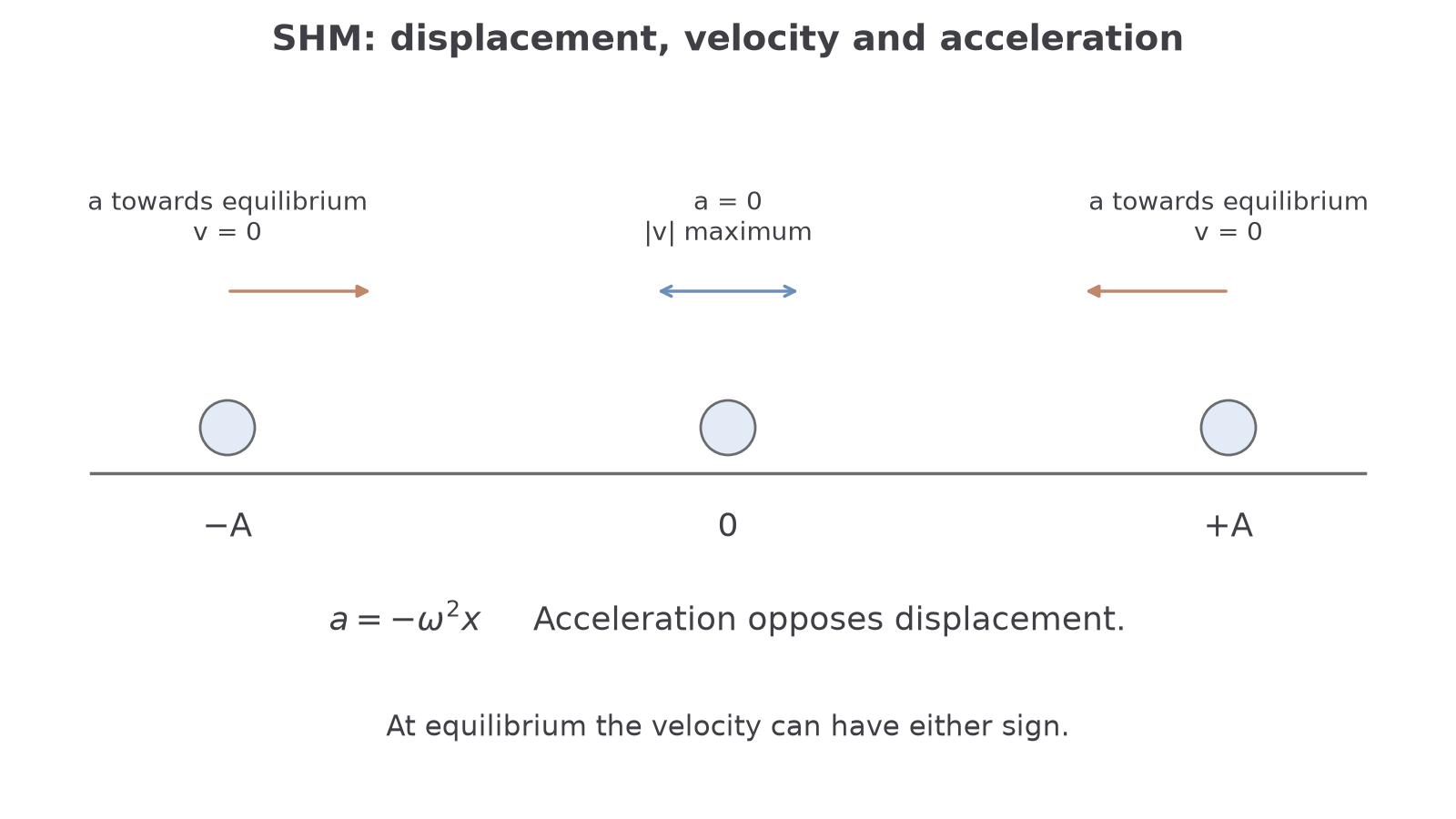
Take displacement as positive to the right of equilibrium. If the oscillator is to the right, is positive, so the acceleration must be to the left and therefore negative. If the oscillator is to the left, is negative, so the acceleration must be to the right and therefore positive. That sign reversal is the heart of the model.
Simple harmonic motion
Simple harmonic motion is oscillatory motion in which the acceleration of the object is directly proportional to its displacement from equilibrium and is directed towards the equilibrium position.
Defining equation for SHM
Here is acceleration in , is displacement from equilibrium in , and is angular frequency in or . The negative sign does not mean "slowing down"; it means the acceleration is in the opposite direction to the displacement.
A useful OCR test is: can the acceleration be written as "a constant multiplied by "? If yes, the motion satisfies the SHM defining equation, and that constant is .
Worked example: a glider has acceleration
where is in and is in .
Compare this with , so
and
The equation also tells you the acceleration direction. At , the acceleration is
The glider is to the positive side of equilibrium, but its acceleration is negative, back towards equilibrium.
[DIAGRAM: asset_slug: 5_03_1_simple_harmonic_motion_kinematics__diagram_01; description: In simple harmonic motion, acceleration is proportional to displacement and directed towards equilibrium.; caption: In simple harmonic motion, acceleration is proportional to displacement and directed towards equilibrium.]
Timing and phase
SHM repeats, so OCR expects you to handle the quantities that describe repeated motion.
Displacement and amplitude
Displacement is the signed distance from the equilibrium position. Amplitude is the maximum displacement from equilibrium.
Period and frequency
Period is the time for one complete oscillation. Frequency is the number of complete oscillations per second, so .
Angular frequency is the rate of phase change. One full cycle is radians, so one period corresponds to radians of phase.
Angular frequency
Phase difference tells you how far apart two oscillations, or two points in the same oscillation, are within the cycle. A quarter-cycle phase difference is rad; a half-cycle phase difference is rad. If two identical oscillators have the same but one reaches a maximum later than the other, their phase difference is
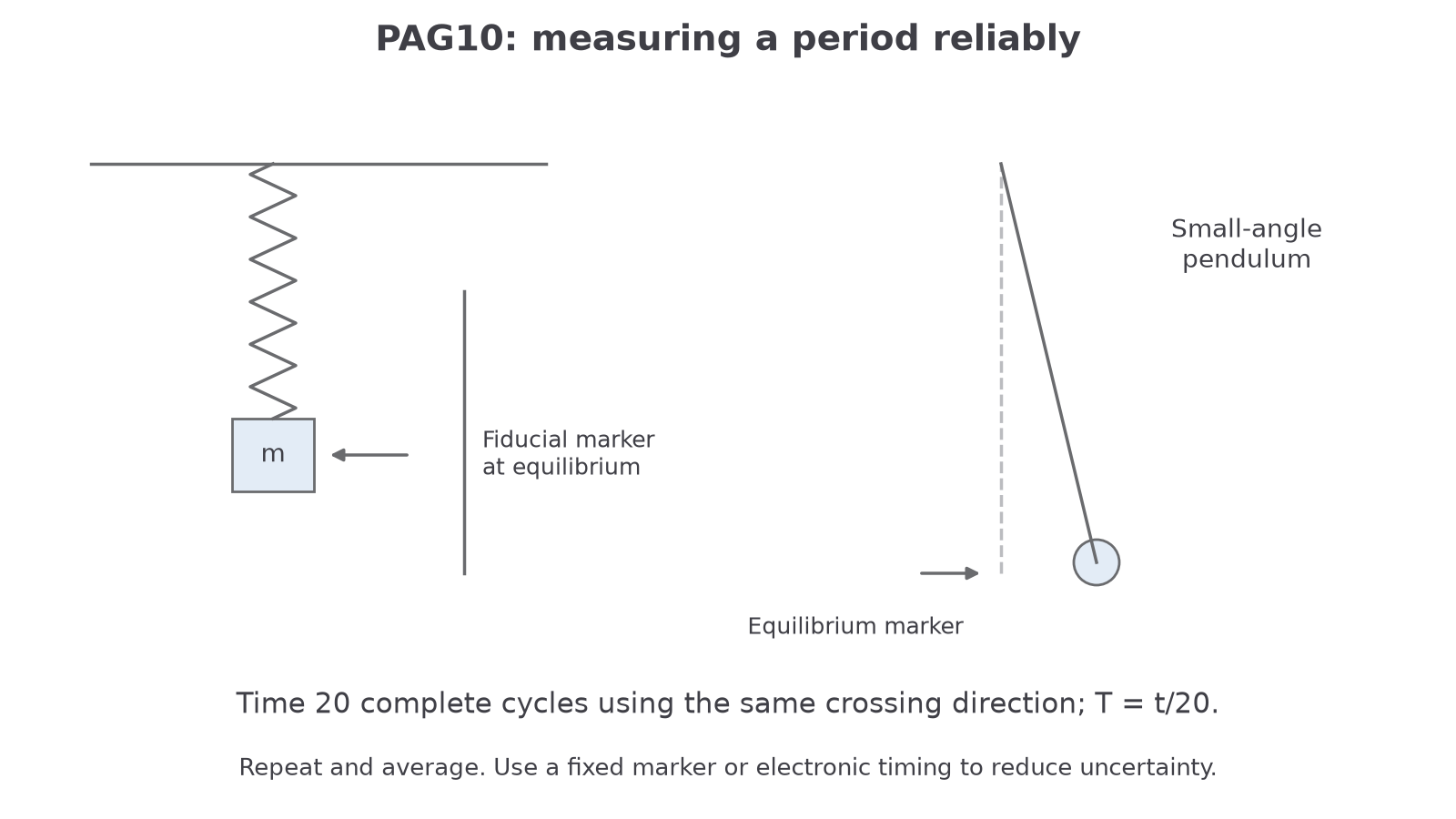
For PAG10-style period measurement, the practical aim is usually to measure or accurately for a mass-spring oscillator or a pendulum. The common good practice is to time many complete oscillations and divide by the number timed:
For a mass on a spring, a student might use a fiducial marker at the equilibrium position and start/stop the timer each time the mass passes the marker in the same direction. For a pendulum, the amplitude should be small, and the bob should pass a fixed marker cleanly. A ruler, set square or plumb line helps measure displacement or amplitude without parallax. Repeating the timing, using a digital timer, light gate, motion sensor or data logger where available, and timing 10 or 20 oscillations reduces the percentage uncertainty in .
Worked example: a student times 20 oscillations of a mass-spring system. The time is .
The final answers are sensible to 3 significant figures because the timing is given to 3 significant figures.
[DIAGRAM: asset_slug: 5_03_1_simple_harmonic_motion_kinematics__diagram_03; description: Time many spring or pendulum oscillations past a fixed reference and divide by the number of complete cycles.; caption: Time several spring or pendulum oscillations past a fixed reference to determine the period.]
Sinusoidal displacement
The defining equation has sinusoidal solutions. OCR gives the common forms:
Displacement in SHM
The two forms describe the same kind of motion. The difference is the choice of when is started.
If the oscillator starts at maximum positive displacement and is momentarily at rest, then is convenient because . If the oscillator starts at equilibrium and moves in the positive direction, then is convenient because and then increases.
The argument is a phase angle, so it is measured in radians. That is why must have units of per second: multiplying by time gives a dimensionless angle in radians.
Worked example: an oscillator has amplitude and period . It starts at maximum positive displacement, so
First find angular frequency:
At ,
The phase is exactly because this is a quarter of the period.
After a quarter of a period, the oscillator has moved from maximum displacement to equilibrium.
Continue this lesson.
You’re previewing NovaLearn without an account. Create a free account to read the rest.
Create free account