2.1.1 - Physical quantities
Physics turns observations into quantities that can be compared, calculated with, and checked. In this lesson you will learn what makes a physical quantity complete, why the unit matters as much as the number, and how to make sensible estimates rather than unsupported guesses. This is a small specification point, but it is a habit you will use in every later topic.
A Quantity Needs A Value And A Unit
A physical quantity is something about a physical object, event, field or system that can be measured or calculated. Examples include length, time, mass, velocity, force, energy, charge and temperature.
Physical Quantity
A physical quantity is a measurable property expressed using a numerical value and a unit.
The two parts do different jobs. The numerical value says how many of the chosen units there are. The unit says what one of those "counts" means physically.
For example, is a complete physical quantity:
- is the numerical value.
- is the unit.
- together they state a length.
For a dimensional measurement such as length, the number on its own is incomplete. It could mean , , , or something else. The unit on its own is also not a quantity; it names the unit but does not say how much length there is.
Worked example: decide whether each statement is a complete physical quantity.
| Statement | Complete physical quantity? | Reason |
|---|---|---|
| yes | numerical value plus unit for time | |
| no | numerical value only | |
| newton | no | unit only |
| yes | numerical value plus unit for force |
Notice that the symbol for a quantity is not enough either. A single letter can mean different quantities in different topics. For example, can mean volume in one context and potential difference in another. The unit helps fix the meaning.
The practical consequence is simple: write a dimensional value with its unit and retain the unit through meaningful calculations. Some ratios, such as strain or refractive index, are dimensionless because matching units cancel; their unit is 1, usually left unwritten.
Reading And Writing Quantities Clearly
OCR questions may ask for a quantity, a unit, or both. These are not the same instruction.
If a question asks for a physical quantity, answer with the measured property, such as current, temperature, mass or time. If it asks for the unit, answer with the unit, such as , , or . Giving the unit when the question asks for the quantity misses the physics.
Worked example: a student is asked to name the physical quantity measured in amperes.
Incorrect answer: ampere
Correct answer: current
The ampere is the unit. Current is the physical quantity.
When you write a measured or calculated value, make the physical quantity, numerical value, and unit visibly separate:
| Complete statement | Physical quantity | Unit |
|---|---|---|
| time | second | |
| mass | kilogram | |
| current | ampere | |
| force | newton |
The point here is narrow: do not confuse the property being measured with the unit used to measure it.
Worked example: a student writes when asked to state the physical quantity measured by a balance.
The answer is the unit. The physical quantity is mass.
Worked example: a student writes after using a thermometer calibrated in kelvin.
The numerical value is present, but the unit is missing. A complete statement is:
Making Sensible Estimates
An estimate is a reasoned approximate value. It is not a wild guess. A good estimate uses a simple model, realistic values, clear units, and rough arithmetic.
Estimate
An estimate is an approximate value based on reasonable assumptions and simplified physical reasoning.
For this lesson, the goal is to estimate physical quantities that appear across the specification. The exact topic may change, but the method is steady:
- Identify the physical quantity you want.
- Choose a simple model or relationship.
- Pick realistic values with units.
- Round values so the arithmetic is manageable.
- Give the answer with a sensible unit and do a scale check.
Worked example: estimate the time for a student to walk the length of a laboratory.
Quantity wanted: time.
Simple model: time is distance divided by speed.
Reasonable assumptions:
- laboratory length is about
- walking speed is about
Calculation:
Conclusion: the estimate is about , with an order of magnitude of . That is reasonable: it is longer than a single step but much shorter than a minute.
The answer should not be written as . An estimate based on rough assumptions should not pretend to be more precise than the assumptions.
Worked example: estimate the volume of air in a classroom.
Quantity wanted: volume.
Simple model: treat the room as a cuboid.
Reasonable assumptions:
- length
- width
- height
Calculation:
Conclusion: a sensible estimate is about , or .
[DIAGRAM: asset_slug: estimates_scale_model; caption: Doubling one classroom dimension doubles the estimated volume. Doubling all three dimensions multiplies it by eight.; description: A classroom cuboid estimate uses three stated dimensions; doubling one length doubles volume while doubling all three multiplies it by eight.]
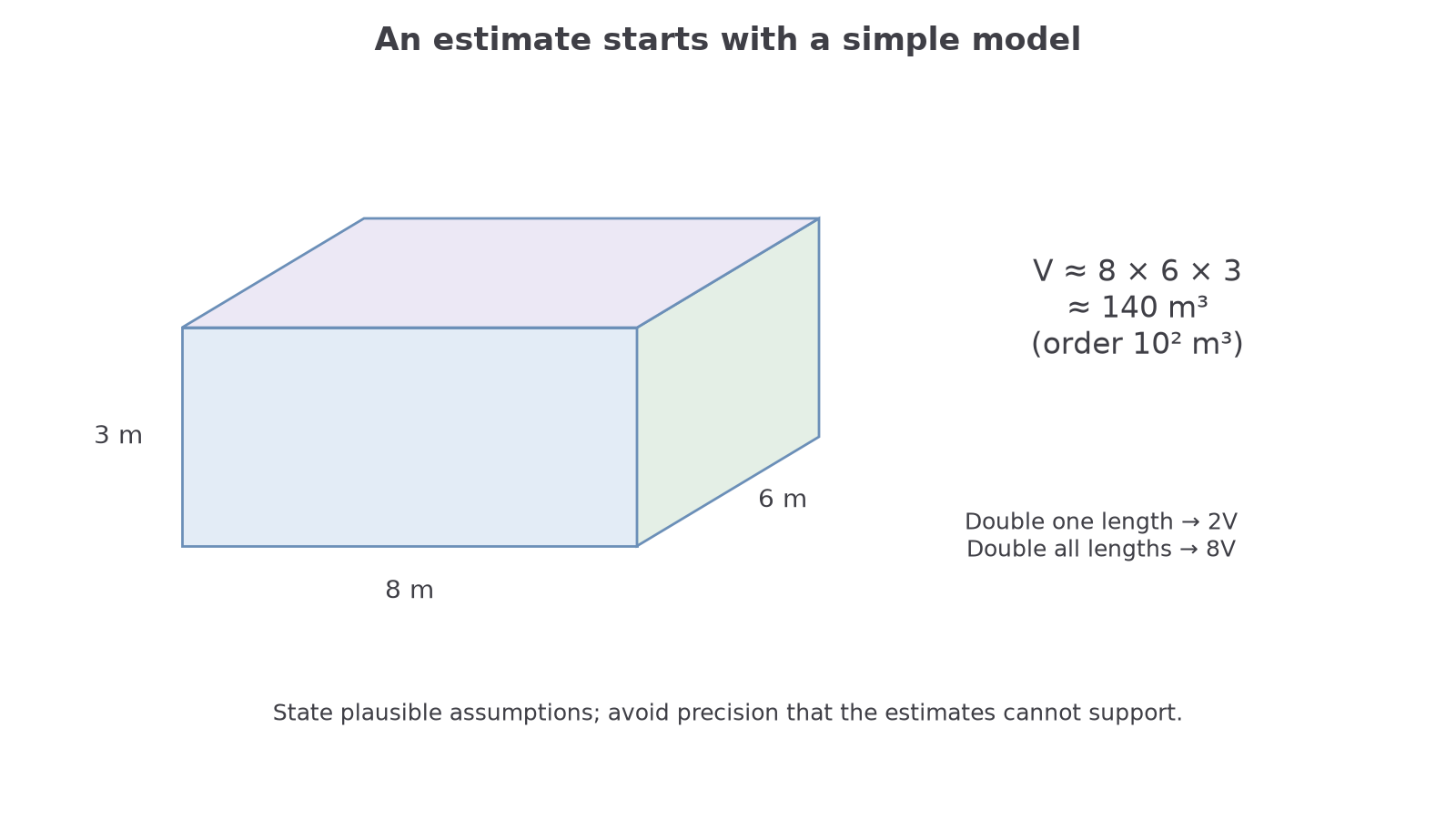
An order-of-magnitude check keeps the main powers of ten. For example, a room volume near multiplied by an air density near gives an air mass of order . A value near would signal an implausible conversion or assumption. Estimates are conditional: changing the model or the chosen scale changes the answer.
Estimating Changes In Measured Values
OCR links this topic to estimating results. One common form is estimating how a measured value changes when an experimental parameter changes.
You do not always need a full calculation. Often the useful question is: if one parameter doubles, halves, or becomes ten times larger, what should happen to the quantity being measured?
Worked example: a trolley moves at approximately constant speed along a track.
First run:
- distance
- time
Second run:
- same trolley, same approximate speed
- distance doubled to
Estimate the new time.
If the speed is the same, time is proportional to distance. Doubling the distance should roughly double the time:
This is not a proof that the trolley really behaved perfectly. It is a reasonableness estimate. If a measured time of appeared for the longer distance, you would suspect a timing error, a changed speed, or a recording mistake.
Worked example: a student estimates the area of a square sensor.
First estimate:
- side length
- area
If the side length is increased to about , the side length has doubled. The area does not double; it becomes:
So the area is about four times larger. The measured quantity depends on how the parameter enters the model.
For a cuboid, doubling all three lengths multiplies volume by ; doubling just one length multiplies it by 2. For a fixed distance, doubling speed instead halves the travel time. Identify what stays fixed and whether the measured quantity depends directly, inversely or on a power of the changed parameter.