3.4.2(a)-(d) - Elastic energy, stress and Young modulus
Stretching a wire is not just a visible change in length. It lets you measure work done, stored elastic energy, stress, strain, and the stiffness of the material itself. In this lesson you will connect force-extension graphs to energy, then use stress and strain to define and determine the Young modulus of a metal.
Work From A Force-Extension Graph
The area gives work done during loading. For reversible elastic loading without dissipation, it equals recoverable elastic energy. A hysteretic elastic material can recover its shape while dissipating some work, and work beyond the elastic limit is not all recoverable.
A force-extension graph shows how the force needed to stretch or compress an object changes as the extension changes. The area under the graph gives the work done on the object.
Work done from a force-extension graph
The work done in stretching or compressing an object is the area under its force-extension or force-compression graph.
The units show why this is energy:
For a linear elastic graph through the origin, the area is a triangle. If the final force is and the final extension is , then:
Elastic potential energy in the linear region
Here is the elastic potential energy stored, is the force at extension , and is the extension in metres. The same result can also be written using Hooke's law, :
Elastic potential energy using spring constant
Here is the force constant in . This formula only applies for the straight-line Hooke's-law part of the graph.
[DIAGRAM: asset_name: 3.4.2(a)-(d) - Elastic energy, stress and Young modulus - diagram 1; asset_slug: work_energy_stress_strain_and_young_modulus__diagram_01; recommended_method: drawn_physics; caption: The triangular area under a linear force-extension graph gives elastic energy.; description: A straight force-extension line reaches 24 N at 0.004 m; its triangular area is 0.048 J of elastic energy.]
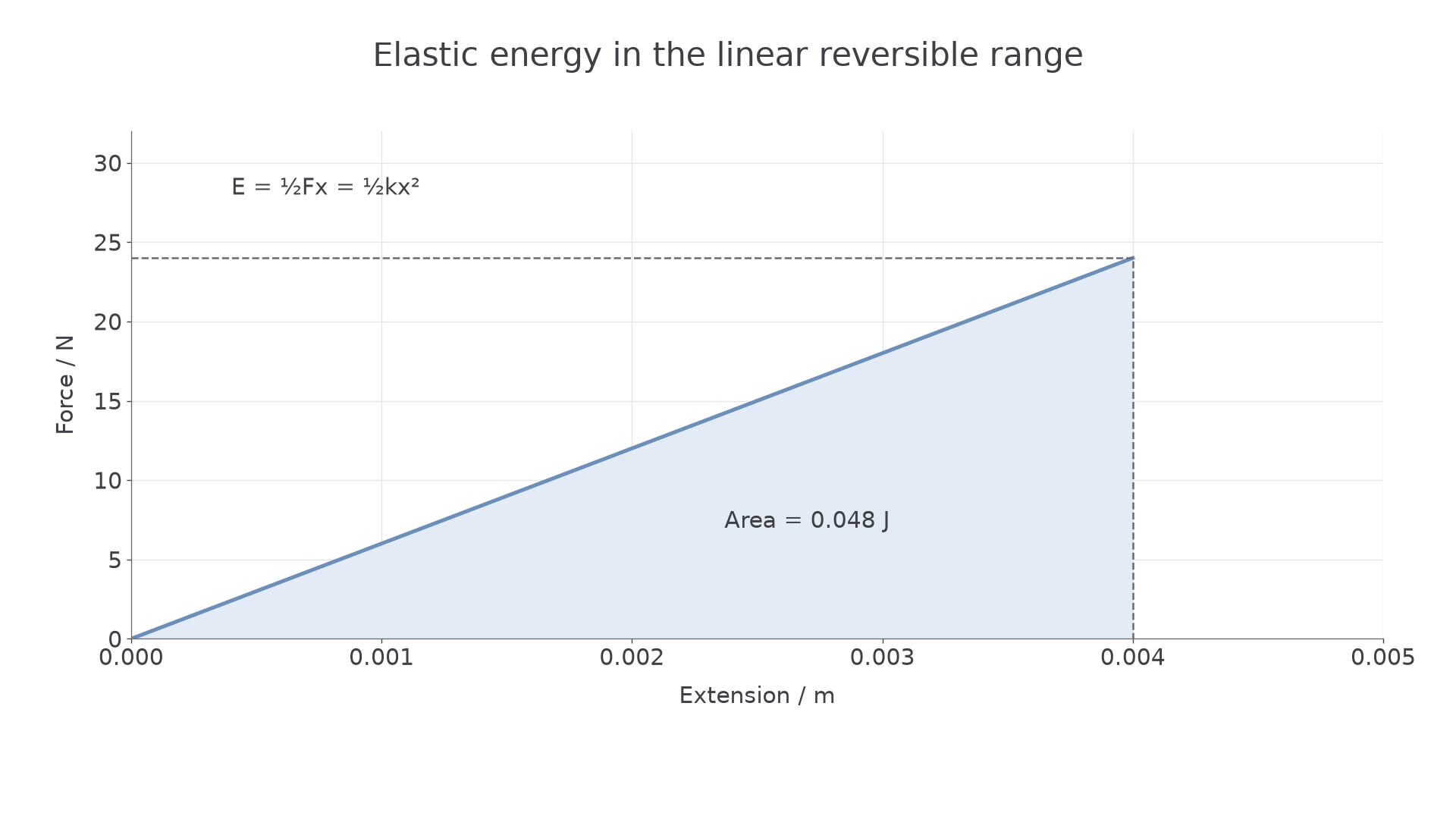
Worked example: energy stored in a stretched wire in the linear region
A wire obeys Hooke's law up to an extension of . At this extension, the tension is . Calculate the elastic potential energy stored.
First convert the extension:
Use the triangular area under the force-extension graph:
Substitute:
The answer is small because the extension is only a few millimetres.
The trap is to multiply force by extension without the factor of one half when the graph is triangular. That would be the area of a rectangle, not the area under this graph.
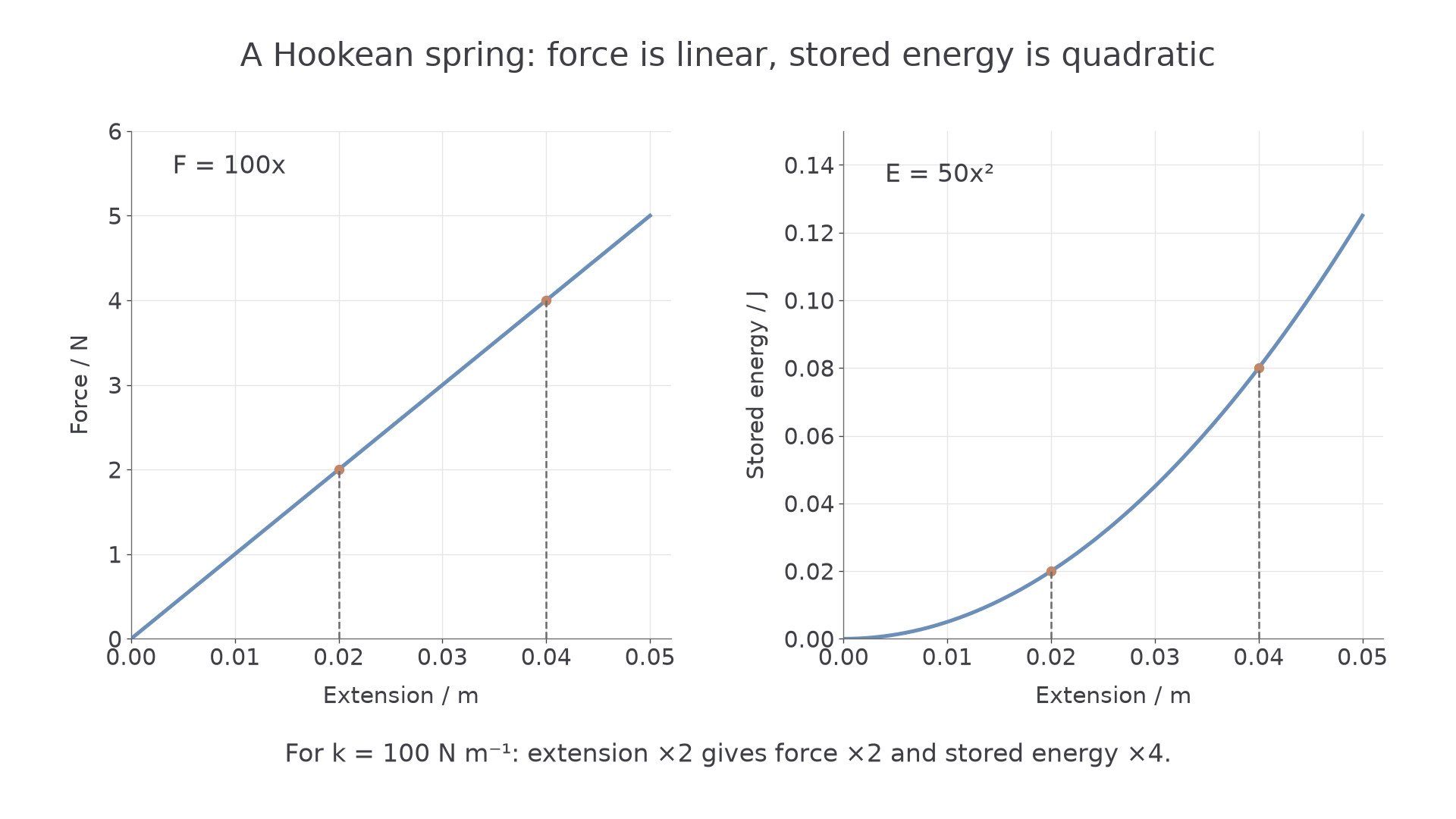
The energy–extension graph is different from the force–extension graph. With constant , gives an upward-curving parabola through the origin: it starts with zero gradient and becomes progressively steeper. Doubling extension multiplies stored energy by four. Plotting energy against instead produces a straight line through the origin with gradient . This comparison applies while the spring stays in its linear reversible range.
[DIAGRAM: asset_name: Force and elastic energy against extension; asset_slug: mechanics_elastic_energy_curve; recommended_method: drawn_physics; caption: Doubling extension doubles spring force and quadruples stored elastic energy.; description: A spring of force constant 100 N per metre has a straight force-extension graph and a quadratic energy-extension graph; doubling extension from 0.02 m to 0.04 m doubles force and quadruples energy.]
Stress, Strain And Ultimate Tensile Strength
Force and extension depend on the size and shape of the sample. A thick wire needs more force than a thin wire of the same material, and a long wire extends more than a short wire for the same stress. Stress and strain remove these specimen-size effects.
Tensile Stress
Tensile stress is the tensile force per unit cross-sectional area.
Tensile Stress
Here is tensile stress in pascals, is the tensile force in newtons, and is the cross-sectional area in square metres. One pascal is one newton per square metre.
Tensile Strain
Tensile strain is the extension divided by the original length.
Tensile Strain
Here is tensile strain, is the extension, and is the original length. Strain has no SI unit because it is a ratio of two lengths. Use fractional strain in calculations, so , not , unless you convert the percentage back to a fraction.
Ultimate Tensile Strength
The ultimate tensile strength is the maximum tensile force divided by the original cross-sectional area: the peak engineering tensile stress during a tensile test. For a ductile material this peak can occur before fracture; the fracture stress can be lower.
Worked example: calculating stress and strain
A metal wire has diameter , original length , and extension when a tensile force of is applied.
First calculate the cross-sectional area. The radius is half the diameter:
Now calculate tensile stress:
Convert the extension:
Calculate tensile strain:
Notice the two common errors: using diameter instead of radius in the area calculation, and leaving extension in millimetres while length is in metres.
Stress tells you how hard the material is being loaded per square metre. Strain tells you the fractional change in length. Together they let you compare materials fairly.
Young Modulus
The Young modulus measures how much tensile stress is needed to produce a given tensile strain in the linear elastic region of a material.
Young Modulus
The Young modulus of a material is the ratio of tensile stress to tensile strain in the linear elastic region.
Young Modulus
Here is the Young modulus in pascals, is tensile stress, and is tensile strain. Since strain has no unit, the unit of Young modulus is the same as the unit of stress: Pa.
You can also combine the equations for stress and strain:
which gives:
Young Modulus From Wire Measurements
This is useful when the measured quantities are force, original length, area and extension.
Continue this lesson.
You’re previewing NovaLearn without an account. Create a free account to read the rest.
Create free account