3.2.3(e)-(f) - Equilibrium and triangle of forces
Equilibrium is the physics word for a situation where forces do not make an object accelerate and torques do not make it start rotating. In this lesson you will learn the two checks for equilibrium, then use a triangle of forces for three coplanar forces. The aim is to make force diagrams useful: not just drawing arrows, but turning them into clear equations and conclusions.
Two Equilibrium Checks
An object is in equilibrium when its motion is not changing. A stationary object in equilibrium stays stationary. An object already moving at constant velocity can also be in equilibrium, because zero resultant force means zero acceleration.
For a real extended object, there is a second check. The forces must also produce no resultant torque, so the object does not gain angular acceleration.
Equilibrium
An object is in equilibrium when the resultant force on it is zero and the resultant torque on it is zero. Its translational and rotational motion do not change.
Equilibrium Conditions
Here, and are perpendicular components of the forces, usually horizontal and vertical. The symbol represents torque or moment. For this lesson, read as "the total clockwise moment equals the total anticlockwise moment" about the chosen point.
The key word is resultant. An object in equilibrium can still have several forces acting on it. The forces have not disappeared; their vector sum is zero.
For example, a book resting on a horizontal table has weight downwards and a normal contact force upwards. If those forces have equal magnitude and act along the same vertical line, the resultant force is zero and there is no turning effect. The book is in equilibrium.
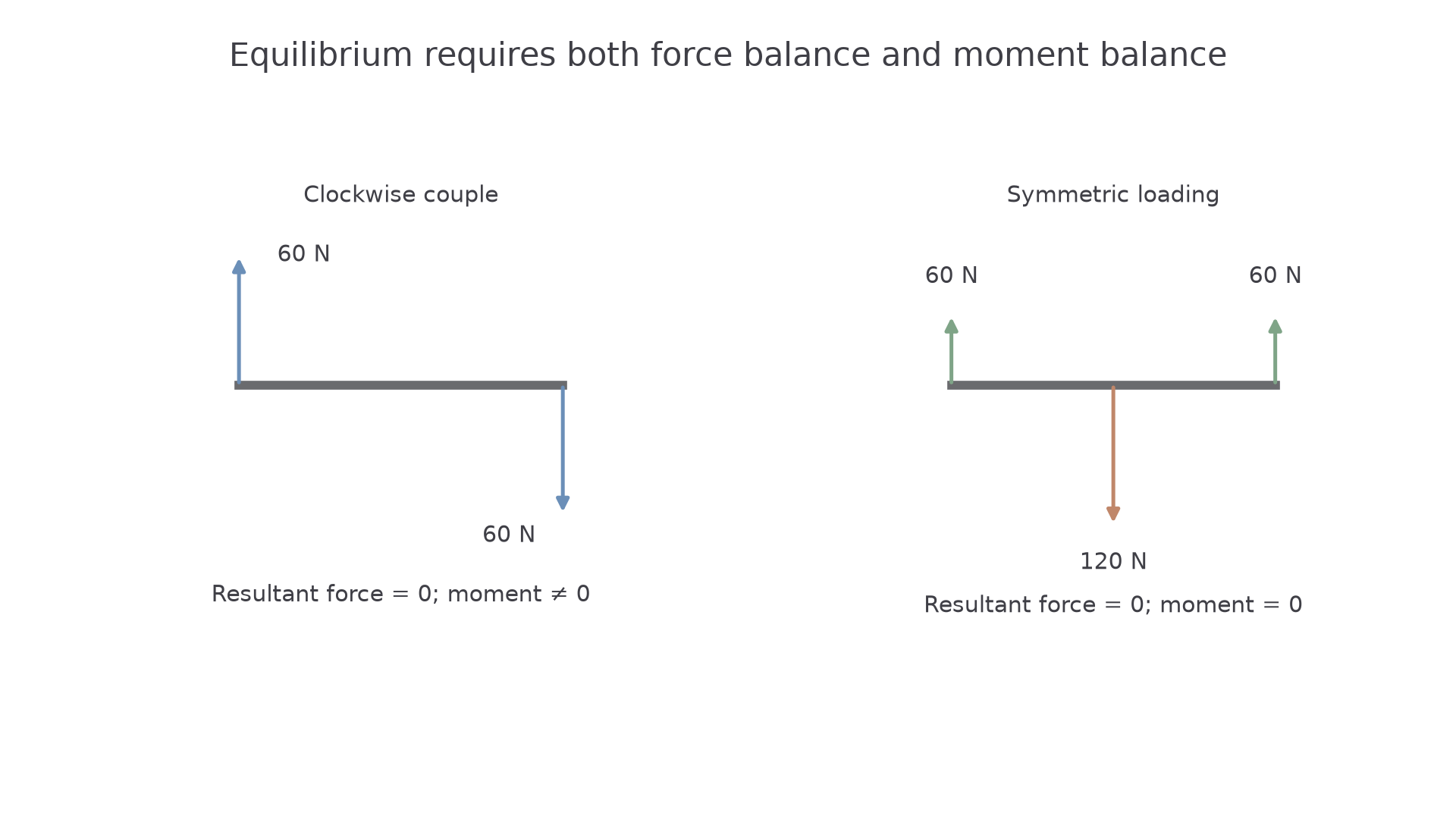
Consider why a force check alone is not enough. For a couple the upward and downward forces are equal and opposite, so the resultant force is zero. However, because their lines of action are separated, they produce a turning effect in the same rotational sense. The rod is not in equilibrium.
For a beam with symmetric upward supports and a central downward weight the upward support forces add to the downward weight, so the resultant force is zero. The arrangement is symmetric, so the clockwise and anticlockwise moments also cancel. That rod is in equilibrium.
Worked example: checking both conditions
A light horizontal rod has a upward force at its left end and a downward force at its right end. The ends are apart.
- Resultant force: up and down give zero resultant force.
- Torque about the centre: each force acts from the centre and each tends to rotate the rod in the same direction.
- Total torque magnitude: .
The rod is not in equilibrium because the resultant torque is not zero.
[DIAGRAM: asset_name: 3.2.3(e)-(f) - Equilibrium and triangle of forces — figure 1; asset_slug: 3_02_3b_equilibrium_and_triangle_of_forces__diagram_01; recommended_method: drawn_physics; caption: Zero resultant force does not ensure zero turning moment.; description: A clockwise couple produces turning despite zero resultant force; symmetric loading can balance both forces and moments.]
Force Diagrams For Equilibrium
A force diagram is the bridge between the physical situation and the calculation. Before adding numbers, decide what object is being considered and draw only the forces acting on that object.
For equilibrium questions, a good force-diagram routine is:
- Isolate one object or one point.
- Draw each external force with a direction and a label.
- Choose perpendicular axes.
- Resolve angled forces into components if needed.
- Write along each axis.
- For an extended object, also check moments or torques.
Do not include the force that the object exerts on something else. If a hanging sign pulls down on a string, the force on the sign from the string is the tension pulling up along the string. The action-reaction pair acts on different objects, so it does not belong on the same force diagram.
Coplanar Forces
Coplanar forces act in the same plane. A flat page can represent their directions without needing a third dimension.
The data booklet gives component relationships for a force at an angle to the horizontal axis:
Vector Components
These equations only match the diagram if is measured from the horizontal. If the angle is measured from the vertical, the sine and cosine swap roles. This is one of the most common errors in equilibrium calculations.
Worked example: a symmetric hanging sign
A sign of weight is supported by two identical cables. Each cable makes an angle of above the horizontal. Find the tension in each cable.
The sign is stationary, so it is in equilibrium.
Horizontal components:
These cancel because the cables are identical and symmetric.
Vertical components:
So:
A sensible final answer is:
The tension is larger than half the weight because each cable has only a vertical component of its tension supporting the sign. The horizontal components cancel each other and do not support the weight.
Triangle Of Forces
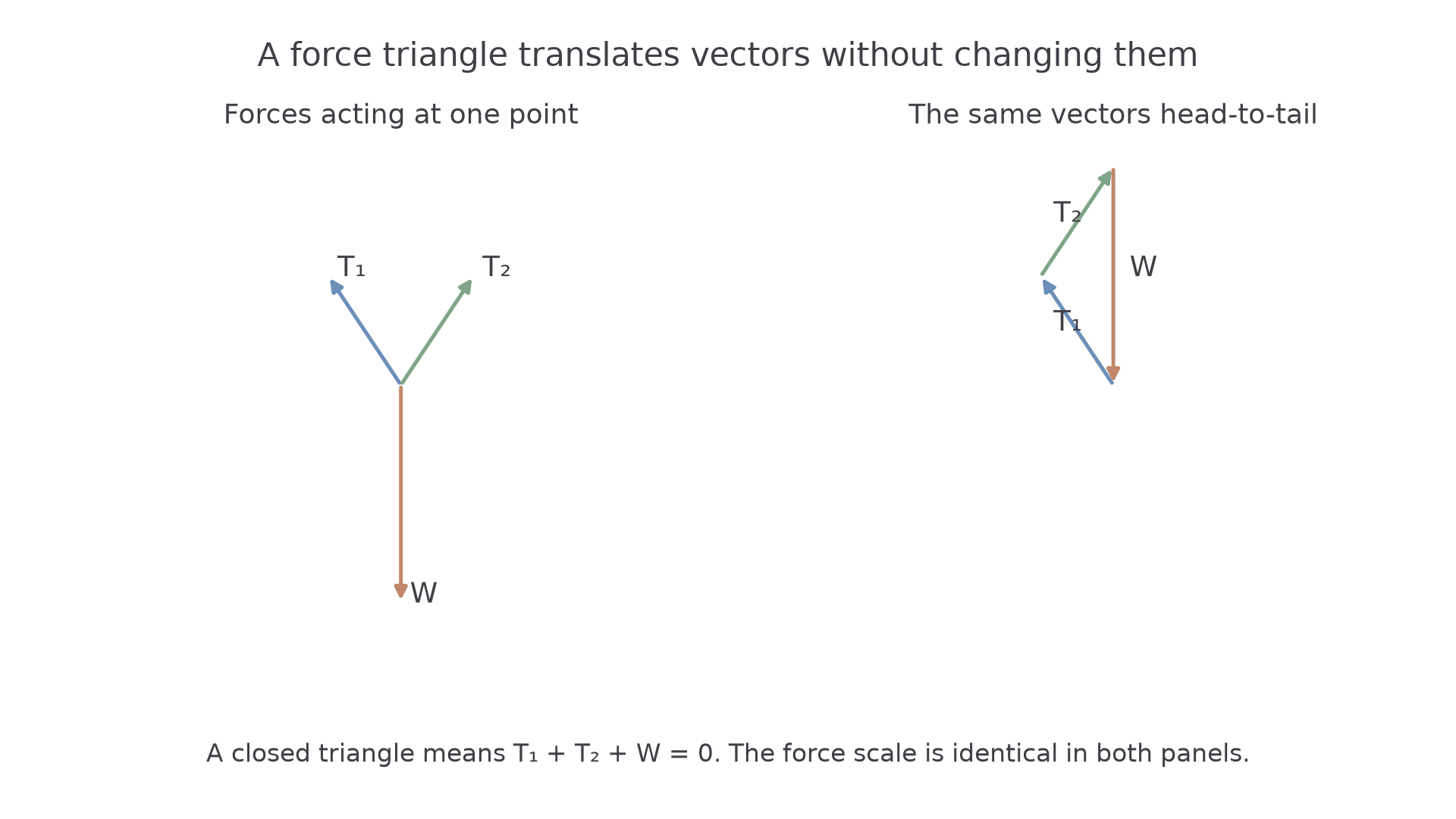
For three coplanar forces in equilibrium, the forces can be represented by a closed triangle when drawn head-to-tail. This is called the triangle of forces.
Triangle Of Forces
For three coplanar forces in equilibrium, the three force vectors can be drawn head-to-tail to form a closed triangle. The closed triangle shows that the vector sum of the forces is zero.
The physical diagram and the triangle of forces are different drawings.
- The physical diagram shows where the forces act on the object.
- The force triangle shows the vectors placed head-to-tail.
- The sides of the triangle represent the magnitudes and directions of the forces.
- The triangle must close. If there is a gap, the gap represents a non-zero resultant force.
[DIAGRAM: asset_name: 3.2.3(e)-(f) - Equilibrium and triangle of forces - diagram 1; asset_slug: 3_02_3b_equilibrium_and_triangle_of_forces__diagram_02; recommended_method: drawn_physics; caption: Three force vectors form a closed triangle when their resultant is zero.; description: Three force vectors translated head to tail form a closed triangle when their resultant is zero.]
The triangle can be used qualitatively or quantitatively. Qualitatively, it proves that if the three vectors close, the resultant force is zero. Quantitatively, it lets you use triangle geometry such as Pythagoras' theorem, the angle sum of a triangle, the sine rule or the cosine rule.
Worked example: finding the balancing force
Two forces act at a point:
- east
- north
Find the third force needed for equilibrium.
First find the resultant of the two known forces. They are perpendicular, so:
The resultant of the first two forces acts north-east. The third force must be equal and opposite to that resultant, so it has magnitude and acts south-west.
The direction angle can be found from:
so north of east for the resultant. The balancing force is therefore south of west, or equivalently directed opposite the resultant.
A closed vector triangle establishes zero resultant force. It does not record where the forces act, so it cannot by itself establish zero resultant moment for an extended body. Three non-parallel coplanar forces on a rigid body in equilibrium must have concurrent lines of action: taking moments about the intersection of two leaves no moment from either, so the third must pass through that point too.
Components Or Triangle
The component method and the triangle method are two ways of saying the same vector fact.
Using components:
Using a triangle:
the three vectors close when drawn head-to-tail.
The best method depends on the information given.
| Information given | Useful method | Why |
|---|---|---|
| Horizontal and vertical directions are obvious | Components | The equilibrium equations are direct. |
| Forces make a right-angled triangle | Pythagoras and trigonometry | Quick for perpendicular components. |
| Three force directions form a non-right triangle | Sine rule or cosine rule | The force triangle contains the useful angles. |
| A scale drawing is requested | Triangle of forces by scale | The side lengths represent force magnitudes. |
For a scale drawing, choose a scale such as represents , draw each force vector in the correct direction and order, and measure the missing side or angle. For a calculation, use the same geometry but keep the numbers exact until the final rounding step.
Worked example: unequal cable angles
A small object of weight is held by two cables. The left cable makes above the horizontal and has tension . The right cable makes above the horizontal and has tension . Find both tensions.
Horizontal equilibrium:
So:
Vertical equilibrium:
Substitute the expression for :
This gives:
Then:
Check the answer physically. The right cable is steeper, so it needs a larger tension than the left cable to balance the horizontal component while also helping support the weight. Both tensions are plausible.
For the unequal-cable example with weight , left angle and right angle , the force triangle has opposite angles , and for , and weight. The sine rule gives Thus and , or and . Keep unrounded values through component substitutions.
Testing three-force equilibrium
For an extended object, do not stop after . If the question is about a beam, ladder, rod, bridge or object with forces at different positions, ask whether the torques cancel. For three forces acting at the same point, the torque issue is usually removed because all the lines of action meet at the point; then the triangle of forces or component equations decide the equilibrium.
You can use a force board, newton meters and a protractor to test three-force equilibrium. To obtain useful evidence:
- use strings meeting at a small ring so the forces are close to concurrent;
- measure the three force magnitudes using newton meters or known weights;
- measure angles with a protractor from a fixed reference line;
- draw a scale vector triangle or resolve the forces into components;
- repeat readings and keep the ring stationary before recording data;
- comment on uncertainty in angle readings, newton-meter resolution and friction at pulleys if used.
Compare any residual vector with the uncertainty from force and angle readings; a small gap on a drawing alone does not establish agreement.
Takeaway
For equilibrium, ask two questions: is the resultant force zero, and is the resultant torque zero? For three coplanar forces acting at a point, a closed head-to-tail triangle is the visual test for zero resultant force.