3.5.1(d)-(e) - Impulse and force-time graphs
Impulse measures what a force does when it acts for a time. In this lesson you will learn how to calculate impulse for a constant force, connect impulse to change in momentum, and determine impulse from the area under a force-time graph. The graph skill is especially important when the force is not constant, because most real contact forces rise and fall during the interaction.
Impulse As Force Acting For Time
Impulse is a way of measuring the effect of a force during a time interval. A large force for a short time can have the same impulse as a smaller force for a longer time, provided the product of force and time is the same.
Impulse
For a constant force, impulse is the product of force and the time interval for which the force acts. For a varying force it is the signed area under the force-time graph, or average force times the interval. It is a vector quantity. For a force of fixed direction it has that direction; if the direction changes, add the signed impulses in each component.
For a constant force, or for an average force over a stated time interval:
Impulse of a constant force
Here is impulse in , is force in N, and is the time interval in s. Some books use instead of for impulse; the physics is the same. Be careful not to confuse the symbol with the unit joule, because impulse is not energy.
The unit checks the idea:
So impulse has the same base units as momentum. That is a clue that impulse is linked to changing momentum, not to doing work.
Worked example: constant force impulse
A bat exerts an average force of on a ball for . Calculate the impulse on the ball.
To two significant figures, the impulse is in the direction of the average force exerted by the bat on the ball.
Keep that product in mind when you read a force-time graph: the same multiplication becomes a physical area.
Impulse is not just "a big force"; it is force multiplied by the time for which the force acts.
Impulse And Momentum Change
The previous lesson introduced the momentum form of Newton's second law:
For a finite interval, take to be the average resultant force and rearrange:
This means the impulse of the resultant force on an object is equal to the object's change in momentum.
Impulse-momentum link
Here the mass is constant and measured in kg, is initial velocity, and is final velocity. Use velocities, not just speeds, because direction matters. If right is chosen as positive, then a leftward velocity is negative.
Worked example: signed impulse
A ball moves to the right at . After a short contact, it moves to the left at . Take right as positive. Determine the impulse on the ball.
Initial momentum:
Final momentum:
Change in momentum:
The impulse is , or to the left. The negative sign is not a problem; it says the impulse is opposite to the positive direction.
If the contact time were , the average force on the ball would be:
The average force is to the left.
The safest calculation habit is to write the momentum change before deciding the force direction.
Impulse changes momentum. Direction and signs matter because both impulse and momentum are vector quantities.
Area Under Force-time Graphs
When a force varies during an interaction, is still useful if means the average force. A force-time graph gives a more direct method: the impulse is the area between the graph and the time axis.
[DIAGRAM: asset_name: 3.5.1(d)-(e) - Impulse and force-time graphs - diagram 1; asset_slug: 3_05_1b_force_impulse_and_force_time_graphs__diagram_01; recommended_method: drawn_physics; caption: The force-time rectangle has an impulse of 400 N s.; description: A force-time rectangle of height 800 N and width 0.50 s has an impulse of 400 N s.]
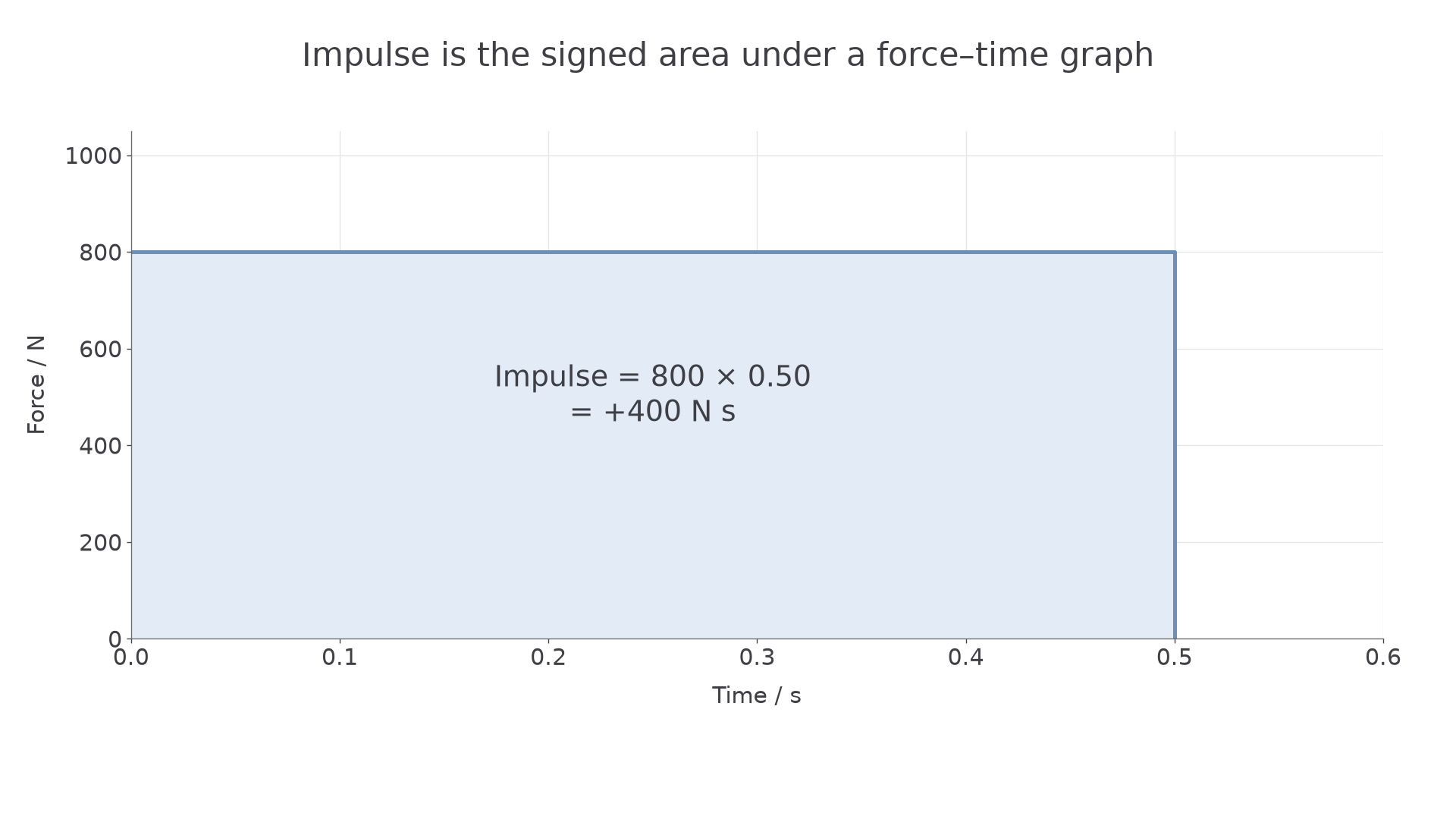
The units of graph area confirm the result:
For straight-line sections, split the area into simple shapes:
- rectangle:
- triangle:
- trapezium:
Worked example: triangular force pulse
A force-time graph for a short impact is triangular. The force rises from zero to a maximum of and returns to zero. The whole contact lasts .
The impulse is the area of the triangle:
This is also a momentum change of in the direction of the force.
Signed area
If a force-time graph is below the time axis, the force is in the negative direction. The area then represents a negative impulse. If a graph has positive and negative sections, add the signed areas to find the net impulse.
For example, a force of for , followed by for , gives . Adding the magnitudes would wrongly give 1.2 N s.
Continue this lesson.
You’re previewing NovaLearn without an account. Create a free account to read the rest.
Create free account