4.5.1 - Photons, the Planck constant and electronvolts
Light has already behaved like a wave for interference, diffraction and polarisation. In this lesson the same electromagnetic radiation is modelled as arriving in packets of energy called photons. You will learn how photon energy depends on frequency and wavelength, why the electronvolt is a useful small energy unit, and how different coloured LEDs can be used to estimate Planck's constant.
The Photon Model
The wave model says electromagnetic radiation has frequency, wavelength and speed. The photon model adds a different idea: when electromagnetic radiation transfers energy to or from matter, the energy is transferred in discrete packets rather than in any continuously variable amount.
Photon
A photon is a quantum of electromagnetic radiation. It is one discrete packet of electromagnetic energy.
Quantum
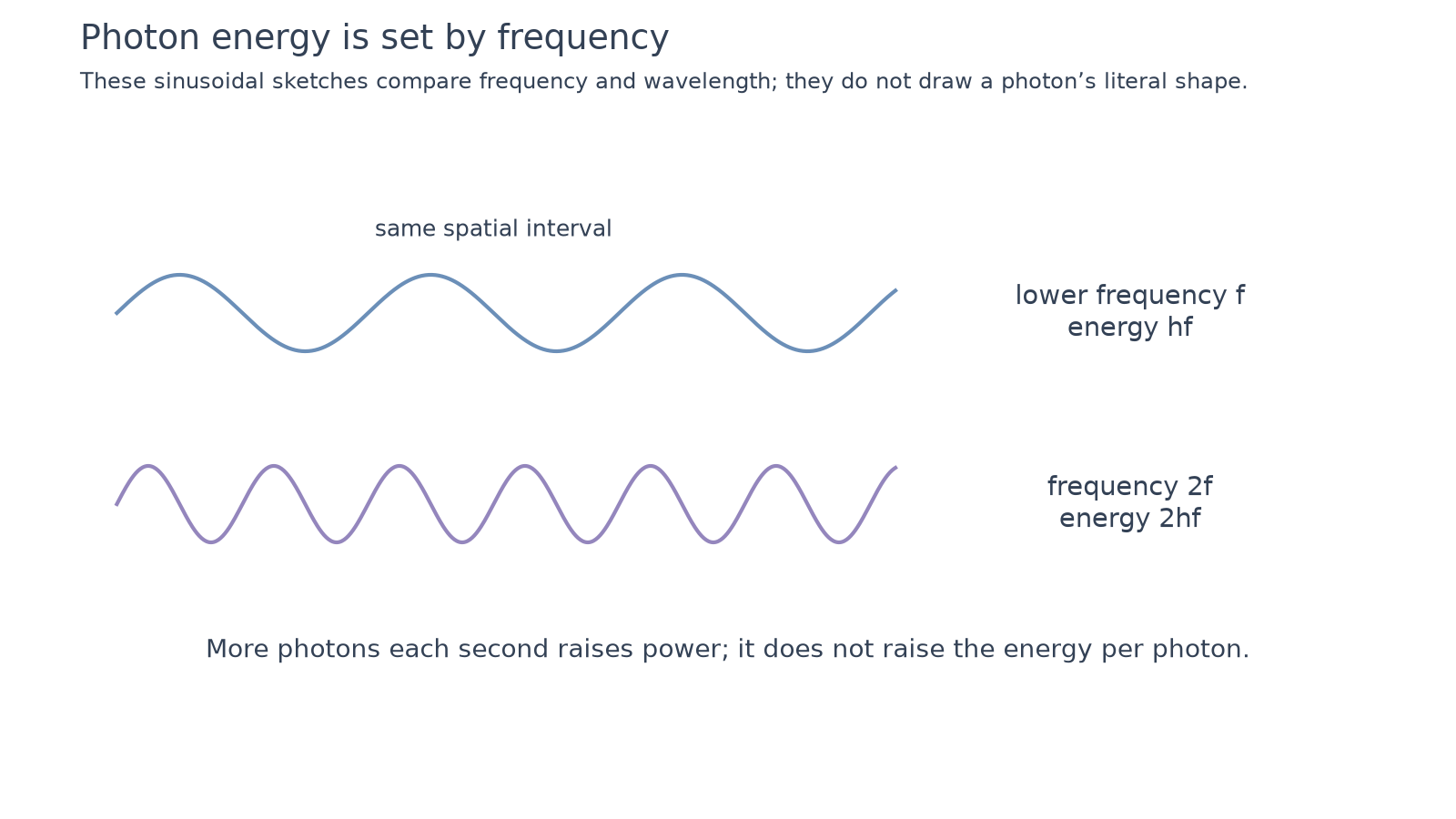
A quantum is one discrete packet. For electromagnetic radiation of a specified frequency, one photon carries the fixed energy ; changing the frequency changes the size of that packet.
The word "particulate" does not mean a photon is a tiny hard ball. It means the energy exchange is particle-like: one photon can transfer one whole packet of energy. The photon energy depends on the radiation frequency, so a photon of higher-frequency radiation carries more energy than a photon of lower-frequency radiation.
A useful way to avoid a misconception is to separate two statements:
- A beam of light can be brighter because it contains more photons per second.
- A single photon has more energy when its frequency is higher.
This lesson is about the energy of one photon. Intensity and photon number are different ideas.
For monochromatic light of power , the photon arrival rate is : total energy per second divided by energy per photon. For example, carried by photons of energy means photons each second. This does not mean that the energy of each photon increases when the source power increases.
[DIAGRAM: asset_slug: 4_05_1_photons_planck_constant_and_electronvolt__diagram_01; caption: At fixed wave speed, halving wavelength doubles the energy of each photon.; description: Two frequency-related sketches at the same wave speed show that halving wavelength doubles photon energy. Photon number rate and energy per photon are separate quantities.]
Photon Energy
Planck's constant, , links the wave frequency to the energy of one photon.
Photon energy from frequency
Here is the energy of one photon in J, is Planck's constant in , and is frequency in Hz. OCR's data booklet gives:
Because , the units work:
Use the wave equation for electromagnetic radiation in a vacuum or air, where . Since :
Photon energy from wavelength
Here is wavelength in metres. This equation says shorter wavelength means greater photon energy.
Worked example: energy of one red-light photon
A red LED emits light with wavelength . Estimate the energy of one photon.
First convert the wavelength:
Then use:
That is a very small energy in joules, which is why the next unit is useful.
Base units of
OCR sometimes asks for base units, not just a derived unit. Since :
So the unit of is:
But is not a base unit:
So the SI base units of are .
The Electronvolt
Photon energies in joules often look awkward because they are around for visible light. The electronvolt is a smaller energy unit that is convenient for photons and atomic-scale energy changes.
Electronvolt
One electronvolt is the energy transferred to an electron when it moves through a potential difference of 1 volt.
The work done on a charge is:
For one electron moving through , the charge magnitude is:
Therefore:
Use this conversion carefully:
- from eV to J: multiply by
- from J to eV: divide by
Worked example: converting a photon energy
The photon from the previous worked example had energy:
In electronvolts:
The powers of ten cancel here, leaving a visible-light photon energy of a few electronvolts. That scale is much easier to read than repeated values.
Be careful with notation. The unit means electronvolt. In the LED equation later, means elementary charge multiplied by threshold p.d. . The symbols look similar, but one is a unit label and one is a product of two quantities.
Continue this lesson.
You’re previewing NovaLearn without an account. Create a free account to read the rest.
Create free account