1F - Pressures on government: the political, economic and social impact of war
War with France placed demands on government, businesses and households from 1793, interrupted by a brief peace in 1802–1803. Learn why war strengthened some parts of Britain's economy and state while increasing insecurity, and assess the country's condition by 1812.
War, security and political authority
War began in February 1793 after revolutionary France declared war on Britain. France's expansion and the danger of invasion made defence of the state a central political task. The Peace of Amiens in 1802 ended fighting briefly, but war resumed in 1803. British strategy relied on the navy, financing allies and, increasingly, an army operating in the Iberian Peninsula. Naval victory at Trafalgar in 1805 reduced the danger of invasion and protected Britain's maritime position; it did not defeat Napoleon's land armies or end the war.
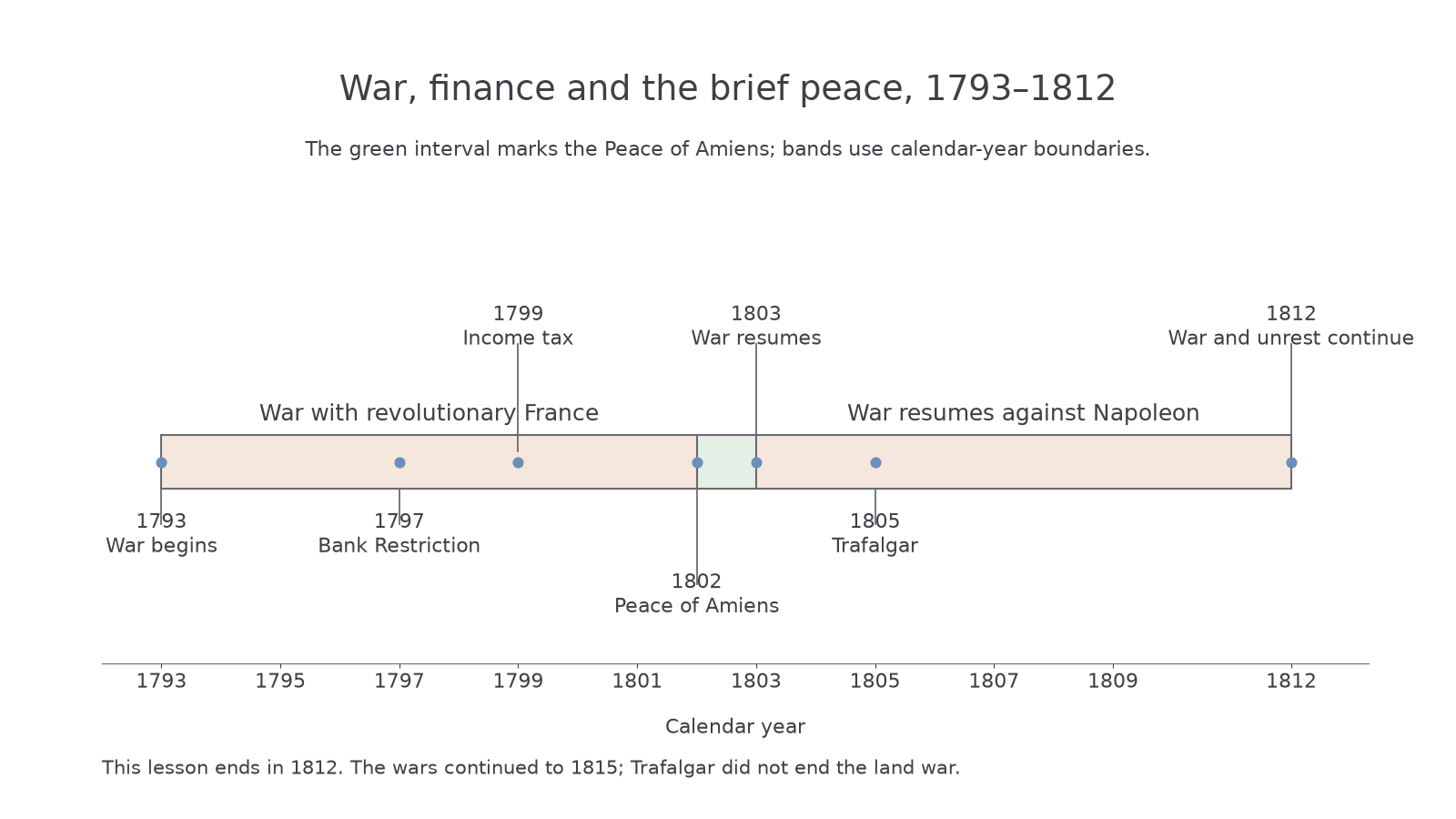
The brief Peace of Amiens separates two long periods of war. The lesson ends in 1812, while the wars themselves continued to 1815.
Security fears strengthened ministers' case for restricting radical activity. They could argue that domestic disorder weakened Britain while it faced a powerful enemy. War also encouraged volunteer forces and patriotic mobilisation. The state drew resources and loyalty from society rather than operating entirely through coercion. Yet patriotic participation did not erase opposition to the war, taxation or particular ministers.
The political consequences were therefore mixed. Pitt's coalition broadened when former Whigs joined him, but expensive and unsuccessful continental campaigns could expose leadership to criticism. Changes of premier after 1801 did not remove the underlying demands. After George III's continuing illness, the regency began in 1811. The Prince Regent retained Perceval rather than immediately restoring his old Whig associates, helping preserve ministerial continuity.
Britain faced war with the United States from June 1812 as well. Maritime restrictions and the impressment of sailors contributed to that conflict, adding pressure to naval and commercial resources. By 1812 ministers confronted a persistent international struggle alongside domestic unrest, rather than a settled postwar economy.
War finance and the Bank
War required ships, soldiers, supplies and subsidies to allies. Government met these costs through taxation and borrowing. Britain's financial institutions and confidence in public credit allowed it to borrow substantial sums, but loans created future interest payments. Financial capacity was therefore a military advantage accompanied by a growing long-term burden.
Indirect taxes raised money through consumption, while Pitt's income tax of 1799 extended the contribution from higher incomes. It was abolished during the brief peace and reintroduced by Addington in 1803 with a more systematic collection structure. The tax expanded state capacity and encountered complaints about intrusion and unfairness. Borrowing remained necessary: effective collection did not mean that annual revenue covered every wartime cost. The wartime origins of income tax
In 1797, pressure on gold reserves and fear of invasion contributed to a crisis in confidence. The Bank of England suspended the conversion of its notes into gold under government authority. Paper money continued to circulate during the Restriction Period, allowing finance and payments to continue without an immediate drain on bullion. This was not the closure of the Bank or the end of money. It changed the relationship between paper notes and a fixed quantity of gold. Bank records of the 1797 crisis
Expansion of paper credit and wartime demand contributed to inflationary pressures, but rising prices cannot be attributed to notes alone. Harvests, import disruption and particular shortages also mattered. By 1812 the state could sustain a major war, yet high debt and taxation limited future choices. The failure of Pitt's peacetime debt-reduction hopes should be judged alongside the achievement of financing survival.
Industrial demand and trade disruption
War increased demand for some British products. Ironworks supplied weapons and equipment, shipbuilding supported the navy and textile producers supplied uniforms and other goods. Farmers could benefit from demand for food and high grain prices. These gains encouraged production, investment and employment in particular sectors. They explain why war cannot simply be described as a uniform economic collapse.
Other effects were disruptive. Merchants faced lost markets, risks at sea and interruptions in supplies. Napoleon's Continental System, introduced from 1806, sought to exclude British trade from territories under French influence. Britain responded with maritime restrictions, including the Orders in Council, attempting to control neutral commerce and force trade through British channels. Smuggling, licences and alternative markets limited how completely either side could enforce its measures, but uncertainty and restrictions still damaged firms and employment.
Demand did not remain constant. A manufacturer might enlarge output during a favourable period and then face falling orders or credit problems. The sharp difficulties around 1810–1812 combined commercial disruption, financial strain and poor harvest conditions. Textile workers already under pressure from mechanisation and competition faced further reductions in earnings. Economic protest therefore had both longer-term industrial causes and immediate wartime triggers.
Agriculture also showed contrasting effects. High prices could benefit producers selling grain, while consumers buying bread paid more. A landowner's prosperity and a labourer's hardship could follow from the same price movement. War intensified distributional conflict rather than giving everyone an identical gain or loss.
Households, patriotism and unrest
Households felt war through prices, taxation, military service and insecure work. Poor harvests in the mid-1790s and other periods raised food prices, while war could make imported supplies harder to obtain. Families spending much of their income on bread had little room to absorb a price rise. Parish relief and wage allowances could prevent destitution but placed additional demands on ratepayers and did not provide equal protection everywhere.
Army and naval service employed men and mobilised national loyalty, but death, injury and absence affected families. Naval impressment compelled some men into service, creating resentment alongside pride in naval success. Volunteer movements and loyalist activity show active support for defence, while protests over food or wages show that patriotism did not imply satisfaction with living conditions.
The naval mutinies at Spithead and the Nore in 1797 reveal this distinction. Sailors pressed grievances over pay, food and treatment within a wartime institution. The mutinies differed in demands and outcome, and should not simply be treated as a united republican conspiracy. Economic grievances could be serious even among those serving the state.
Luddism, beginning in Nottinghamshire in 1811 and spreading into Yorkshire and Lancashire in 1812, connected distress to disputes over production. Machine-breaking targeted practices workers believed threatened earnings, skill or customary standards; it was not merely an irrational dislike of all technology. Trade depression and high food prices intensified those grievances. Government treated attacks as a threat to property and order, deployed troops and made the breaking of certain textile machinery a capital offence in 1812. Luddite documents and regional grievances
War thus brought mobilisation and division together. The government had to protect Britain abroad while deciding whether domestic complaints represented economic hardship, political danger or both.
Britain by 1812 and testing arguments
Britain in 1812 possessed a resilient state and important economic strengths alongside acute pressure. The navy protected maritime power, public credit sustained expenditure, and industrial capacity had continued to grow. The unreformed parliamentary system remained intact; union with Ireland and the regency had changed constitutional arrangements without establishing broad democracy. These facts suggest survival and adaptation, not an inevitable collapse.
Yet Britain had not won the war. Debt, taxation, trade disruption and high food prices constrained government and living standards. Luddism demonstrated the intensity of regional industrial conflict, while Perceval's assassination in May created another leadership crisis. His murder should not be presented as proof that the whole country was engaged in a revolutionary conspiracy. Liverpool's succession resolved the immediate governmental vacancy without resolving the wider pressures.
Consider this original educational interpretation, not a quotation from a historian: “By 1812, war had ruined Britain because it had interrupted trade and impoverished its people.” The trade interruption and hardship give the argument a real basis. To assess how convincing its overall claim is, ask what “ruined” implies and test that implication. Continuing industrial production, military supply, naval strength and the capacity to borrow qualify a claim of total breakdown. The argument is more convincing for vulnerable households or disrupted export trades than for the country's entire productive and governing capacity.
This evaluation does not require replacing the argument with the opposite assertion that war made everyone prosperous. It needs a supported judgement about its reach. Conditions, groups and dates explain why apparently conflicting evidence can both be true: state resilience and social distress coexisted.
Evaluate a historical argument by testing its main claim against relevant context. Accurate supporting examples do not automatically justify a conclusion about the whole country.