1F - Government: Pitt the Younger as Prime Minister and his successors
Pitt used royal backing, parliamentary management and practical reform to establish a long ministry after the crisis of 1783. Learn how he strengthened government, why war and religious disagreement limited his plans, and what changed under his successors by 1812.
Pitt, the King and the 1784 election
Pitt became prime minister in December 1783 at the age of twenty-four after George III dismissed the Fox–North coalition. The King wanted to weaken Fox and supported Pitt through the difficult opening months when the Commons repeatedly challenged the new ministry. Pitt refused to resign merely because of those early defeats. In March 1784 Parliament was dissolved, and the resulting election supplied him with a strong body of parliamentary supporters.
Royal influence helped, but the election cannot be explained by it alone. The Fox–North coalition appeared opportunistic because its leaders had been enemies. Pitt cultivated a reputation for integrity, financial competence and independence from faction. Support in more open constituencies and the activity of local supporters mattered alongside influence in controlled boroughs. His victory therefore showed that public reputation and the unreformed electoral system could work together. It did not establish a mandate from the whole population.
The King and Pitt also depended on one another. George III gained a minister able to manage Parliament; Pitt gained protection from royal hostility. In the Regency Crisis of 1788–1789, the King's illness threatened to bring the Prince of Wales, associated with Fox, into power as regent. Pitt supported a restricted regency established through Parliament. George's recovery ended the immediate crisis. This episode exposes the insecurity behind Pitt's success: a change in the person exercising royal authority could have transformed his position.
In 1801 the partnership broke down over Catholic relief. Pitt believed the union with Ireland needed an accompanying settlement admitting Catholics to Parliament. George III opposed it as inconsistent with his coronation oath to defend the Protestant settlement. Pitt resigned. His dependence on royal consent thus remained important even after years of effective parliamentary leadership. Pitt's career and the constitutional limits of reform
Finance, taxation and public debt
Pitt inherited the expensive aftermath of the American War. His peacetime aim was to collect revenue more effectively, restore confidence and reduce debt. He did not assume that a higher tax rate always produced more revenue. The Commutation Act of 1784 sharply reduced the duty on tea, making legal imports more competitive with smuggled supplies. A larger volume of legitimate trade could then be taxed. Other assessed taxes, including those on houses, servants, horses and carriages, widened the sources of revenue. Measures against fraud and improvements in collection supported this approach.
The Sinking Fund of 1786 set aside an annual sum to purchase government debt. Interest saved on debt already redeemed was added to the fund, so Pitt expected the process to accelerate through accumulation. Its logic depended on a genuine surplus: if the government borrowed new money to maintain the fund, paying off one debt did not necessarily reduce its total liabilities. War after 1793 therefore undermined the peacetime strategy, even while financial administration became more effective. Parliament's account of the 1786 fund
Pitt introduced income tax in 1799 because indirect taxation and borrowing could not meet wartime demands comfortably. It applied on a graduated basis to incomes above £60 a year, up to ten per cent on larger incomes. It was a major extension of the state's claim on personal resources, but most low-paid workers were below its threshold. Its unpopularity and evasion also show the practical limits of taxation. Workers nevertheless paid indirect taxes when buying taxed goods: exclusion from income tax did not mean freedom from the fiscal burden of war. War and income tax
Indirect tax
A tax charged on goods or transactions. Consumers bear it through purchases, unlike a tax charged directly on their income.
Administration and commercial reform
Administrative reform sought a government able to account for money and implement policy consistently. Pitt encouraged closer scrutiny of public expenditure, more effective auditing and reductions in wasteful fees and offices. The Consolidated Fund of 1787 brought major revenue streams together, helping Parliament and ministers relate expenditure to the resources available. Efficiency could reduce waste and strengthen confidence among those lending to the state. It could also strengthen executive government without widening the electorate: better administration and greater democracy were different reforms.
Pitt's India Act of 1784 created a government Board of Control to supervise the East India Company's political affairs while the Company retained its commercial organisation. It addressed the difficulty of leaving an expanding territorial empire wholly to a trading corporation. The settlement increased government oversight but did not end Company power or colonial exploitation. Pitt's India Act
Pitt favoured the idea that reducing unnecessary trade barriers could increase prosperity. The Eden Treaty with France in 1786 reduced duties on a range of goods traded between the two countries. British manufacturers hoped to gain access to French consumers, while imports might become cheaper. Such policies encountered resistance from interests afraid of competition; a proposed commercial settlement with Ireland in 1785 failed amid opposition. War with France later destroyed the immediate political setting for Anglo-French commercial cooperation.
These examples support a qualified view of Pitt as a reformer. He reorganised how the existing state raised money, supervised empire and encouraged commerce. His limited parliamentary reform proposal failed in 1785, and he did not repeatedly force the issue. Reform to make established government work more effectively was easier to reconcile with royal and landed support than reform that redistributed political power.
Successors and ministerial continuity
Changes of prime minister after 1801 did not remove the pressures of war or the King's influence. Henry Addington, prime minister from 1801 to 1804, made the Peace of Amiens in 1802. The settlement offered a breathing space, but unresolved Anglo-French tensions led to renewed war in 1803. Addington reintroduced income tax using improved schedules of taxable income. Pitt returned in 1804 and remained until his death in January 1806.
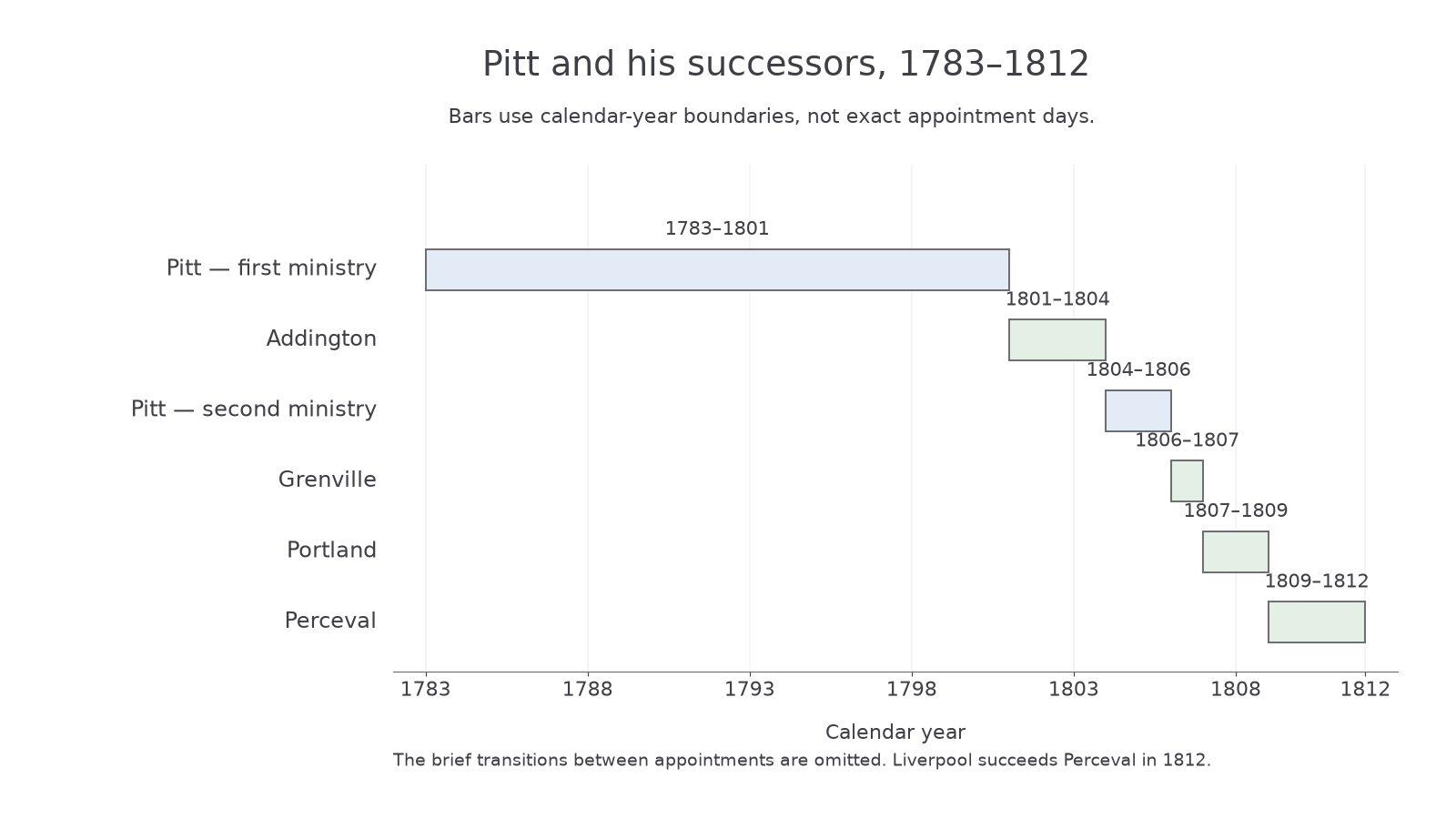
The dated sequence shows Pitt's long first ministry and the more frequent changes after 1801. A change of premier did not necessarily mean a complete change of political personnel or priorities.
| Ministry | Main significance within this period |
|---|---|
| Grenville, 1806–1807 | The broad Ministry of All the Talents included Fox until his death; Parliament abolished the British slave trade in 1807. It fell after disagreement with the King over concessions to Catholics in military service. |
| Portland, 1807–1809 | A largely Pittite administration continued the war. Internal divisions included rivalry between Canning and Castlereagh; Portland's failing health weakened leadership. |
| Perceval, 1809–1812 | Sustained the war and opposed Catholic emancipation. George III's continuing illness led to the regency in 1811. Perceval was assassinated in May 1812. |
The 1807 law abolished the British slave trade, not slavery throughout the empire; confusing the two would exaggerate its immediate social effect. The ministry's fall also illustrates continuity with Pitt's resignation: religious policy could bring a government into conflict with the Crown. By contrast, political groupings had changed. Former Whigs could serve with Pittites, and individuals moved between ministries. Cabinet leadership mattered, but no succession instantly replaced every governing interest. Official succession record