1F - Greater democracy: the election of the Whigs
Learn how the Whigs gained power, why parliamentary reform passed in 1832 and how far it changed Britain. Connect the constitutional settlement with the country's changing economy and unequal society.
Why reform became possible
The campaign for reform addressed a mismatch between social and economic change and political representation. Some small boroughs retained MPs while industrial towns lacked direct representation. The franchise varied between constituencies and was restricted by property and local rules. Reformers could object to corruption, unequal seats or exclusion without agreeing that every adult should vote.
By 1830, middle-class manufacturers and professionals had stronger claims to political influence, while many working people associated exclusion with policies that favoured property owners. Thomas Attwood's Birmingham Political Union, established in 1830, brought middle- and working-class support together for parliamentary reform. Their common immediate objective did not remove differences over the desired final franchise.
The revolution in France in July 1830 and rural disorder in Britain heightened elite fears. These events did not make reform inevitable, but they made the costs of refusing change more visible. Wellington's declaration against parliamentary reform alienated potential supporters. His government fell in November 1830 after a parliamentary defeat, and William IV appointed Earl Grey to lead a Whig administration.
Distinguish that sequence from a modern direct election of a prime minister. The general election of 1830 weakened Wellington's position, but Grey took office after the government's loss of support and resignation. The election of 1831 then gave Grey a strong mandate for the reform bill. Political change depended on elections, parliamentary arithmetic and royal appointment together. UK Parliament: Grey and the reform struggle.
The crisis of 1831–1832
Grey's ministry introduced reform in March 1831. After difficulty in the Commons, the government secured a dissolution and won the 1831 election on the issue. A second bill passed the Commons but was rejected in the Lords in October. Riots, including those at Bristol, and intensified political organisation showed that parliamentary rejection could provoke disorder outside Parliament.
The central obstacle was the Lords' ability to block or weaken legislation. In May 1832, Grey wanted assurance that the King would create enough new peers to overcome resistance. When William IV would not initially provide it, Grey resigned. Wellington attempted to form a government but could not assemble workable support. This produced the Days of May, when constitutional uncertainty and popular pressure interacted.
Political unions organised large meetings and protests. The Birmingham movement helped demonstrate the depth of support, while calls to withdraw money from banks threatened financial confidence. The danger was not simply that Parliament would lose an argument: refusal risked instability affecting government, property and credit. UK Parliament: Birmingham's part in the crisis.
Grey returned after the King accepted the possibility of creating peers if necessary. Enough opponents in the Lords abstained to allow passage without the large-scale creation of new peers. The English and Welsh Reform Act received royal assent on 7 June 1832; Scotland and Ireland had separate reform legislation.
A causal explanation should distinguish conditions from the final mechanism. Long-term economic change and earlier reform ideas made the demand substantial. Mass pressure raised the cost of obstruction. Grey's persistence, the King's decision and the prospect of new peers provided the constitutional route to passage. Saying only that riots caused reform neglects the decisions required to turn pressure into law.
[DIAGRAM: asset_slug: 1F.R12 - 1; description: Six events in the reform crisis, 1830–1832, in chronological order rather than on a proportional time axis]
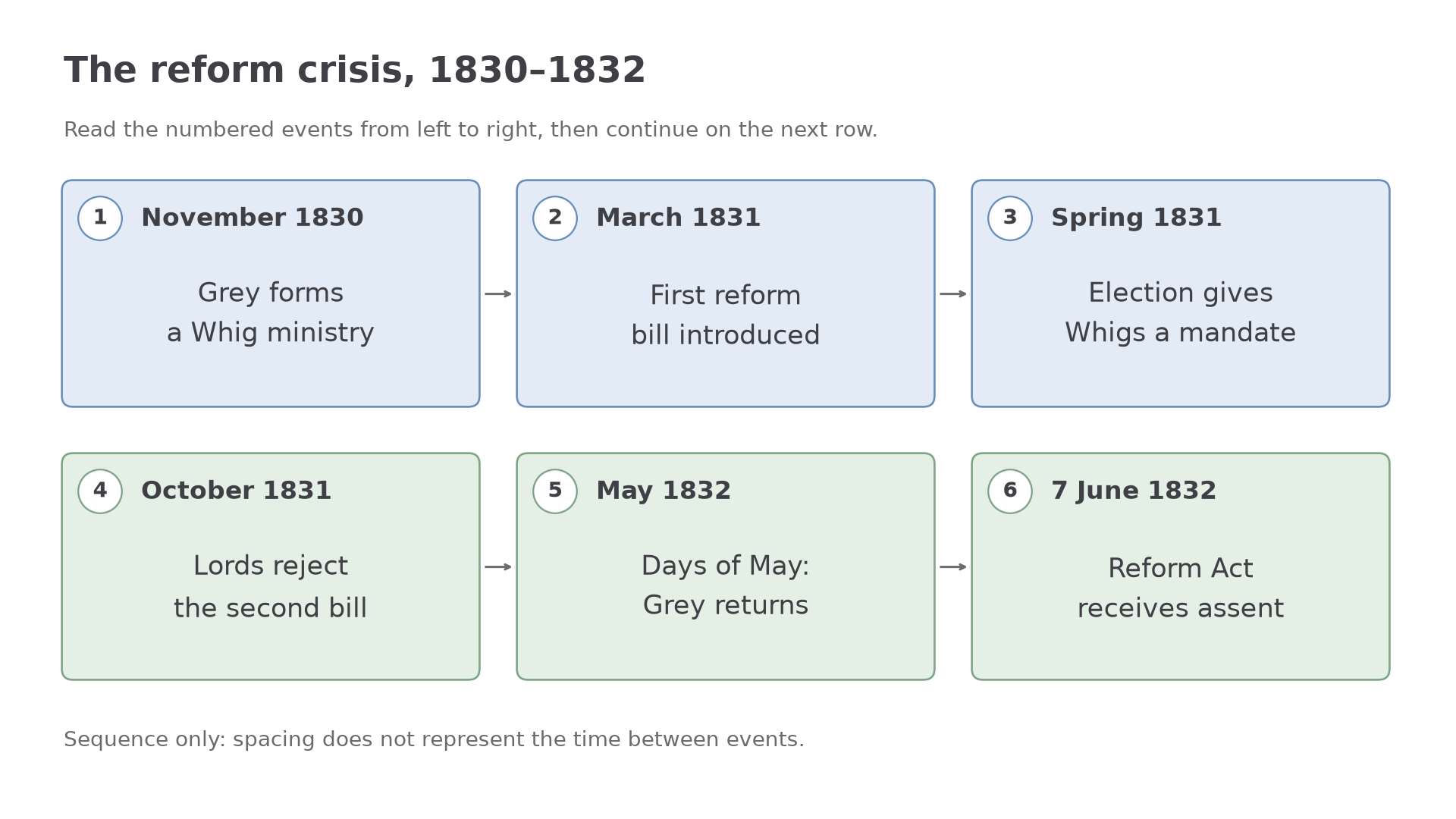
The sequence separates an electoral mandate, continued obstruction and the eventual constitutional route to passage. It does not imply that the same pressure operated at every stage.
The settlement and its boundaries
The reform settlement changed constituencies and voting qualifications while preserving representation through property. In England and Wales, 56 small boroughs lost representation altogether and seats were redistributed to counties and growing towns. Manchester, Birmingham and Leeds gained MPs. This made representation more responsive to population and wealth without creating equally sized constituencies.
The borough franchise generally gave the vote to qualifying male occupiers of premises worth at least £10 a year, subject to residence and registration rules. Some established voting rights survived. County voting qualifications were broadened, while the old forty-shilling freehold qualification continued. These details matter: reform enlarged and regularised the electorate but did not replace every older right with one national qualification. The Representation of the People Act 1832.
Franchise
The legal right to vote, defined by the qualifications that a person must meet. A wider franchise does not necessarily mean universal suffrage or equal representation.
More middle-class men could participate. Most wage-earning men still lacked the required property qualification, and women were formally excluded from the parliamentary franchise. Voting remained public, enabling pressure from landlords and employers; MPs still required resources to sustain a political career. Neither a secret ballot nor payment for MPs was introduced.
The Act also strengthened the importance of registration and local organisation. Parties had to identify eligible supporters and ensure they appeared on electoral registers. Competition became more systematic, but landed influence, patronage and the social predominance of elite MPs persisted. Reform changed how established power operated as well as who could enter the system.
Judging the extent of political change
The importance of 1832 depends on the criterion used. If democracy means that every adult has an equal vote and can participate freely, the settlement was far from democratic. If political change means weakening the most obvious representational anomalies, incorporating new social interests and showing that Parliament could be reformed, its significance was substantial.
Consider two original practice interpretations, written for this lesson rather than attributed to historians:
- Interpretation A: The Reform Act was a conservative settlement designed to preserve established institutions by admitting respectable property owners.
- Interpretation B: The Reform Act decisively altered politics because it demonstrated the power of organised public pressure and established a precedent for further reform.
A is convincing when tested against the property franchise, elite leadership and continued exclusion of most workers. However, describing the Act as a defence of institutions does not prove it left those institutions untouched. New industrial constituencies and electoral registration altered political competition. B is supported by the reform crisis and the subsequent expectation that further change was possible. Its word “decisively” needs qualification: popular pressure helped pass a bill whose franchise fell short of many activists' aims.
The arguments focus on different questions: the purpose and limits of the settlement, and its effects on political possibilities. They can both contain truth. Evaluating an interpretation means testing its particular reasoning and extent against context, not rejecting it because it does not tell the entire story.
Britain at the 1832 turning point
Britain in 1832 was more industrial and commercially connected than in 1783, but remained unevenly transformed. Steam power, cotton, coal and iron had expanded productive capacity. The Liverpool and Manchester Railway signalled an emerging transport change. Agriculture still fed the population and supported powerful landowners; national railway integration lay ahead.
Government had survived war, economic crises and radical challenges without losing the monarchy or Parliament. Economic liberalisation had reduced some restrictions, while grain protection remained. Catholic emancipation in 1829 and parliamentary reform in 1832 showed that ministers could concede major changes when resistance became dangerous or impractical. These reforms widened inclusion in specific ways, not through a shared commitment to universal democracy.
Society combined growing wealth with insecurity. Industrial employers, merchants and professionals had greater resources and influence. Many workers endured long hours, unemployment, unhealthy housing or declining occupational status. Agricultural labourers also faced insecurity, as the Swing protests had shown. Working-class support for reform did not yield equivalent political power after the Act.
The turning point therefore involved both adaptation and unfinished pressures. Institutions had accommodated some new interests; the problems of labour conditions, poor relief, local government and political exclusion persisted. Those issues help explain the reforms and movements of the following period. The Reform Act did not create every later reform, but changed the parliamentary setting in which they were debated.