1F - Government and democracy: Gladstone, his ministries and ideas and policies
Gladstone and Disraeli offered different accounts of good government, but both adapted institutions to a changing society. This lesson explains their ministries and legislation in 1846–1885, the expansion of voting rights and the limits of that democratic change.
Gladstone and Disraeli: ideas of government
Gladstone's liberalism combined moral seriousness, financial economy, free trade and opposition to unjust privilege. As Chancellor of the Exchequer in the 1850s and 1860s, he supported tariff reductions, careful expenditure and a tax system intended to encourage commerce. Liberty often meant allowing individuals and associations to act with limited state interference, but it could also require legislation to remove barriers or abuses. His religious convictions did not prevent him from challenging an established Church when he considered its position unfair.
Disraeli defended monarchy, Church, property and national cohesion. He argued that established institutions could offer leadership and social responsibility, rather than merely protect wealthy interests. Social reform could reconcile classes and make institutions more secure. His political appeals also placed greater emphasis on empire and national prestige. These positions did not make him an opponent of every constitutional or social change.
It is useful to compare principles with decisions. Gladstone's economy and individual liberty did not prevent the creation of school boards or intervention in Irish land relations. Disraeli's defence of inherited institutions did not prevent franchise expansion or legislation improving labour relations. Cabinet colleagues, parliamentary votes, campaigners and administrative experience helped shape policy. Two famous individuals mattered, but did not act in isolation.
Liberal reform and Conservative adaptation
Liberal reform commonly sought to remove abuses and unequal privileges in the name of liberty and fairness. Conservative adaptation accepted selected changes to preserve institutions and social order. Their policies could overlap without their purposes being identical.
Gladstone's first ministry, 1868–1874
Gladstone's first ministry used its electoral mandate to attack several inherited privileges. The Irish Church Act of 1869 disestablished the Anglican Church of Ireland from 1871. A Church serving a minority no longer enjoyed the same position as a state-supported establishment. This addressed a major Catholic and Nonconformist grievance, but could not by itself resolve land insecurity or Irish demands for national autonomy.
The Irish Land Act of 1870 recognised aspects of tenant custom and offered compensation in specified circumstances, including disturbance and improvements. Its protections were limited: tenants could still face high rents, and the law did not establish general tenant ownership. Later unrest demonstrates why an important first intervention should not be equated with a settled land question.
The Education Act of 1870, introduced by Forster, allowed elected school boards to provide elementary schools where provision was insufficient in England and Wales. Existing voluntary, often denominational, schools remained. It did not immediately create a universally free, compulsory system. This compromise advanced provision while provoking Nonconformist dissatisfaction about religious schools and funding. Scotland received separate legislation in 1872. Parliament's account of the 1870 Act distinguishes provision from later compulsory attendance.
Cardwell's army reforms abolished the purchase of officers' commissions in 1871 and reorganised recruitment and service. Removing purchase challenged wealth-based privilege and could improve professional organisation, although it did not end social influence throughout the officer corps. The Universities Tests Act of 1871 removed religious tests for most positions and degrees at Oxford, Cambridge and Durham, widening access beyond Anglicans.
The Trade Union Act of 1871 strengthened unions' legal standing and protected their funds. Yet the accompanying Criminal Law Amendment Act restricted forms of picketing and pressure, disappointing unionists. The Ballot Act of 1872 introduced secret voting. A licensing law in the same year regulated drink-selling and provoked publican opposition. Reform therefore created beneficiaries and opponents; disagreements, economic concerns and the ministry's contested record contributed to Liberal defeat in 1874.
Disraeli's ministries and social legislation
Disraeli first became Prime Minister in February 1868 after Derby retired. That brief ministry ended following the general election. His second ministry, 1874–1880, rested on a Conservative majority, giving it greater capacity to legislate. Much detailed social policy was led by Home Secretary R. A. Cross and other ministers; attributing every reform directly to Disraeli exaggerates personal control.
The Public Health Act of 1875 consolidated sanitary law and strengthened local duties concerning water, drainage, refuse and public health. The Artisans' Dwellings Act of 1875 enabled local authorities to clear unhealthy housing areas. Its powers were permissive, and clearance did not automatically produce affordable replacement homes. Expense, rates and local willingness limited results. The Sale of Food and Drugs Act of 1875 improved legal action against adulteration. These measures enlarged government's responsibility while relying heavily on local implementation.
Labour legislation made an especially important distinction. The Employers and Workmen Act of 1875 treated breaches of employment contracts principally as civil matters, reducing the unequal criminal treatment of workers. The Conspiracy and Protection of Property Act of the same year limited the use of criminal conspiracy against trade disputes and permitted peaceful picketing within legal limits. It did not authorise violence or create an unrestricted right to strike in all circumstances.
Disraeli's government also developed an assertive imperial image: the purchase of Suez Canal shares in 1875 and the settlement at Berlin in 1878 served that presentation. Foreign policy costs, unpopular conflicts and the worsening agricultural and economic environment helped weaken the ministry. Gladstone's attacks on its morality and expenditure mattered in the campaign which returned the Liberals in 1880. The statutory Public Health Act supplies the legal basis for the sanitary measures.
Franchise and election law
Democratisation involved both widening the vote and changing how votes influenced representation. The Second Reform Act of 1867 was passed under Derby, with Disraeli leading it in the Commons. In England and Wales it enfranchised many male householders and qualifying lodgers in boroughs and lowered county qualifications. It substantially enlarged working-class participation, especially in towns, while separate Acts followed for Scotland and Ireland in 1868. It did not enfranchise all adult men or any women for parliamentary elections.
The 1872 secret ballot made a vote harder for a landlord or employer to monitor. The Corrupt and Illegal Practices Act of 1883 tightened limits on spending and election conduct. A wider franchise could still be distorted by unequal constituency sizes, so electoral law and distribution of seats mattered alongside eligibility to vote.
Gladstone's 1884 Representation of the People Act extended household and lodger qualifications from boroughs into counties, giving many rural working men the vote. The Conservatives in the Lords resisted proceeding without a redistribution agreement. The 1885 Redistribution of Seats Act then reduced the representation of small boroughs, increased representation in growing areas and made single-member constituencies the norm. The two Acts solved related but different problems: 1884 concerned the franchise, while 1885 concerned the geography of seats. Parliament's reform chronology keeps these changes distinct.
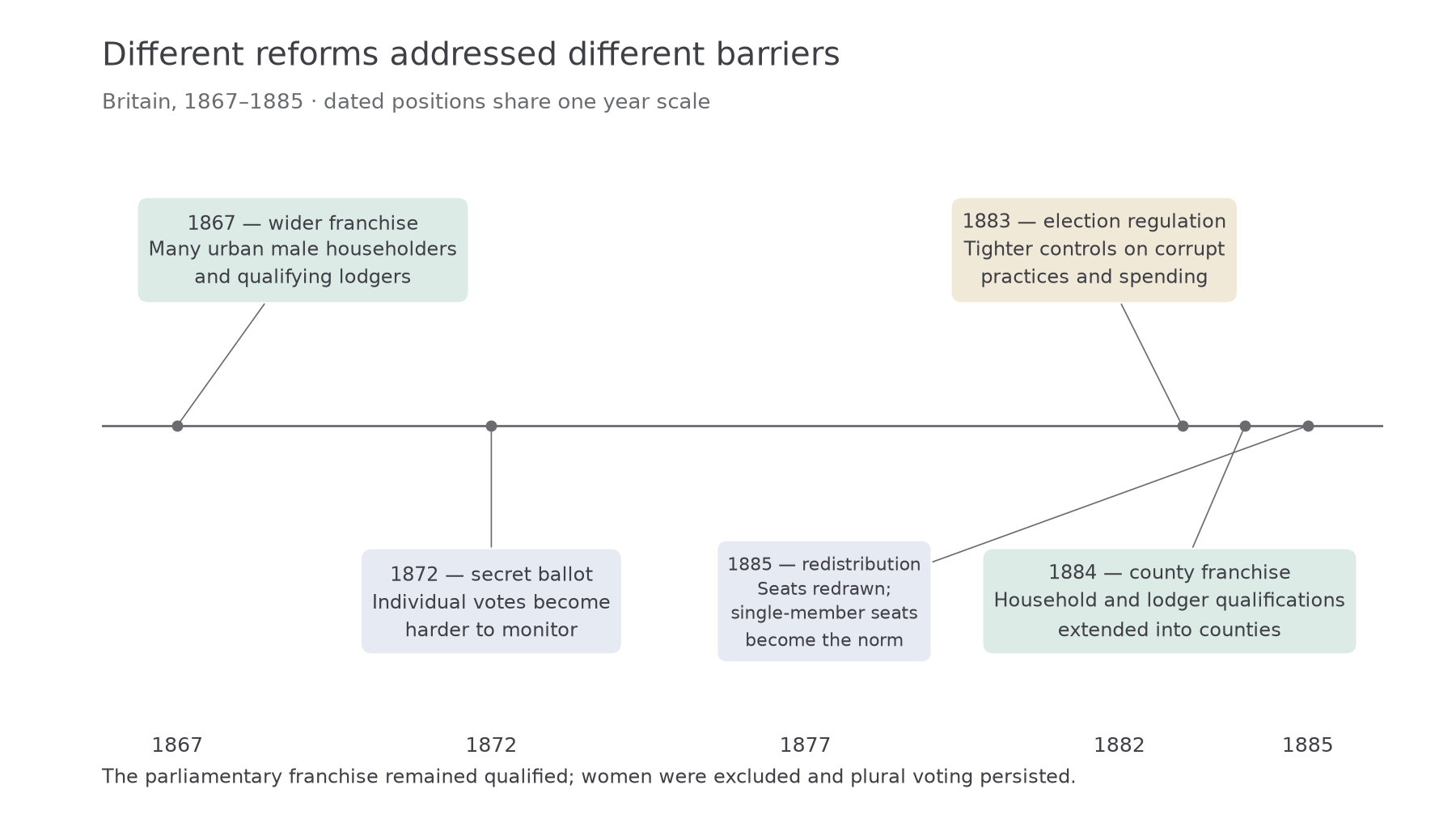
Voting qualifications, ballot secrecy, campaign regulation and seat distribution changed at different dates; the timeline does not imply universal suffrage.
By 1885 most adult men could vote, but residence and other qualifications still excluded a substantial minority. Women remained excluded from parliamentary voting, even though some women ratepayers had gained local voting rights. Plural voting persisted for men qualified in more than one place. The hereditary Lords, monarchy, unpaid MPs and the costs of election also limited equality of political power. Democracy had widened substantially without reaching one adult, one parliamentary vote.
1867 and 1884 widened voting qualifications; 1872 protected secrecy; 1883 regulated election practices; 1885 redistributed seats. Each addressed a different obstacle to representative government.
Gladstone's second ministry, 1880–1885
Gladstone returned to office in 1880 with promises of economical and morally responsible government, but faced crises which made those aims difficult to reconcile. In Ireland, land agitation and nationalism created pressure for reform and pressure to restore order. The 1881 Land Act recognised the “three Fs”: fair rent, fixity of tenure and free sale of a tenant's interest. Land courts could determine rents, reducing some landlord power. The protections had exclusions and did not provide universal tenant ownership.
The government also used coercion, including imprisonment of Parnell in 1881. His release in 1882 followed an understanding associated with the Kilmainham negotiations, but the Phoenix Park murders then intensified demands for repression. Reform and coercion were simultaneous responses to a problem which combined economic grievances, political organisation and violence. The first Home Rule bill came in 1886, after this lesson's endpoint; no Home Rule settlement had been enacted by 1885.
The 1884–1885 electoral settlement was the ministry's major constitutional achievement. Other policies illustrate a government balancing liberty with regulation: compulsory elementary attendance in England and Wales was enacted in 1880, while the Married Women's Property Act of 1882 strengthened married women's control over property. Neither measure created complete educational equality or equal parliamentary rights.
Overseas crises also damaged Gladstone's position. Britain occupied Egypt in 1882, and Gordon's death at Khartoum in 1885 provoked criticism. These outcomes qualify any claim that moral language or opposition to Disraeli's imperial policy prevented intervention. A Commons defeat over the budget brought the ministry down in June 1885, followed by Salisbury's Conservative minority ministry.
Assessing reform and democracy
The comparison between Gladstone and Disraeli should use criteria rather than a list of Acts. For religious and institutional privilege, Gladstone's first ministry made major changes in Ireland, universities and the army. For sanitary consolidation and the legal treatment of workers, the Conservative ministry of 1874–1880 made important advances. Both enacted measures which depended on administrative capacity and neither removed poverty or elite influence.
The original practice interpretation “Gladstone transformed Britain into a democracy by 1885” contains a defensible emphasis but an exaggerated result. His ministries helped secure secret voting and the 1884–1885 settlement. Yet the 1867 franchise extension occurred under a Conservative government, pressure from outside Parliament affected both parties, women remained excluded and many adult men still lacked votes. A sound evaluation credits Gladstone's contribution without treating him as either the sole cause or the creator of complete democracy.
It would also be wrong to argue that continuing exclusions made reform meaningless. Larger electorates, stronger party organisation and more secure voting changed how governments sought and retained support. The historically defensible distinction is between substantial democratisation and completed democratic equality. The interpretation used here is NovaLearn-authored practice wording.