R9 - Reverse percentages and simple interest
A sale price tells you the amount left after a reduction. You will work backwards to the original amount, calculate simple interest, and use percentage methods with profit, tax and bank balances. The words around the numbers tell you which amount to use.
Finding an original value after a decrease
A bicycle costs after a discount. Is its original price , found by adding to ? If that seems reasonable, try reducing by . We will find a price that really works.
You already know
A decrease of leaves of the original value. For example, a decrease uses multiplier . Multiplication is undone by division.
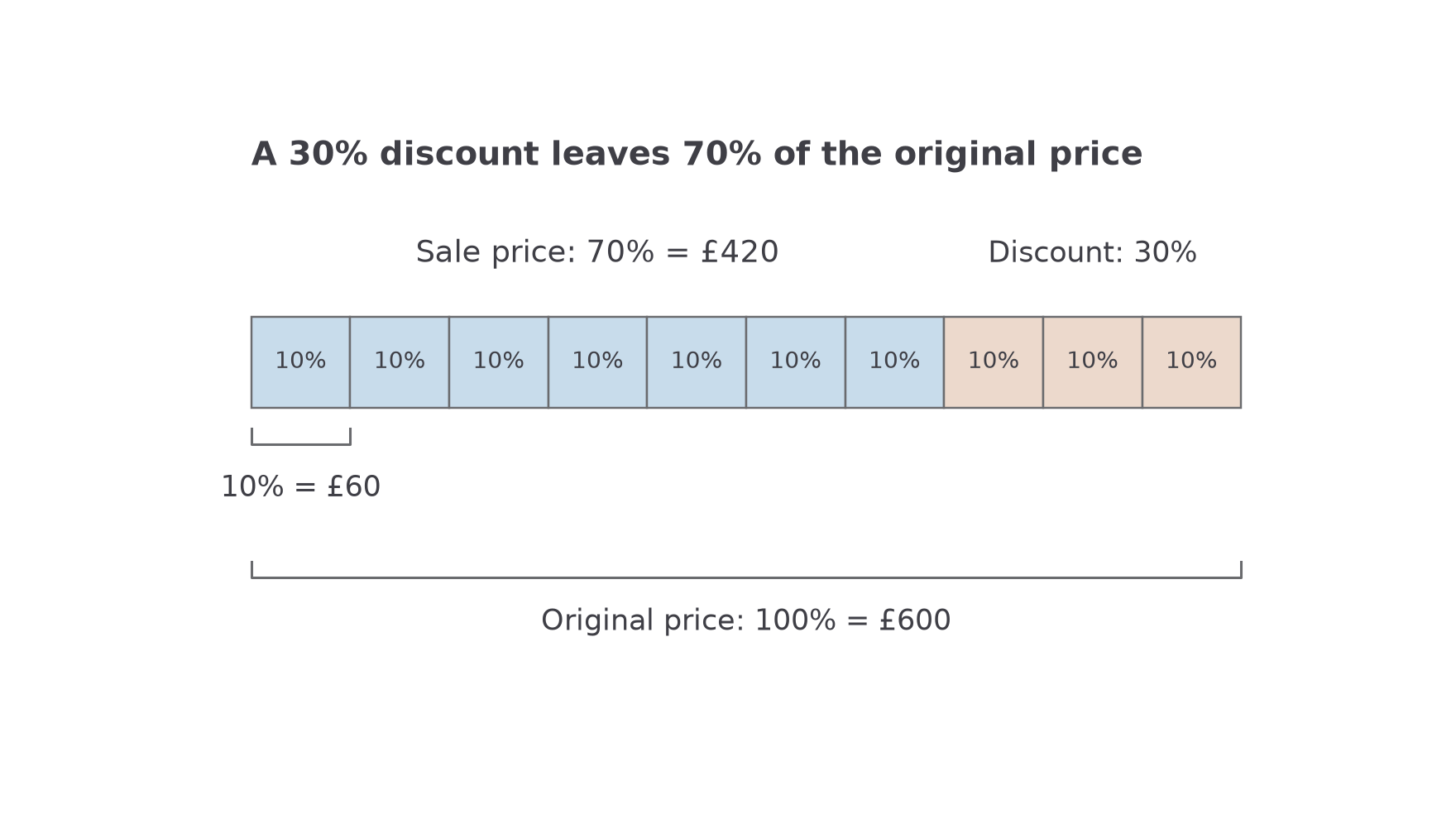
The sale price is of the unknown original price. It is not a new for working backwards. If is , divide by to find , then multiply by to recover the whole.
[DIAGRAM: asset_name: Rebuilding the original from the sale price; asset_slug: aqa8300_r05_reverse_bar; caption: Seven equal parts cost 420 pounds, so all ten parts cost 600 pounds; description: A horizontal bar is split into ten equal sections, each worth 10 per cent of the original price. The first seven are blue and labelled sale price, 70 per cent, 420 pounds. The final three are pale clay and labelled discount, 30 per cent. A bracket under one section says 10 per cent is 60 pounds. A bracket below all ten sections says original price, 100 per cent, 600 pounds.]
Dividing by the decimal multiplier does the same job in one step. Here , since .
Reversing a percentage decrease
After a single decrease of , where ,
A decrease leaves zero whatever the original value, so the original cannot be recovered from that information alone.
Not on the formulae sheet: learn it.
A fraction can make the non-calculator division easier. After a reduction, the sale price is four fifths of the original.
Worked example 1: reversing a twenty per cent reduction
Question. A bag costs after a reduction. Work out its original price. Do not use a calculator.
Plan. The sale price represents ; find one fifth, then all five fifths.
Why this step? The covers four equal fifths, so divide it by , not , to find one fifth.
Answer.
Check. of is , and .
The next example changes only the discount rate. The sale price is still , but now it represents three quarters of the original.
Worked example 2: the same sale price with a different discount
Question. A bag costs after a reduction. Work out its original price. Do not use a calculator.
Plan. Find one quarter from the three quarters left, then multiply by .
Why this step? A larger discount can lead to the same sale price only if the original price was larger. Here is three quarters, rather than four fifths, of it.
Answer.
Check. of is , and .
The opening bicycle follows the same rule: . Its original price is . Reducing that by removes , leaving .
Watch out
Wrong: undo a reduction by adding to the sale price: . The added percentage uses the smaller sale price as its base. Right: divide by to recover .
Now change the sale price as well as choosing the percentage that remains. A calculator is useful for this less tidy multiplier.
Finding an original value after an increase
A price after an increase is more than the original whole, so reverse it by dividing by a multiplier greater than .
Suppose a repair costs including VAT at a stated rate of . VAT, value added tax, is a tax added to the price before VAT. The total is of that price, so the price before VAT is . The VAT is . Use the rate given in the question; different situations can use different rates.
Reversing a percentage increase
After a single increase of , where ,
The percentage increase is based on the original value, not the new value.
Not on the formulae sheet: learn it.
Profit questions use the same idea when the profit percentage is based on the price paid for the item.
Cost price, selling price, profit and loss
The cost price is the amount a trader pays for an item. The selling price is the amount received when selling it. A profit is the selling price minus the cost price when the selling price is greater. A loss is the cost price minus the selling price when the selling price is smaller. Equal prices give neither profit nor loss.
For example, buying for and selling for gives a profit of . Relative to the cost price this is . Selling for instead gives a loss, also of the cost price. Check the question's stated base whenever it names a percentage.
Worked example 3: recovering a cost price
Question. A trader sells a desk for , making a profit of of its cost price. Work out the cost price. A calculator may be used.
Plan. Treat the selling price as of the cost price and divide by .
Why this step? The cost price is the amount, because the profit is of that price.
Answer. The cost price was .
Check. of is , and .
The next example changes only the profit rate. The selling price stays the same, so a higher percentage profit means a smaller cost price.
Worked example 4: a different profit rate
Question. A trader sells a desk for , making a profit of of its cost price. Work out the cost price. A calculator may be used.
Plan. Divide the selling price by the multiplier for a increase.
Why this step? The selling price is now times the unknown cost price. Subtracting of would use the wrong base.
Answer. The cost price was .
Check. of is , and .
Reversing an increase makes a positive new value smaller. Reversing a decrease makes it larger. This is a quick way to spot the wrong multiplier.
Watch out
Wrong: the VAT within , at of the price before VAT, is . Right: first find , then subtract: .
A VAT problem changes the context, but the original-value decision is the same as in the profit examples.
Simple interest on the original amount
Simple interest adds the same cash amount each year when the starting amount and rate stay fixed.
The principal is the original money saved or borrowed. Interest is money earned on savings or charged for borrowing. An interest rate gives the interest as a percentage for a stated period. “Per annum” means per year. At simple interest per annum, earns each year: after one year, after two.
Simple interest
Interest calculated using the original principal for every period. For a fixed rate and no deposits or withdrawals, the interest amount is the same each period. It is not recalculated from a growing balance.
Continue this lesson.
You’re previewing NovaLearn without an account. Create a free account to read the rest.
Create free account