R9 - Percentages and percentage change
Percentages put amounts on a common scale of one hundred. You will compare quantities, work with percentages above one hundred, increase or decrease an amount, and describe a change as a percentage of its starting value. The key is to decide which amount represents the whole.
What one hundred per cent means
A club's membership grows from to . The new membership is of the old membership. Has it increased by ? Keep the two claims separate: by the end you will be able to explain exactly what happened.
You already know
A percentage can act as a multiplier: of an amount means times it. Fractions and decimals can name the same number, such as .
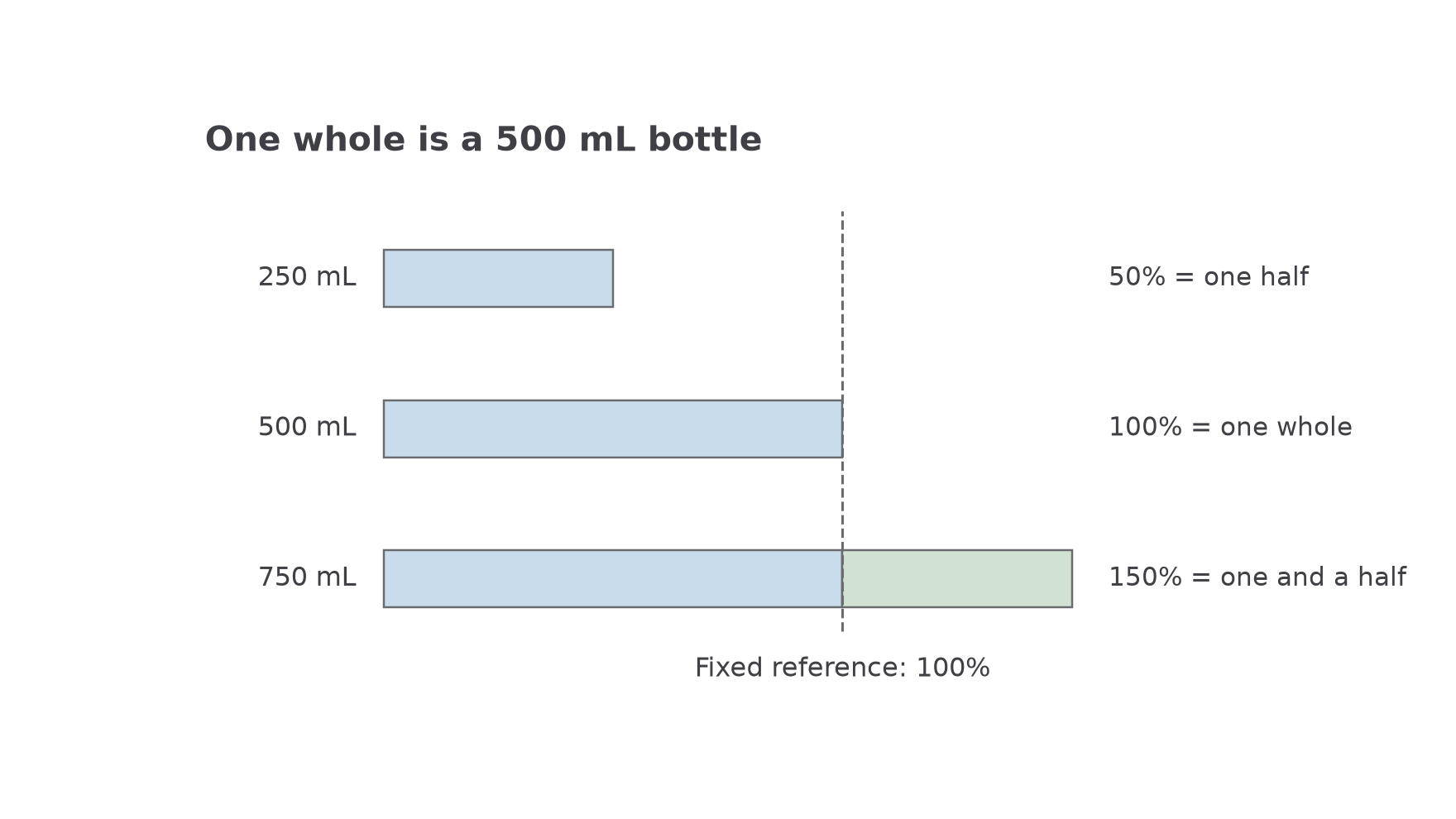
Imagine one full bottle holds . Half a bottle is of that capacity. One and a half bottles hold . Nothing has gone wrong with the percentage: you have more than one whole bottle's worth.
Percentage
A percentage is a number of parts per hundred. The reference amount is . For example, . It does not mean objects unless the reference amount is objects.
The same reference amount must stay fixed while you interpret the percentage. A bottle cannot be more than completely full, but a jug can hold more than of that bottle's capacity.
[DIAGRAM: asset_name: Percentages on a bottle-capacity scale; asset_slug: aqa8300_r04_percentage_scale; caption: With 500 millilitres as the whole, 750 millilitres is 150 per cent; description: Three horizontal bars share a scale of 0 to 750 millilitres. The first blue bar reaches 250 millilitres and is labelled 50 per cent and one half. The second blue bar reaches 500 millilitres and is labelled 100 per cent and one whole. The third bar has a blue section to 500 millilitres and a sage extension to 750 millilitres, labelled 150 per cent and one and a half. A dashed vertical line at 500 millilitres marks the fixed reference amount.]
Multiplying by keeps an amount unchanged. A multiplier above makes a positive amount larger; a multiplier between and makes it smaller.
Percentage, fraction and multiplier
For a percentage ,
The decimal value of is its multiplier. For example, , while .
Not on the formulae sheet: learn it.
Zero per cent gives none of a positive reference amount. One hundred per cent gives exactly that amount. More than one hundred per cent means more than the amount, rather than an impossible percentage.
Key idea
A percentage needs a reference amount: ask “one hundred per cent of what?” before interpreting it.
The next check separates a percentage of an amount from a number simply added to it.
Expressing and comparing amounts as percentages
To express one amount as a percentage of another, divide by the reference amount first.
Suppose of seedlings survive. The fraction surviving is , so out of every would survive at that same rate. The percentage is . Both amounts must use the same units: convert metres to centimetres, for example, before dividing them.
One amount as a percentage of another
For a positive reference amount,
The result is expressed as a percentage. It can exceed .
Not on the formulae sheet: learn it.
Percentages make comparisons fair when the groups have different sizes. A larger number of successful seedlings need not mean a larger success rate.
Worked example 1: comparing survival rates
Question. Grower A has surviving seedlings out of . Grower B has out of . Work out each survival percentage and state which is greater. Do not use a calculator.
Plan. Express each surviving group as a fraction of its own starting group, then convert to percentages.
Why this step? Each denominator is that grower's own starting group. Comparing with alone ignores the group sizes.
Answer. A has survival and B has , so A's survival percentage is greater.
Check. of is , and of is .
The next example keeps the two surviving counts but changes what they are compared with. The reference is now the other grower's surviving group, so the two percentages are different.
Worked example 2: reversing the reference amount
Question. Grower A has surviving seedlings and grower B has . Express B's number as a percentage of A's number, then A's as a percentage of B's. Give answers to decimal place. A calculator may be used.
Plan. Put the named reference number on the bottom of each fraction, then multiply by .
Why this step? “As a percentage of A's number” makes the whole. Reversing the words reverses the fraction, rather than merely changing the sign.
Answer. B's number is of A's. A's number is of B's.
Check. B has more seedlings, so the first percentage exceeds . A has fewer, so the second is below . Use the unrounded multipliers to recover and .
The phrase after “of” decides the denominator. Write it down before reaching for a calculator.
Watch out
Wrong: as a percentage of is . This answers the reverse question. Right: .
Use the same decision with two lengths, expressing the first length as a percentage of the second.
Increasing and decreasing an amount
An increase adds to the original whole; a decrease removes part of it.
Start with . An increase of adds , making . You now have of the original amount, or times it. A decrease of leaves , or times it.
Continue this lesson.
You’re previewing NovaLearn without an account. Create a free account to read the rest.
Create free account