G18 - Arc length and sector area
An arc and its sector take the same fraction of a circle's full turn. In G18 you will use that fraction to calculate arc lengths, sector areas and unknown angles. You will also distinguish a curved arc from the complete perimeter of a sector.
Arc length and sector perimeter
Two fan-shaped pieces have the same curved-edge length, . One has radius and angle ; the other has radius . Do they have the same area? A longer radius can change the answer even when the curves match.
You already know
A full turn is . Circle circumference is , and circle area is . Those two circle formulae are on the 2027 formulae sheet.
An arc is part of a circle's circumference. A sector is the region bounded by two radii and the arc between them. For example, a quarter-circle slice is a sector. A region bounded by a chord and an arc is a segment, not a sector.
An angle of is of a full turn. Its arc is therefore of the circumference. The same fraction will also work for sector area.
[DIAGRAM: asset_name: Angle fraction of a circle; asset_slug: aqa8300_gd_sector_fraction; caption: A 72 degree sector takes one fifth of the full circle's circumference and area; description: A circle has a pale blue 72 degree sector bounded by two radii. Its curved edge is labelled arc. Text gives 72 divided by 360 equals one fifth, arc length equals one fifth times 2 pi r, and sector area equals one fifth times pi r squared. Not drawn accurately.]
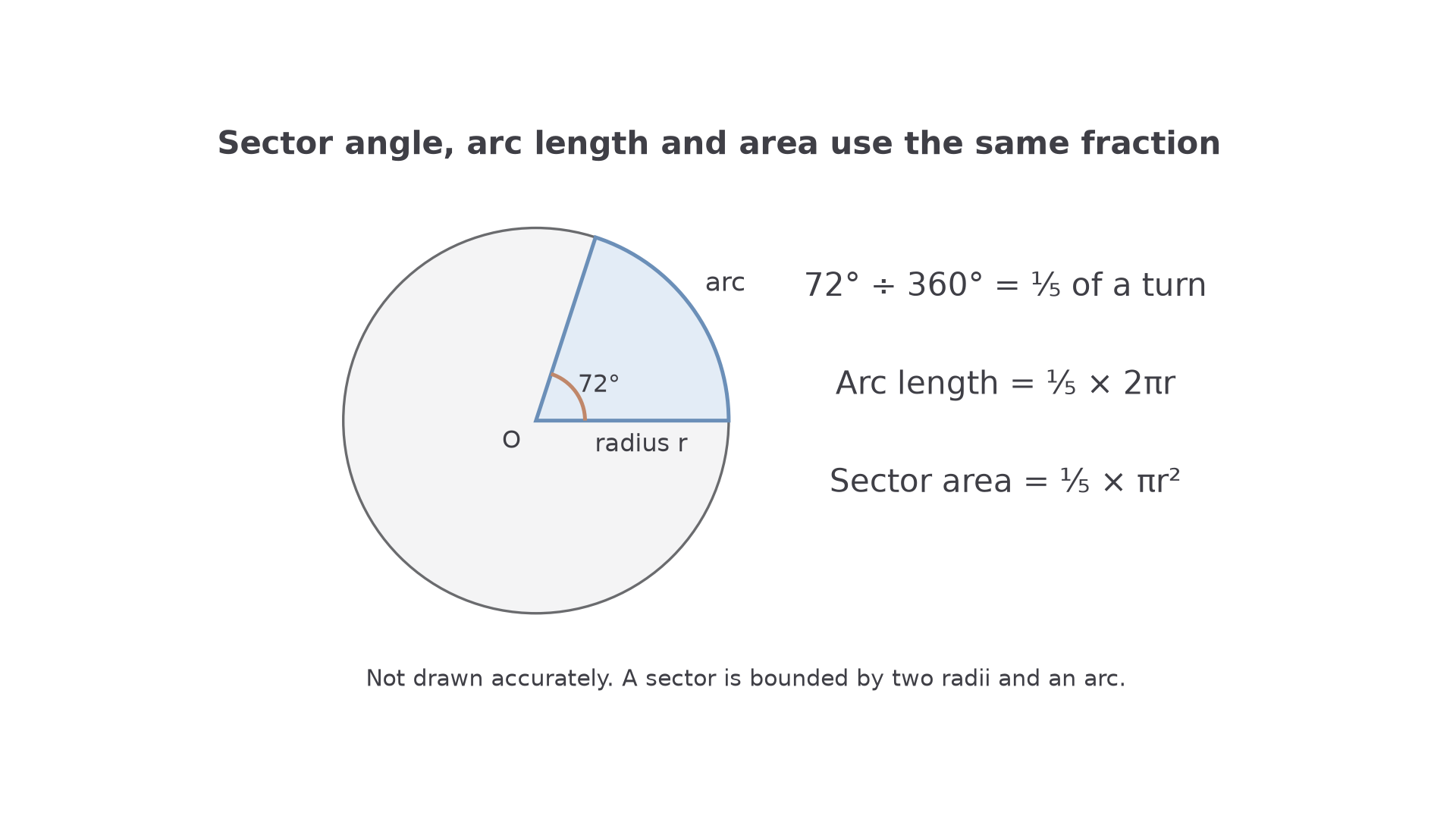
Arc length and sector perimeter
For radius and sector angle in degrees,
Here is the arc length. The perimeter also includes both radii. The perimeter expression applies to a genuine sector with .
Not on the formulae sheet: learn it.
The centre angle tells you the fraction; the radius tells you the size of the whole circle. Both are needed.
Worked example 1: one third of a circle
Question. A sector has radius and angle . Work out its arc length and perimeter in terms of . Non-calculator.
Plan. Find the fraction of a turn, apply it to the circumference, then add the two radii for perimeter.
Why add only for perimeter? The arc is just the curved edge; the whole boundary has two extra straight edges.
Answer. Arc length ; perimeter .
Check. Three arcs of make the full circumference .
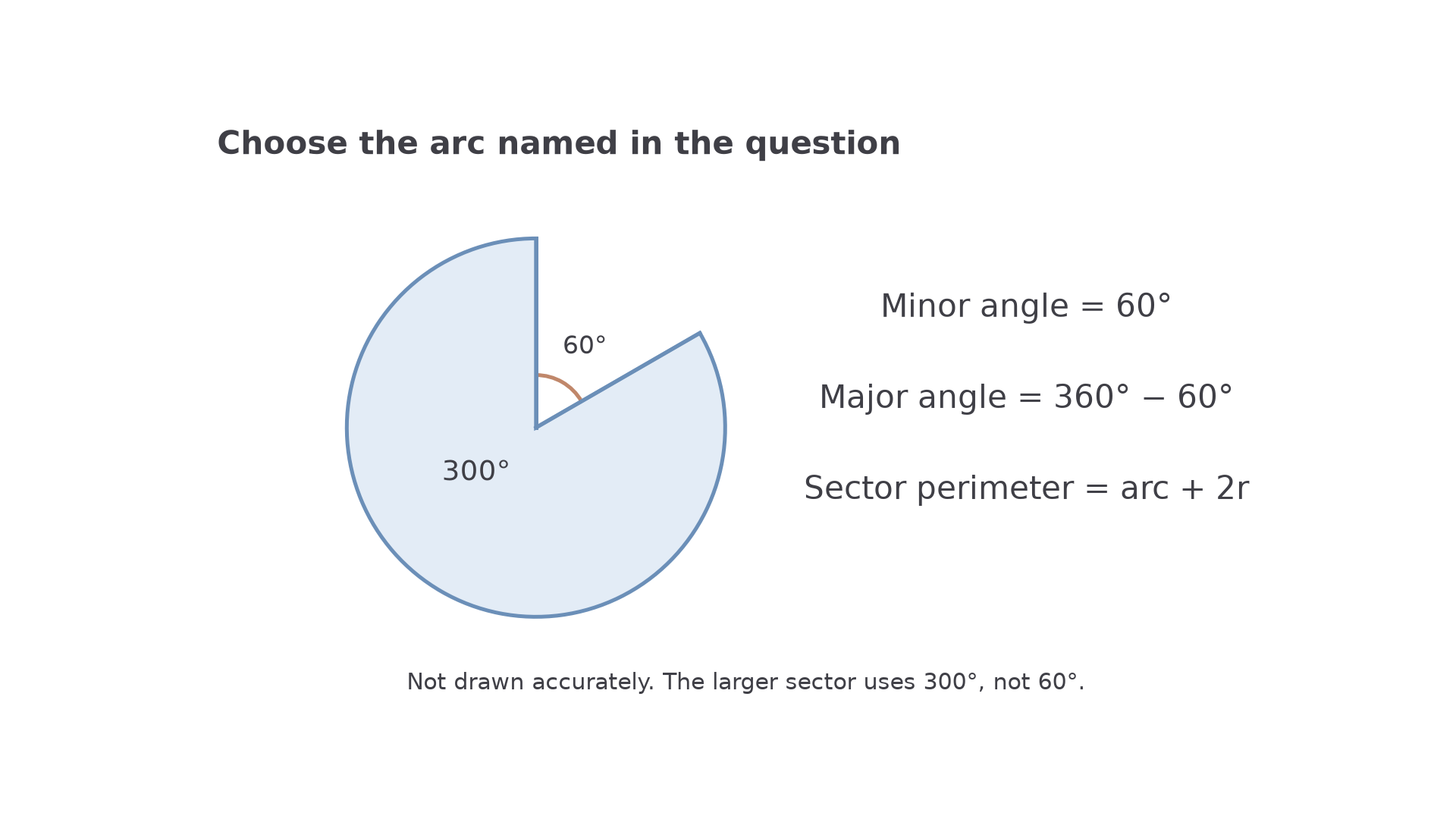
Change only the angle to a reflex angle, making a major sector. Use the larger angle for its longer arc.
[DIAGRAM: asset_name: Major sector and the omitted minor angle; asset_slug: aqa8300_gd_major_sector; caption: A major sector uses the reflex angle rather than the smaller gap angle; description: A pale blue major sector takes 300 degrees of a circle. Its missing 60 degree gap is marked in clay between two radii. Text gives major angle equals 360 degrees minus 60 degrees and sector perimeter equals arc plus twice the radius. Not drawn accurately.]
Worked example 2: the major arc
Question. A circle has radius . Two radii make a smaller angle of . Work out the length of the major arc between them in terms of . Non-calculator.
Plan. Find the reflex angle for the major arc, then take that fraction of the full circumference.
Why not use ? That would find the minor arc across the small gap.
Answer. .
Check. The minor arc is ; , the full circumference.
Circle diagrams often show the small angle because it is easier to label. The words “major arc” tell you to work with the rest of the turn.
Watch out
Wrong: arc length . That expression finds an area. Right: an arc is a length, so take the fraction of .
The question below supplies the major angle directly.
Sector area
A sector's area takes the same fraction of the full area as its angle takes of a full turn.
If three equal sectors fit around the centre, each takes one third of the full-circle area. This is an area fraction, so it uses , not the circumference. The angle is still measured at the circle's centre.
Sector area
For radius and centre angle in degrees,
Use the angle of the sector actually required, including a reflex angle for a major sector.
Not on the formulae sheet: learn it.
Keep an exact fraction while working without a calculator. With a calculator, enter the whole expression and round only the final answer.
Continue this lesson.
You’re previewing NovaLearn without an account. Create a free account to read the rest.
Create free account