G10 - Circle theorems about tangents and chords (Higher)
Use and prove circle theorems involving tangents and chords. Build clear arguments from radii, right angles and congruent triangles, then connect a tangent angle to an angle at the circumference.
A tangent and its radius
Two straight paths touch a circular garden from the same gate. Could one path be shorter than the other? We will prove that the two tangent lengths are equal. First, find the right angles hiding at their contact points.
You already know
A tangent touches a circle at one point. All radii of a circle are equal. In an RHS proof, two right-angled triangles are congruent when their hypotenuses and one corresponding pair of other sides are equal.
A radius points directly towards the touching point. The tangent runs across it at a right angle. The theorem applies at the contact point, not where an unrelated chord meets the tangent.
[DIAGRAM: asset_name: The radius meets a tangent at a right angle; asset_slug: aqa8300_g26_radius_tangent; caption: The radius to the point of contact is perpendicular to the tangent. A line meeting the circle twice cannot be a tangent; description: Left panel shows circle centre O, bottom contact point T and horizontal tangent through T, with a right-angle square between OT and the tangent. Right panel shows a hypothetical line meeting the circle at T and T prime, symmetric about the perpendicular OM. It explains the reflection argument without labelling that two-intersection line a tangent.]
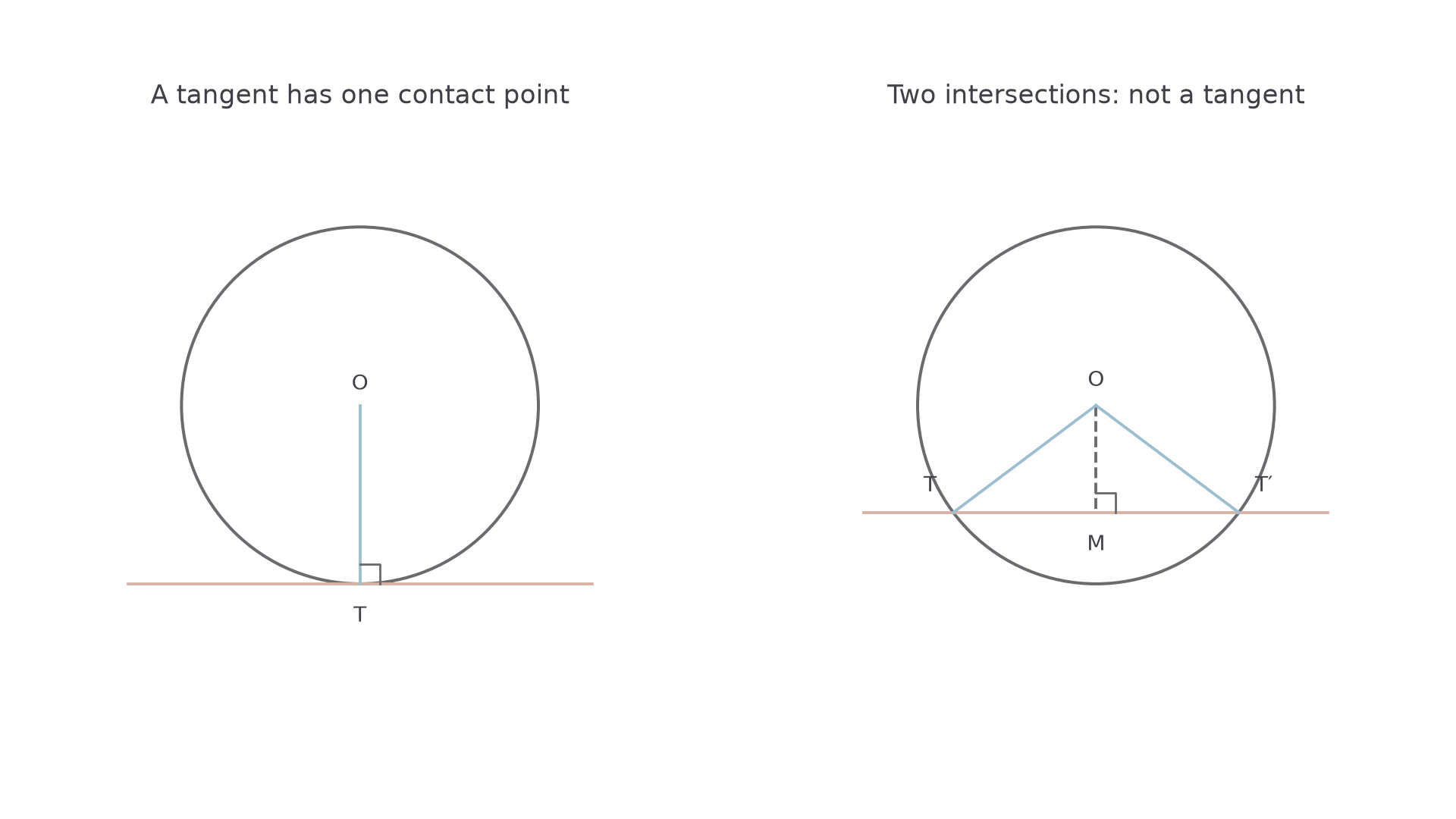
Radius and tangent
If a line is tangent to a circle at , and is its centre,
Not on the formulae sheet: learn it.
Here is a proof using reflection. Drop the perpendicular from to the line and call its foot . Suppose were different from . Reflect in . Its image lies on the same line, and , because reflection preserves distance and fixes . So would be a second point of the circle on that line. A tangent has only one contact point. Therefore , and the radius is perpendicular to the tangent.
Worked example 1: a radius in a triangle
Question. is tangent to a circle at , with centre . . Work out . Non-calculator.
Plan. Mark the right angle at , then use triangle .
Why this step? The centre-to-contact line is the radius named in the theorem.
Answer. .
Check. .
The second example changes the given angle from a number to an expression. The same right triangle supplies the equation.
Worked example 2: an algebraic angle
Question. is tangent at . In triangle , and . Work out . Non-calculator.
Plan. The two non-right angles sum to .
Why this step? has not been given: is outside the circle, so is not a radius.
Answer. .
Check. , and .
A right-angle mark at the contact point is often the first useful addition to an exam diagram.
Watch out
Wrong: “A tangent is perpendicular to every chord through its contact point.” Right: it is perpendicular to the radius there. A different chord generally makes a different angle.
Use that distinction to build the next equation.
Tangents from one external point
The two paths from the gate can touch different parts of the circle, yet their lengths are equal. The shared starting point is essential.
[DIAGRAM: asset_name: Two tangents and two congruent triangles; asset_slug: aqa8300_g26_equal_tangents; caption: Radii to the contact points and the shared hypotenuse OP give two congruent right-angled triangles; description: A circle centre O has tangents PA and PB from an external point P on the right. OA OB and OP are drawn. Right-angle squares mark A and B. Matching ticks identify the two radii, and the two tangent lengths are highlighted in the same clay colour.]
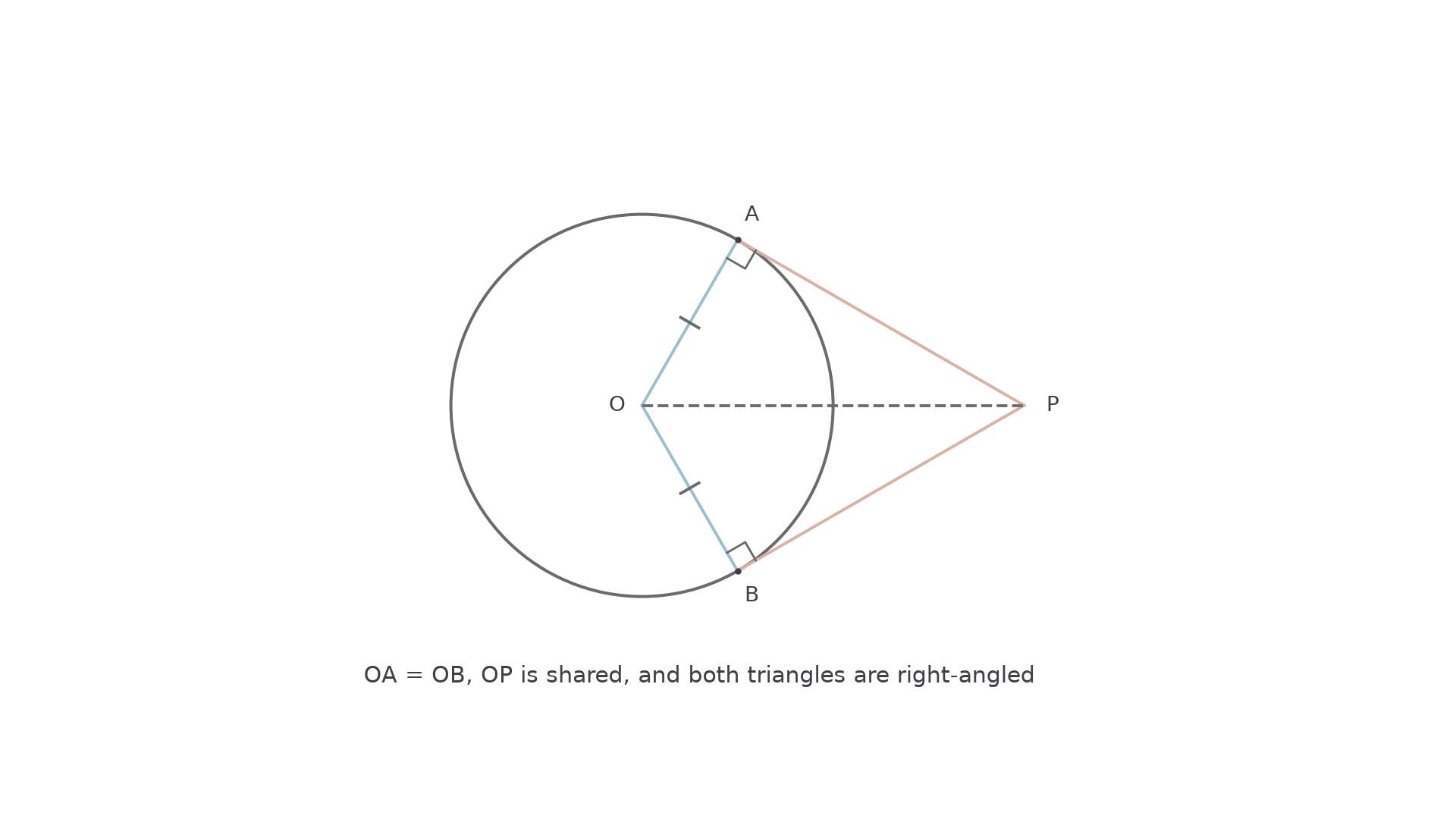
Equal tangents
If and are tangents from the same external point to one circle,
Not on the formulae sheet: learn it.
Join to , and . Triangles and have right angles at the contact points, common hypotenuse and equal radii . They are congruent by RHS, so . This proves the equal lengths rather than assuming the diagram is symmetrical.
The congruent triangles also show that bisects the angle between the tangents. Another useful related result follows from the angle sum of quadrilateral :
The other two angles are both , leaving for these two. These related results are not on the formulae sheet: learn them.
Worked example 3: transferring a length
Question. and are tangents to a circle. . Work out . Non-calculator.
Plan. Check that both tangents begin at the same point, then use equal lengths.
Why this step? Both segments begin at and end at their contact points.
Answer. .
Check. The two congruent right triangles have matching tangent sides.
The next example changes the lengths into algebraic expressions. Equality now gives an equation to solve.
Worked example 4: equal tangent expressions
Question. Tangents and have lengths and . Work out . Non-calculator.
Plan. Equate the tangent lengths, then check both are positive and equal.
Why this step? Equal tangents concern the complete lengths, not just the coefficients of .
Answer. .
Check. and , so both lengths are .
The garden question is settled: the two tangent paths from the same gate are equally long. Moving the gate changes both lengths, while preserving their equality.
Watch out
Wrong: “Any two tangents to a circle have equal lengths.” Right: the finite segments from the same external point to their contact points have equal lengths. An entire tangent line has no finite length.
Apply the same equality with new expressions.
A perpendicular from the centre to a chord
A perpendicular from the centre cuts a chord into two equal lengths. It does not usually cut the radius into two equal lengths.
Continue this lesson.
You’re previewing NovaLearn without an account. Create a free account to read the rest.
Create free account