A4 - Simplifying, expanding single brackets and factorising
You can change the appearance of an expression without changing its value. Learn to collect matching terms, simplify products and powers, expand a single bracket, and reverse that process by taking out a common factor. These are the tools that make longer algebra manageable.
Collecting like terms
Two clubs charge pounds and pounds for the same activity. Will one always cost less, or are the charges equal? We will simplify both expressions by the end of the lesson.
You already know
Terms are added or subtracted, while factors are multiplied. A coefficient tells you how many of a term you have: means five lots of .
If you have and add , you have . The size of does not matter: three lots plus two lots make five lots. But cannot be collected into one term unless you know a relationship between and .
Like terms
Terms with exactly the same variable part, including the same powers. For example, and are like terms. and are not, because and are different variable parts.
Collect like terms by adding or subtracting their coefficients. Keep the variable part unchanged. Constant terms collect with other constants. A missing coefficient is , and a minus sign belongs to the term after it. This rule is not on the formulae sheet: learn it.
Worked example 1: two kinds of term
Question. Simplify . Non-calculator.
Plan. Put the terms together and the constants together.
Why this step? and count the same kind of thing; the constants are another kind.
Answer. .
Check. At , the original is , and the answer is .
The next example changes only the sign of the second term. Move its minus sign with it.
Worked example 2: keeping a negative sign
Question. Simplify . Non-calculator.
Plan. Collect the terms using , then collect the constants.
Why this step? Reordering does not change into .
Answer. .
Check. At , both expressions give .
The letters must match as well as the powers. For example, and do match, because multiplication can be reordered; and do not.
Watch out
Wrong: . Adding terms adds their coefficients, not their powers. Right: . Multiplying is different: .
In the next question, the squared terms form one group and the single terms form another.
Simplifying products and powers
In a product, multiply the numerical factors and collect repeated letters using the laws of indices.
For example, is . This is why addition and multiplication need different rules. You already met the number laws of indices; the same laws apply when the base is a letter.
Index laws in algebra
For positive integer powers, these follow by counting repeated factors. Also for . The quotient rule never permits division by zero.
Not on the formulae sheet: learn it.
A power outside a product applies to every factor: , because the whole product appears three times. A power outside a sum does not split in that way; is a product of two brackets, which comes next lesson.
Worked example 3: multiplying terms
Question. Simplify . Non-calculator.
Plan. Multiply the coefficients, then combine powers of each letter separately.
Why this step? The exponent counts how many copies of that letter are multiplied, not how many different letters there are.
Answer. .
Check. At , , the original is , and the answer is .
The next example changes only multiplication to division. Now subtract powers and divide coefficients.
Worked example 4: dividing terms
Question. Simplify , where and are non-zero. Non-calculator.
Plan. Divide the coefficients, then cancel matching letter factors.
Why this step? Two factors and one factor cancel, leaving one and three factors above.
Answer. .
Check. At , , the original is , and the answer is .
A power of a term needs its coefficient too: . Here the inner power is multiplied by the outer power because there are two groups of three factors.
Watch out
Wrong: . The whole term is squared, including its coefficient. Right: .
One quotient and one power in the next check keep those two decisions separate.
Expanding a single bracket
Expanding a bracket means multiplying every term inside it by the factor outside.
Four bags each containing counters and spare counters contain counters altogether. That is the same total as . The outside factor reaches both terms because there are four complete bags.
[DIAGRAM: asset_name: Splitting a rectangle to expand a bracket; asset_slug: aqa8300_a03_distributive_area; caption: The two parts of a rectangle have areas 4x and 12, so its total area is both 4(x + 3) and 4x + 12; description: A rectangle of height 4 has its width split into x and 3, with x positive. The left region is pale blue and labelled 4x, and the right region is pale sage and labelled 12. The height and both width segments are labelled outside. Beneath it the equality 4(x + 3) = 4x + 12 appears. Not drawn accurately.]
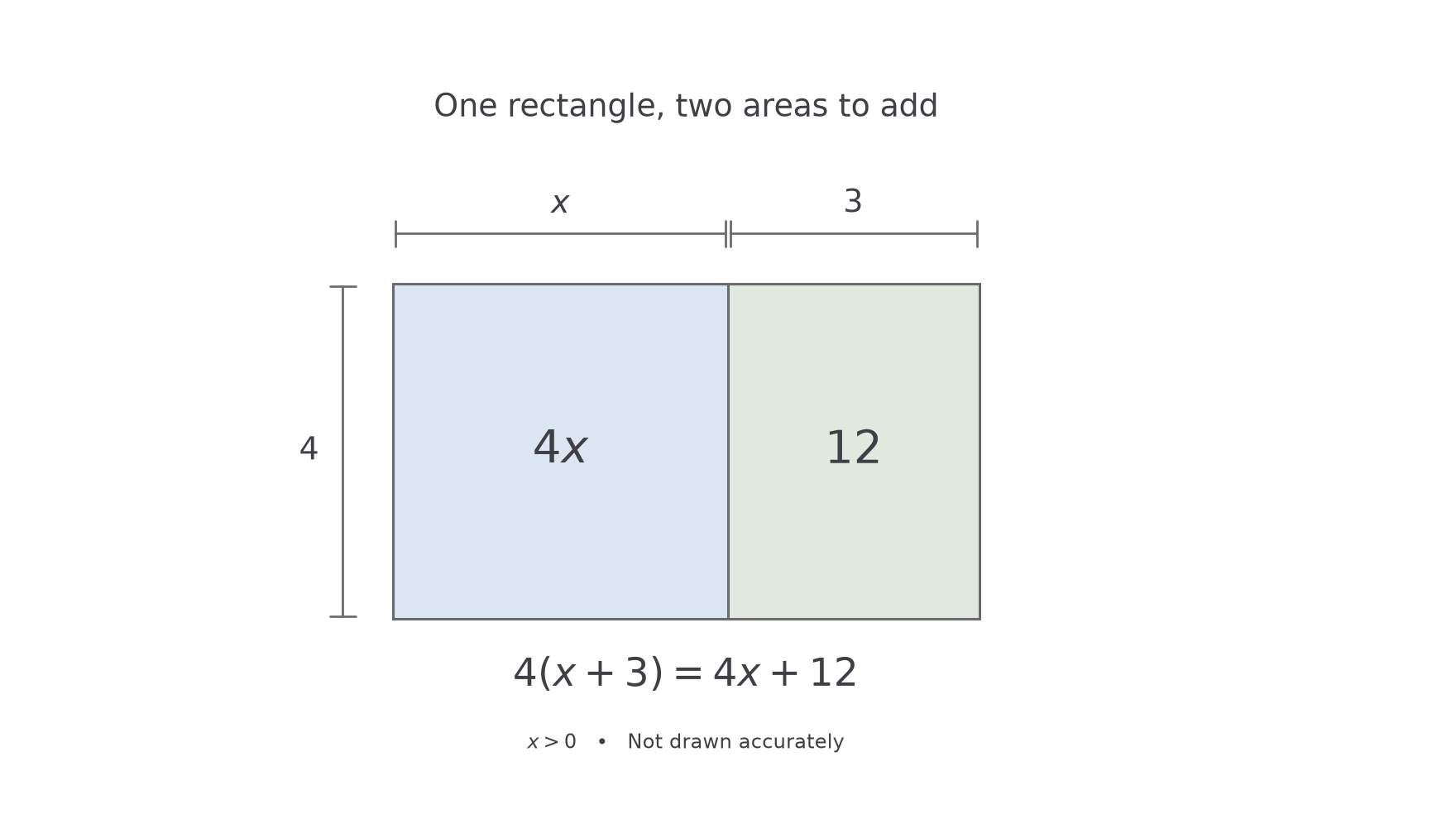
The rectangle shows the same multiplication. It uses positive lengths, but the algebraic rule also works for zero and negative numbers.
Distributing over a bracket
This holds for any numbers , and . Subtraction works too: .
Not on the formulae sheet: learn it.
Multiply signed terms, rather than trying to change a sign by eye. A negative outside factor multiplies every term, including any negative term inside.
Worked example 5: a positive outside factor
Question. Expand . Non-calculator.
Plan. Multiply both terms inside by .
Why this step? The bracket is a whole group, so the outside multiplies the as well as the .
Answer. .
Check. At , the original is , and the answer is .
The next example changes only the sign of the outside factor. This reverses both product signs.
Worked example 6: a negative outside factor
Question. Expand . Non-calculator.
Plan. Multiply each signed term by .
Why this step? The second product contains two negative factors. Its sign must be positive.
Answer. .
Check. At , both forms give , the negative of the previous example.
This rule has a pleasant numerical trick hidden in it: multiplying a three-digit whole number by repeats its digits. For example, . The first product shifts the digits three places; the addition fills the empty places. No magic, just a bracket in disguise.
Watch out
Wrong: . That treats the second factor as . Right: , so the result is .
An outside letter multiplies just like an outside number. After expanding, collect any like terms that appear.
Taking out a common factor
Factorising reverses expansion: write a sum as a product by taking out a factor shared by every term.
Since , the factorised form of is . “Factorise fully” means take out the largest common numerical factor and every letter factor common to all terms.
Common factor
A factor of every term in an expression. For example, is a common factor of and . The letter is not common to both, because has only one factor.
Find the highest common factor of the coefficients. For each common letter, use the smallest power present in all terms. Divide each term by the chosen factor to fill the bracket. The term divided by itself leaves , not . This factorising method is not on the formulae sheet: learn it.
Worked example 7: a common numerical factor
Question. Factorise fully . Non-calculator.
Plan. Take out the highest common factor of and , which is .
Why this step? Taking out or would leave another numerical factor shared inside the bracket.
Answer. .
Check. Expanding gives , the original expression.
The next example adds one factor to each term. The common factor now includes that letter.
Worked example 8: a common letter factor
Question. Factorise fully . Non-calculator.
Plan. Take out , dividing both terms by it.
Why this step? Both terms contain an , but only the first contains , so take out just one .
Answer. .
Check. and .
Signs stay inside unless you choose to take out a negative factor. For example, . You may also write it as ; expanding either form gives the same expression.
Watch out
Wrong: . Dividing the last term by leaves . Right: .
Now return to the two charges. Expanding and collecting gives . Factorising gives . The charges are equal for every allowed , even though their forms look different.
Quick Recap
- Collect terms only when their letters and powers match. Keep each term's sign.
- In products, multiply coefficients and add matching powers. A power of a power multiplies the exponents.
- Expand a bracket by multiplying every term inside by the outside factor.
- Factorise fully by taking out the highest common numerical factor and all common letter factors. Expand to check.
The two club charges are equal: both simplify to .