G3 - Angles in triangles and polygons
Derive the angle sum of a triangle, then build angle sums for polygons from triangles. Use interior and exterior angles to work out missing angles and identify a regular polygon from its corners.
Why triangle angles total 180 degrees
A regular polygon has an interior angle of . Can you discover how many sides it has without seeing the shape? A small outside turn will reveal the answer. Start with the triangle, which supplies every polygon's angle sum.
You already know
Angles on a straight line total . Alternate angles on parallel lines are equal. A regular polygon has equal sides and equal interior angles.
Take any triangle . Draw a straight line through , parallel to . The angles at and can be copied beside the angle at , using alternate angles. All three now fit on one straight line.
[DIAGRAM: asset_name: Deriving the triangle angle sum; asset_slug: aqa8300_g03_triangle_sum; caption: Alternate angles place a, c and b together on a straight line through C; description: Triangle ABC has base angles a and b and top angle c. A line through C parallel to AB creates alternate angles a and b beside c. Their sum is 180 degrees.]
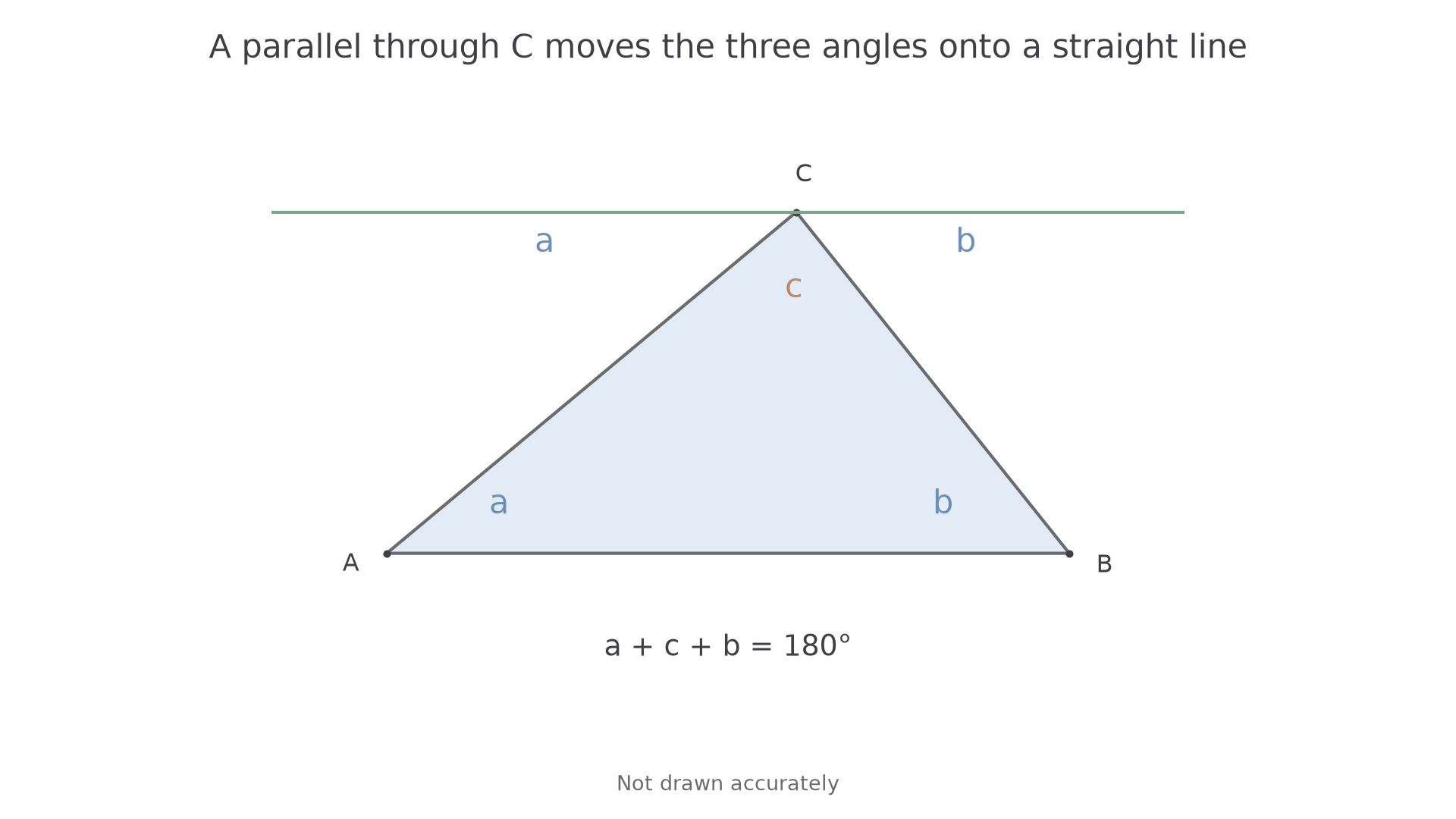
Triangle angle sum
For any triangle in a plane,
where , and are its three interior angles.
Not on the formulae sheet: learn it.
The derivation does not use any equal sides, so the result works for a thin, tilted or obtuse triangle as well as a familiar upright one.
Worked example 1: a missing angle, non-calculator
Question. Two angles in a triangle are and . Work out the third angle.
Plan. Add the known angles, then subtract from .
Why this step? Three sides make one triangle, so its interior-angle total is .
Answer. .
Check. .
The second example changes one known angle to a right angle. You can subtract that first to simplify the calculation.
Worked example 2: a right-angled triangle, non-calculator
Question. A right-angled triangle has one other angle of . Work out the remaining angle.
Plan. Remove the right angle, then the known acute angle.
Why this step? The two non-right angles of a right-angled triangle must share .
Answer. .
Check. , and both remaining angles are acute.
A triangle cannot have two right angles or two obtuse angles: those would already use at least the entire total, leaving no positive third angle.
Watch out
Wrong: use because a triangle is a closed shape. Right: its interior angles sum to . A full turn is a different quantity.
The same subtraction works whenever the triangle has enough stated angle information.
Build a polygon from triangles
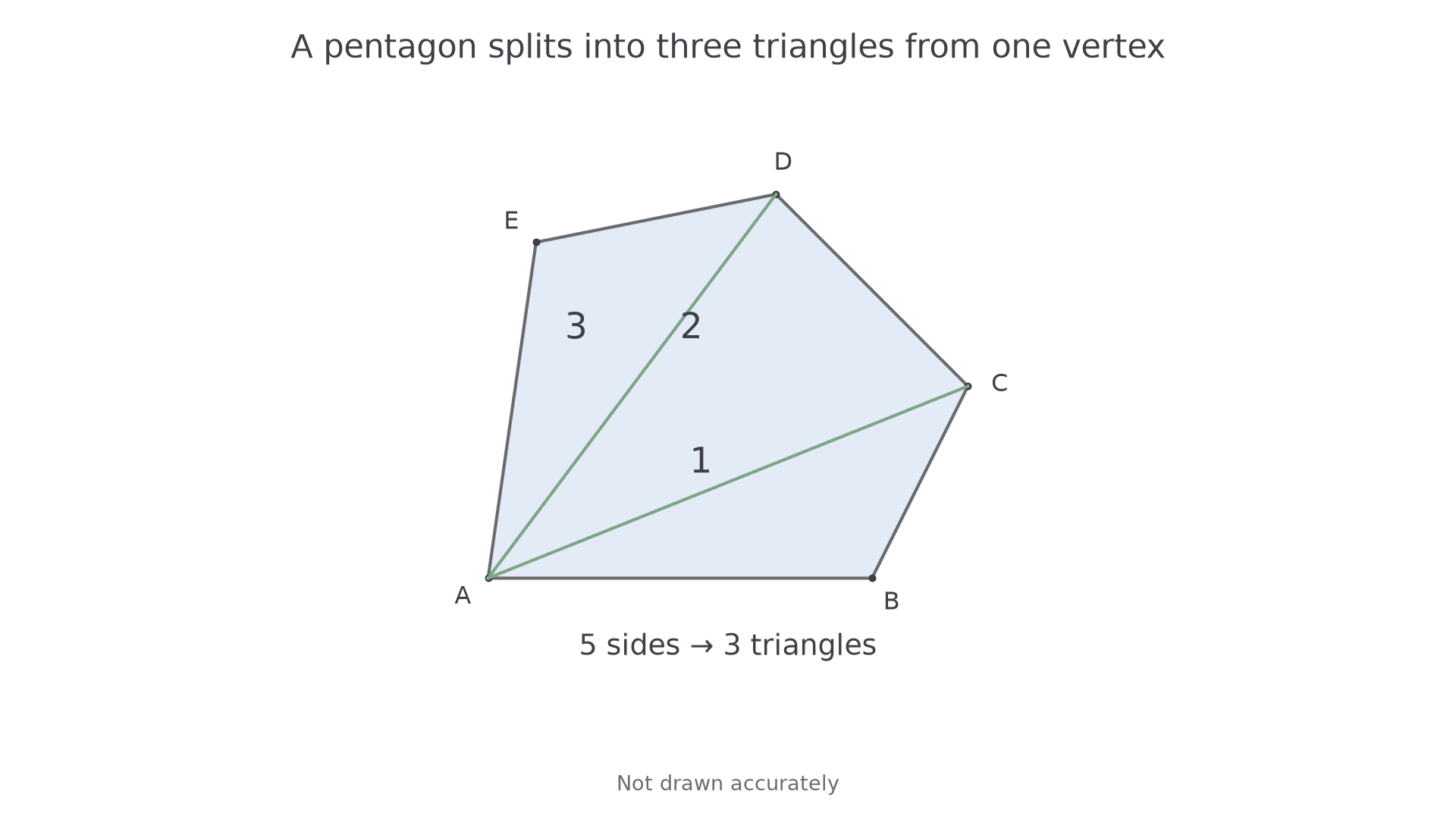
A quadrilateral can be split into two triangles by one diagonal, giving an angle sum of . A pentagon splits into three triangles, so its angle sum is .
Draw diagonals from one vertex of a convex polygon. Each new triangle uses one more side, and the total number of triangles is two fewer than the number of sides.
[DIAGRAM: asset_name: Pentagon triangulation; asset_slug: aqa8300_g03_polygon_sum; caption: Three triangles fill a pentagon without adding any new angles inside it; description: Pentagon ABCDE is divided by AC and AD into three numbered triangles, all sharing vertex A. Five sides give three triangles.]
Convex polygon
A polygon with every interior angle less than . A regular pentagon is convex. A polygon with an inward-pointing corner has a reflex interior angle and is concave.
The diagonals inside a convex polygon give a direct derivation. The same angle-sum formula also holds for a simple concave polygon, although you must choose a triangulation that stays inside it. A simple polygon has no crossing sides.
Interior-angle sum
For a simple polygon with sides,
where is a whole number at least .
Not on the formulae sheet: learn it.
This gives the total whether or not the angles are equal. Dividing it equally between vertices needs the extra information that the polygon is regular or equiangular.
Worked example 3: a total, non-calculator
Question. Work out the sum of the interior angles of a hexagon.
Plan. Count the triangles formed from one vertex.
Why this step? Six sides do not give six triangles from one vertex: the two sides meeting at that vertex account for the difference.
Answer. .
Check. A pentagon totals ; adding one side adds one triangle, so a hexagon totals .
The second example changes from finding a whole total to finding the missing part of that total.
Worked example 4: an irregular pentagon, non-calculator
Question. Four interior angles of a pentagon are , , and . Work out its fifth angle.
Plan. Find the pentagon's total, then subtract the four known angles.
Why this step? The pentagon is not stated to be regular, so its angles cannot be assumed equal.
Answer. .
Check. .
The same derivation gives for an octagon and for a decagon. Naming a polygon tells you its side count; it does not tell you that it is regular.
Watch out
Wrong: every pentagon has angles of . Right: every simple pentagon totals , but its five individual angles need not match.
Keep the total and the individual angle separate in your working.
Continue this lesson.
You’re previewing NovaLearn without an account. Create a free account to read the rest.
Create free account