G12, G13 - 3D shapes, plans and elevations
Describe solid shapes using faces, surfaces, edges and vertices. Draw flat views from above, in front and from the side, then use those views to reason about arrangements of cubes.
Faces, edges and vertices
Could two different cube models have exactly the same views from above, in front and from the side? Yes. A flat view can hide a cube behind another one. First, get to know the solid shapes those views describe.
You already know
A square is a special rectangle. Triangles and quadrilaterals are flat, or two-dimensional, shapes. A solid is three-dimensional: it has width, depth and height.
A cube has six square faces. The lines where faces meet are its edges. The corners where edges meet are its vertices. Count the entire solid, including edges and vertices at the back that a drawing hides.
[DIAGRAM: asset_name: Four flat-faced solids; asset_slug: aqa8300_g09_polyhedra; caption: Count the whole solid, including hidden edges and vertices. A prism has matching parallel ends; a pyramid has triangular faces meeting at one apex; description: Four labelled panels show a cube, a cuboid, a triangular prism and a square-based pyramid. Hidden edges are dashed, visible edges solid. A face, edge and vertex are identified on the cube with separate leader lines. The visible triangular end is shaded blue and its matching hidden end is traced by dashed edges. The pyramid apex and square base are labelled.]
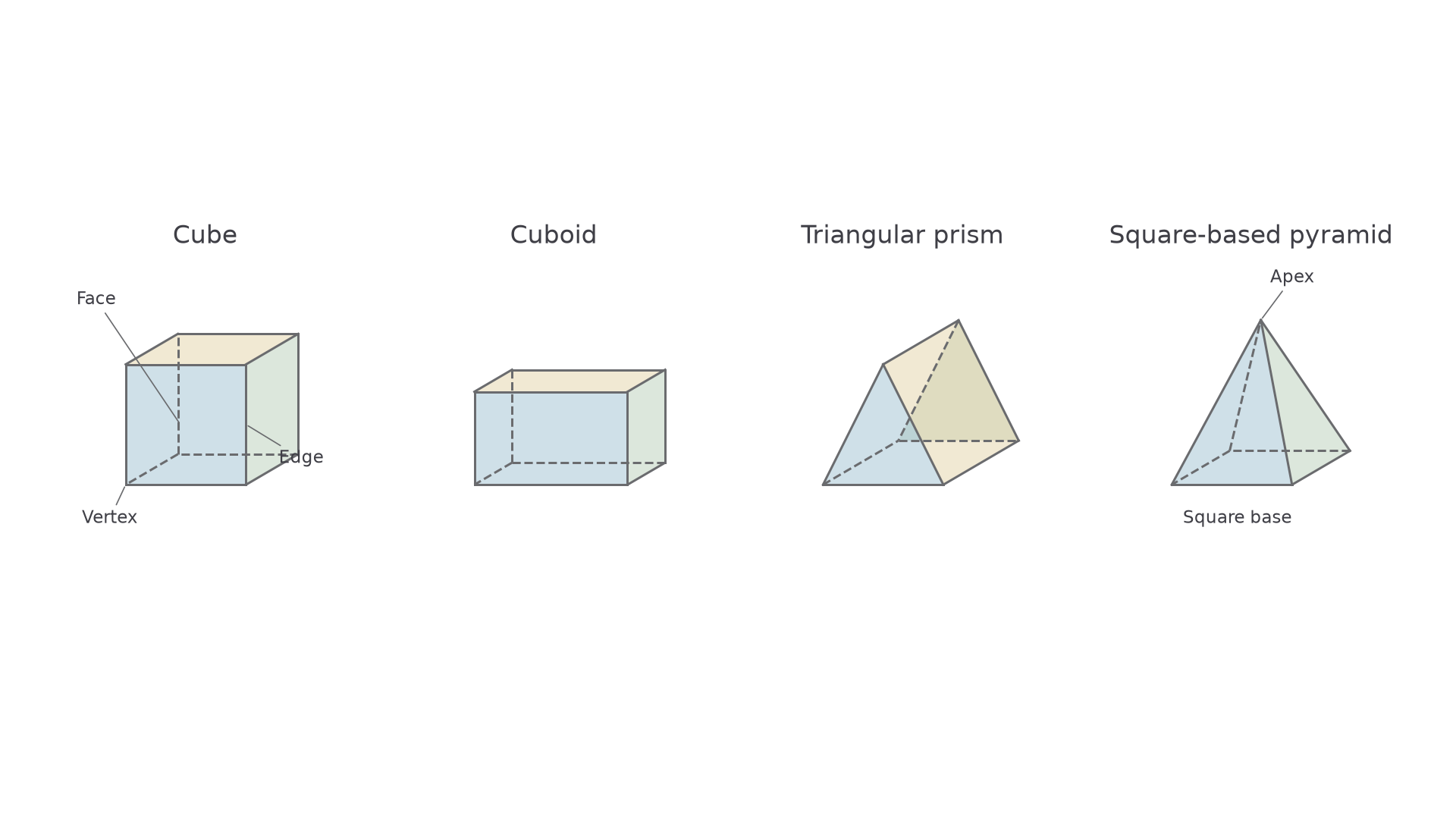
Face, edge and vertex
A face is a flat surface of a solid. An edge is where two surfaces meet; it can be straight or curved. A vertex is a corner point. The plural is vertices. A flat-faced solid is also called a polyhedron.
A prism has a constant polygonal cross-section along its length: slices parallel to its two matching ends have the same shape and size. In a right prism, the side faces are rectangles. A cube and a cuboid are both right prisms. A pyramid has a polygonal base and triangular side faces meeting at one point, the apex. A pyramid's slices parallel to the base become smaller towards the apex, so it is not a prism.
| Solid | Faces | Edges | Vertices |
|---|---|---|---|
| Cube | squares | ||
| Cuboid | rectangles | ||
| Triangular prism | triangles and rectangles | ||
| Square-based pyramid | square and triangles |
The cube row also fits the cuboid row: a square counts as a rectangle. For a triangular prism, count three edges on each triangular end and three joining edges, giving . For a square-based pyramid, count four base edges and four edges to the apex, giving . These shape properties are not on the formulae sheet: learn them.
Watch out
Wrong: a triangular prism has only vertices because its front end is a triangle. Right: it has vertices at each end, giving . Hidden corners still count.
Match the complete solid to its full set of properties.
Solids with curved surfaces
A curved surface is not a collection of tiny flat faces. Keep the flat and curved surfaces separate when describing a cylinder, cone or sphere.
[DIAGRAM: asset_name: Cylinder cone and sphere; asset_slug: aqa8300_g09_curved_solids; caption: Cylinders and cones have circular edges. A sphere has one continuous curved surface and no edges or vertices; description: Three panels show an upright cylinder with two circular ends and one curved surface, an upright cone with one circular base and an apex, and a sphere. Circular edges are shown with solid near halves and dashed hidden halves. A lightly drawn equator on the sphere is explicitly labelled a guide line, not an edge.]
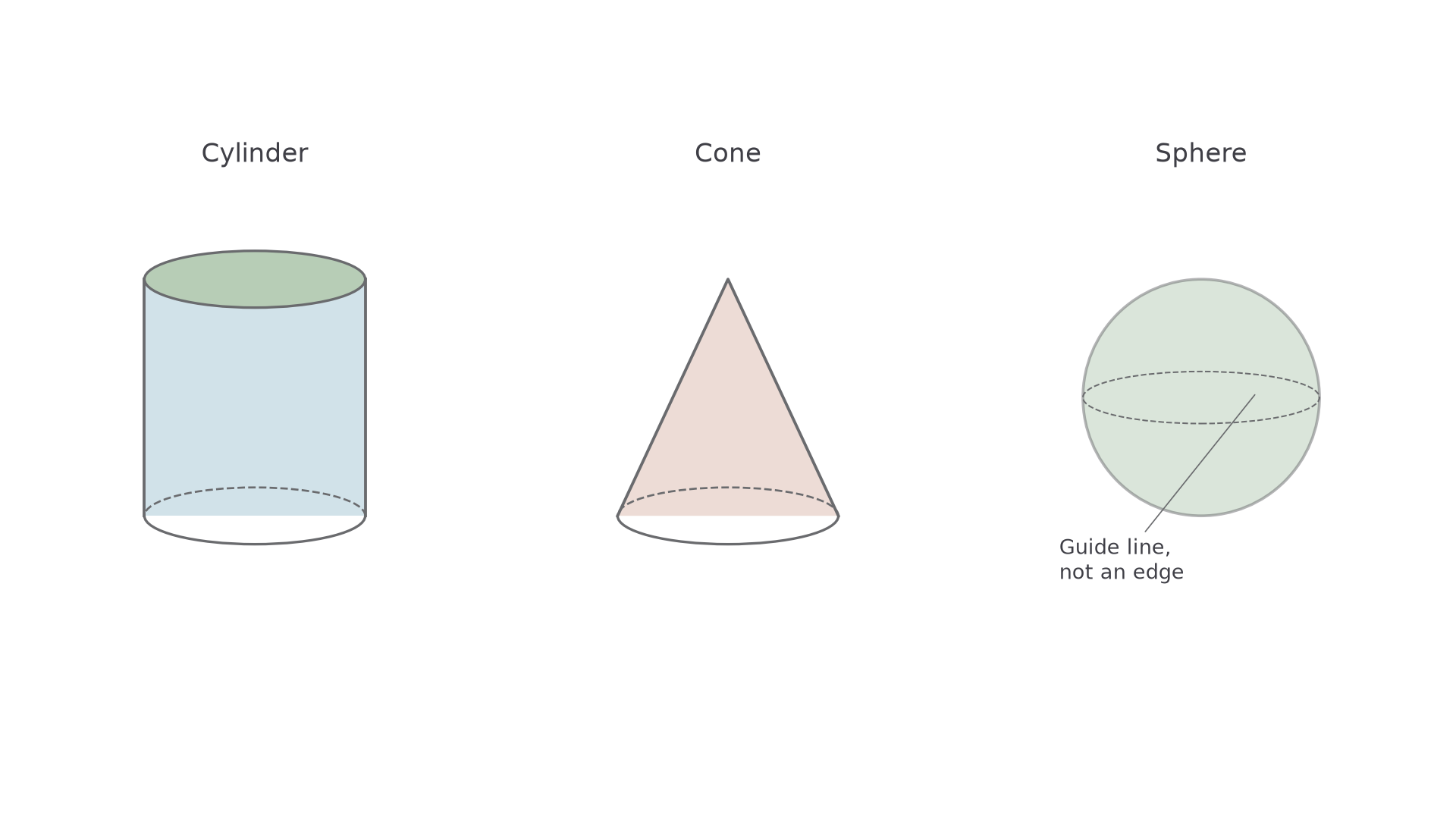
Curved solids
A cylinder has two equal parallel circular flat faces joined by one curved surface. A cone has one circular flat face and a curved surface meeting at an apex. A sphere has one continuous curved surface, with every surface point the same distance from its centre.
On a cylinder, each circular rim is an edge where a flat face meets the curved surface. Neither rim has a corner, so the cylinder has no vertices. A cone has one circular edge and one vertex at the apex. The circle sometimes drawn around a sphere is a guide to its round shape, not an edge: no two surfaces meet there.
| Solid | Flat faces | Curved surfaces | Edges | Vertices |
|---|---|---|---|---|
| Cylinder | circles | circular edges | ||
| Cone | circle | circular edge | ||
| Sphere |
These properties are not on the formulae sheet: learn them. A cylinder has a constant circular cross-section; unlike a polygonal prism, its side surface is curved.
Key idea
A drawn line is not automatically a real edge. An edge is where surfaces actually meet. A sphere's guide circle and a cylinder's drawn side outlines do not add extra edges.
The next description needs both the surface count and the corner count.
Plans and elevations
Look straight at a solid from one chosen direction. Its view is flat: draw the shape you see, with no receding lines to suggest depth.
Plan and elevation
A plan is the view directly from above. A front elevation is the view directly from the stated front direction. A side elevation is the view directly from a stated side. These are orthographic views: looking straight on keeps the dimensions in the viewing plane at their true scale.
For an upright cuboid, the plan shows width and depth. The front elevation shows width and height. The side elevation shows depth and height. One dimension disappears in each view because you are looking along that direction.
| Upright solid | Plan outline | Front elevation outline | Side elevation outline |
|---|---|---|---|
| Cuboid | Rectangle | Rectangle | Rectangle |
| Cylinder | Circle | Rectangle | Rectangle |
| Right circular cone | Circle | Triangle | Triangle |
| Sphere | Circle | Circle | Circle |
| Square-based pyramid, apex above centre | Square | Triangle | Triangle |
The pyramid's plan also shows the edges from the square corners to the apex, seen at the centre. A circle in a plan does not identify the solid by itself: the other views distinguish a cylinder, cone and sphere. These view rules are not on the formulae sheet: learn them.
[DIAGRAM: asset_name: Three views of a cuboid; asset_slug: aqa8300_g09_cuboid_views; caption: Width appears in the plan and front elevation; depth in the plan and side elevation; height in both elevations; description: An upright cuboid has width 4 centimetres, depth 3 centimetres and height 2 centimetres, with front and right-side viewing arrows. Its separate true-scale plan is a 4 by 3 rectangle, front elevation a 4 by 2 rectangle and right-side elevation a 3 by 2 rectangle. Dimensions are labelled outside the shapes.]
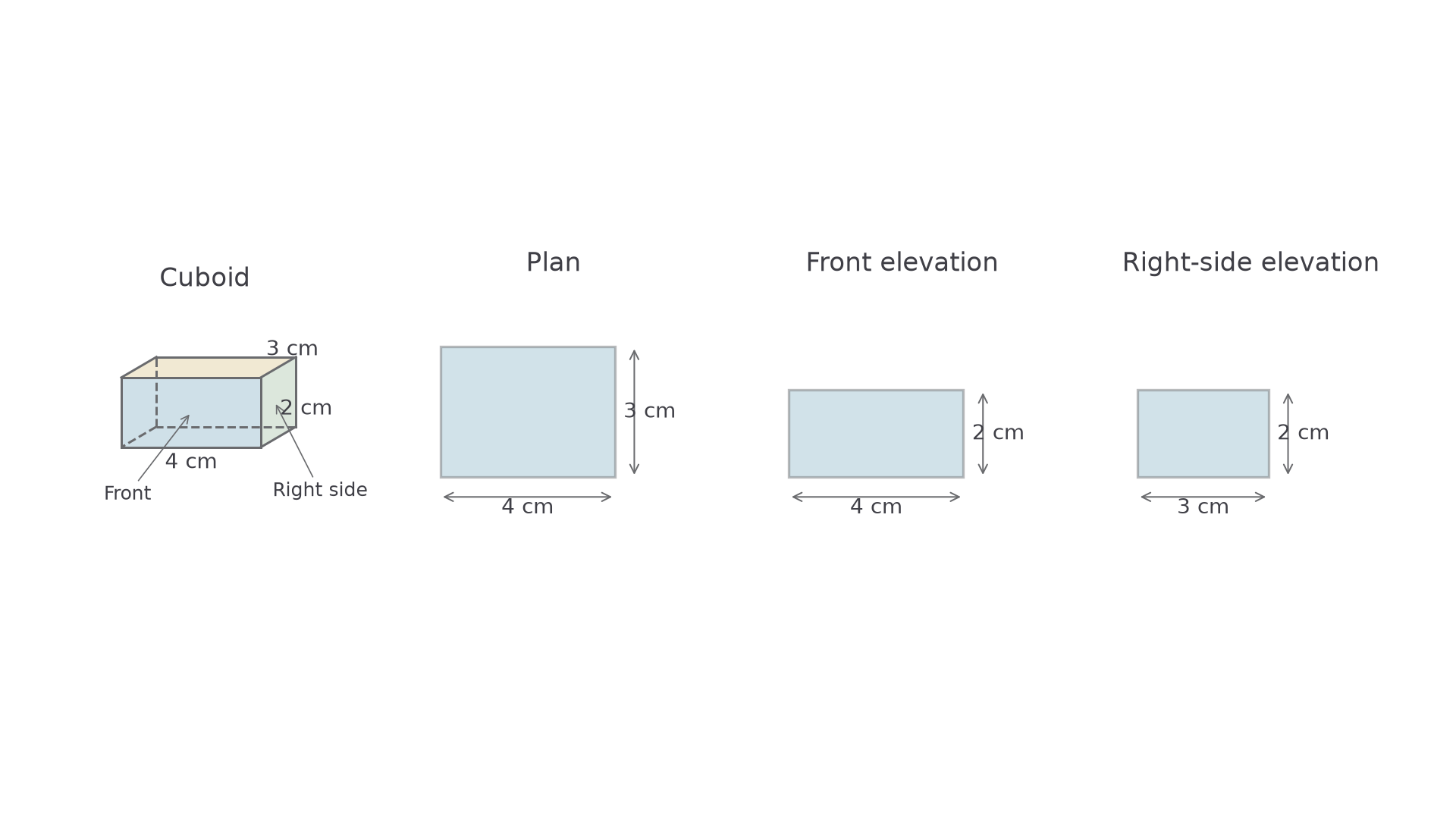
Worked example 1: a cuboid's three views
Question. An upright cuboid is wide, deep and high. Draw its plan, front elevation and right-side elevation at full size. Non-calculator.
Plan. Keep the pair of dimensions visible from each direction.
Why this step? The front view looks along the depth, so the depth cannot become one of the front rectangle's dimensions.
Answer. The three labelled rectangles are shown in the diagram. On paper, draw them with a ruler to the stated lengths.
Check. The two elevations have the same height, and the plan and front view have the same width.
Continue this lesson.
You’re previewing NovaLearn without an account. Create a free account to read the rest.
Create free account