G7 - Reflections, rotations and translations
Move a shape on a grid while keeping its exact size and shape. You will construct and recognise reflections, rotations and translations, then describe each movement precisely enough for someone else to reproduce it. These transformations make congruent images.
Reflections in horizontal and vertical lines
A triangle keeps every side length and angle, yet the letters around its edge run the other way round. Has it been slid, turned or reflected? We will use that clue after learning how each movement works.
You already know
Coordinates give horizontal position first, then vertical position. A vertical line has equation ; a horizontal line has equation . Congruent shapes have equal corresponding lengths and angles.
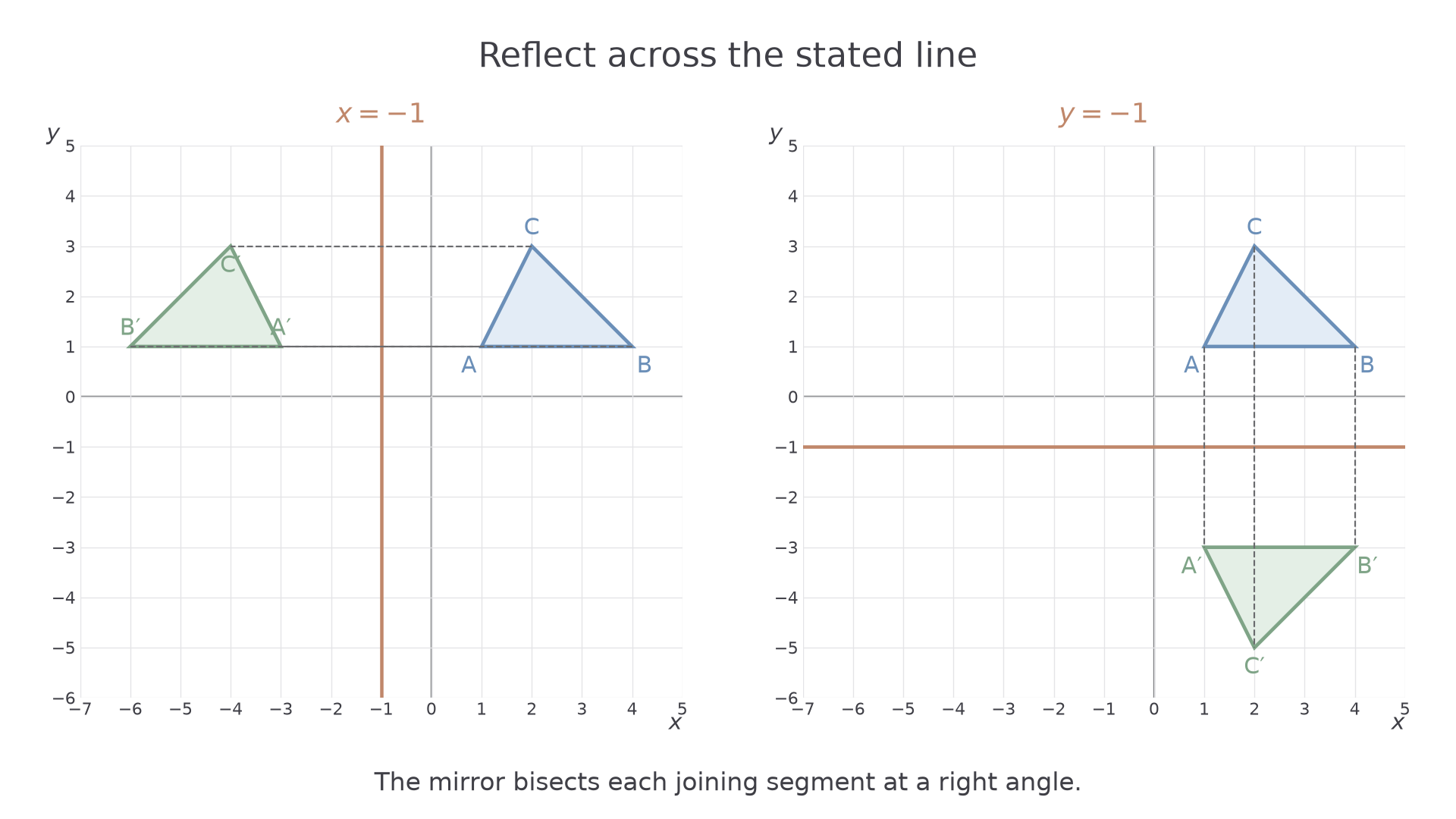
Imagine folding the grid along a mirror line. Each point lands on its image. The joining segment crosses the mirror at a right angle, with half its length on each side. A point already on the mirror stays there.
Reflection
A transformation that sends every point to the opposite side of a mirror line at the same perpendicular distance. The image of is labelled , read “A prime”. Points on the mirror line do not move.
To construct a reflected shape, reflect every vertex, then join the images in the original label order. Count perpendicular to the mirror, rather than diagonally towards it.
[DIAGRAM: asset_name: Equal perpendicular distances from a mirror; asset_slug: aqa8300_g06_axis_reflections; caption: A reflected point is the same perpendicular distance on the other side of the mirror line; description: Two coordinate-grid panels. Left triangle A1comma1 B4comma1 C2comma3 and its image in x equals minus1, with images minus3comma1 minus6comma1 minus4comma3. Right triangle A1comma1 B4comma1 C2comma3 and its image in y equals minus1, with images 1comma minus3 4comma minus3 2comma minus5. Dashed perpendicular guides join corresponding vertices.]
Reflections in axis-parallel lines
For a vertical mirror ,
For a horizontal mirror ,
Each mirror coordinate is the midpoint of a point's coordinate and its image's coordinate. In particular, reflection in the -axis changes the sign of , and reflection in the -axis changes the sign of .
Not on the formulae sheet: learn it.
You can count squares instead of using a formula. The calculation records exactly the same equal-distance idea.
Worked example 1: a vertical mirror away from the axis
Question. Triangle has vertices , , . Reflect it in . Write down the image coordinates. Non-calculator.
Plan. Keep each height and put each vertex equally far to the left of the vertical mirror.
Why this step? The mirror is , so changing just the sign of would reflect in the wrong line.
Answer. , , .
Check. The midpoint of each point and image has , and corresponding heights agree.
Change only the direction of the mirror: use instead. Distances are now counted vertically.
Worked example 2: a horizontal mirror
Question. Reflect the same triangle , , in . Write down the image coordinates. Non-calculator.
Plan. Keep each horizontal coordinate and put each image equally far below the mirror.
Why this step? A horizontal mirror changes height, so it changes the second coordinate.
Answer. , , .
Check. and , placing both midpoints on the mirror.
For a description, give the transformation and the mirror's equation: “reflection in ” is complete. “Reflection downwards” leaves the line unspecified.
Watch out
Wrong: reflection in sends to . That uses the -axis. Right: is above , so its image is below , at .
The next horizontal mirror has a positive coordinate.
Reflections in diagonal lines
For a diagonal mirror, count shortest distances perpendicular to the line. A horizontal gap alone is not the distance from a point to a sloping line.
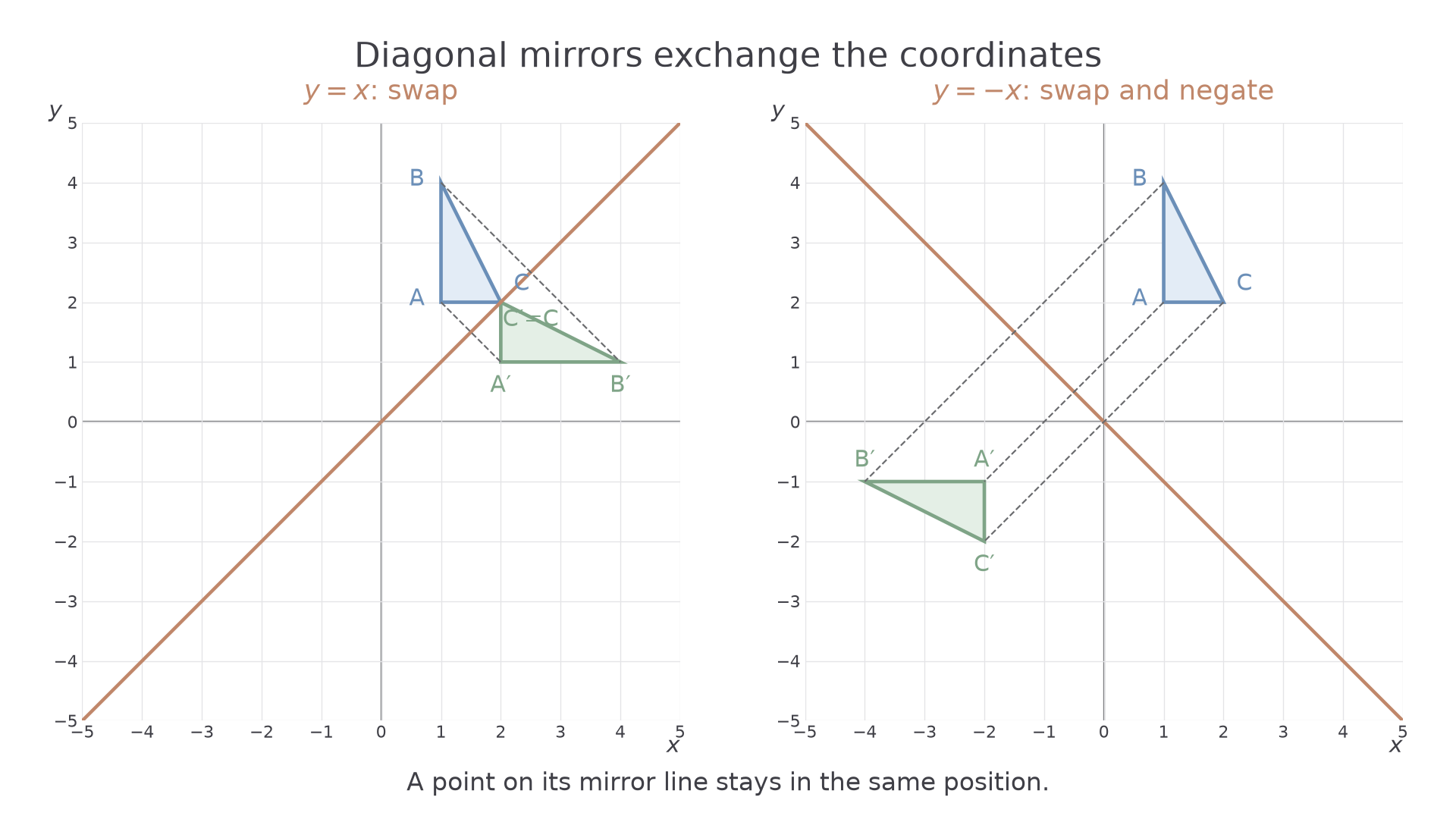
The line runs through points whose coordinates agree, such as , and . Reflection in it swaps horizontal and vertical positions: becomes . Both points are equally far from the diagonal.
[DIAGRAM: asset_name: Reflections in the two diagonal mirrors; asset_slug: aqa8300_g06_diagonal_reflections; caption: Reflection in y equals x swaps coordinates while reflection in y equals minus x swaps and negates them; description: Two coordinate-grid panels show triangle A1comma2 B1comma4 C2comma2. Left its image in y equals x has vertices 2comma1 4comma1 2comma2. Right its image in y equals minus x has vertices minus2comma minus1 minus4comma minus1 minus2comma minus2. Each mirror is clay and the original and image triangles are blue and sage.]
Reflections in the diagonal mirrors
These rules use the stated lines through the origin. A point on the mirror remains fixed.
Not on the formulae sheet: learn it.
A ruler-and-set-square construction gives the same result: draw a perpendicular to the mirror, then copy the distance to the other side. Check every vertex, including any that sit on the mirror.
Worked example 3: swapping the coordinates
Question. Reflect , , in . Non-calculator.
Plan. Swap the two coordinates of each vertex.
Why this step? The mirror exchanges the roles of horizontal and vertical position; it does not change both signs.
Answer. , , .
Check. The midpoint of and is , on ; their joining line is perpendicular to the mirror.
Change only the mirror's slope from positive to negative. You must now negate as well as swap.
Worked example 4: swapping and changing signs
Question. Reflect the same vertices , , in . Non-calculator.
Plan. Make the new first coordinate the negative of the old second, and the new second the negative of the old first.
Why this step? The line is a different mirror. The point , fixed in the previous example, now moves.
Answer. , , .
Check. The midpoint of and is , which lies on .
If you need to identify a mirror, join a vertex to its image. The mirror is the perpendicular bisector of that segment. Check a second corresponding pair before naming the line.
Watch out
Wrong: reflection in sends to . That is a half-turn about the origin. Right: swap the coordinates as well, giving .
Keep the negative signs attached to their original coordinates while swapping in the next question.
Rotating about a centre
A rotation turns every point through the same angle about one fixed centre. It keeps each point the same distance from that centre.
Rotation
A transformation specified by a centre, an angle and a direction, clockwise or anticlockwise. At , either direction gives the same image. A rotation preserves corresponding lengths and angles.
Continue this lesson.
You’re previewing NovaLearn without an account. Create a free account to read the rest.
Create free account