A9 - Equations of straight lines
A gradient tells you a line's direction, but one more piece of information fixes its position. You will use parallel lines, a point and gradient, or two points to work out a straight-line equation. The final part uses perpendicular gradients at Higher tier.
Parallel lines and their gradients
Two lines both rise units for every unit right. One passes through , the other through . Will they ever meet, however far you extend them? Their equations will settle the question.
You already know
For a non-vertical line in the form , is its gradient and its -intercept. Rearrange so that has coefficient before reading these values.
Compare and . At any shared -value, subtracting their heights gives . The gap never closes. That constant gap is why the lines cannot meet; it is not just how the picture looks.
[DIAGRAM: asset_name: Parallel lines keep a fixed separation; asset_slug: aqa8300_a19_parallel; caption: Equal gradients keep the two lines apart at every x-value; description: Equal-scale coordinate axes showing y equals 3x plus 1 and y equals 3x minus 4. Their different y-intercepts are labelled and vertical segments at x equals 0 and x equals 1 each show a height difference of 5.]
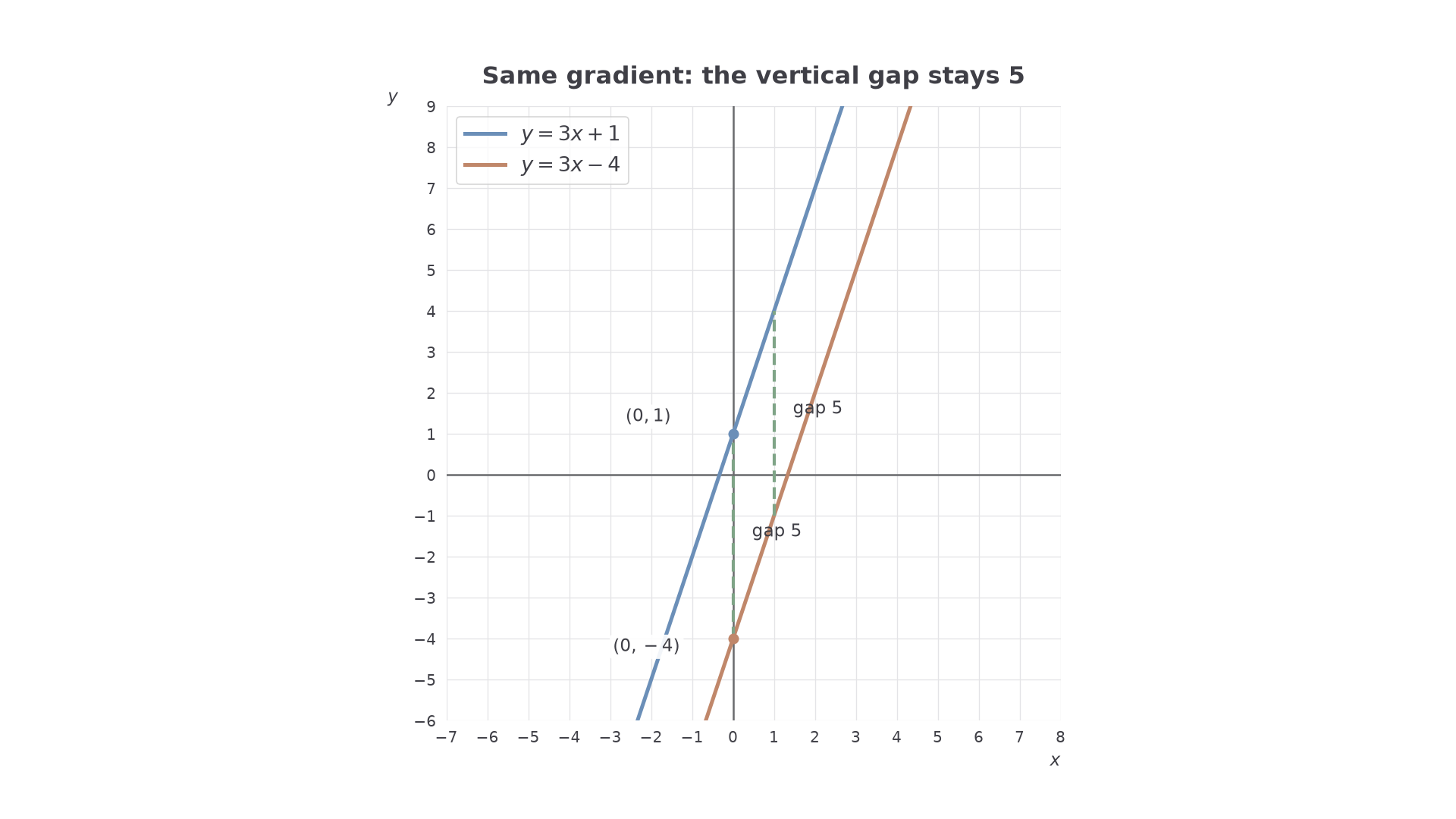
Parallel gradients
Distinct non-vertical straight lines are parallel exactly when their gradients are equal:
In and , equal gradients and equal intercepts give the same line. All vertical lines are parallel to one another.
Not on the formulae sheet: learn it.
A different-looking equation can still describe the same line. Simplify before deciding whether there are two distinct lines.
Worked example 1: matching gradients
Question. Which of these lines is parallel to ? Non-calculator.
Plan. Compare the coefficient of in each equation, with as the subject.
Why this step? Parallel lines have the same rate of rise; the intercept only moves the line's position.
Answer. Line .
Check. 's intercept is , different from , so it is a distinct line with the same gradient.
Change only the form of the given equation. Its gradient is hidden until you rearrange.
Worked example 2: writing a new parallel line
Question. Write down the equation of a line parallel to . Non-calculator.
Plan. Divide by and keep the gradient, choosing a different intercept.
Why this step? A new intercept gives a different line; simply rewriting the given equation does not.
Answer. For example, .
Check. The height difference is always , so the two lines cannot meet.
There are infinitely many possible answers to “a line parallel to”, unless the question also fixes a point or intercept. Write one actual equation with a numerical constant.
Watch out
Wrong: answering for a parallel line to . This is the same line. Right: keep but change the intercept, for example .
Try a new coefficient and make sure your answer names one distinct line.
A line through one point with a given gradient
A gradient fixes the slope. A point fixes which of the parallel lines you want. Start with , put in the known gradient, then substitute the point's two coordinates to work out .
For gradient , all candidates look like . Requiring the line to pass through gives , leaving just unknown. Subtracting from both sides fixes the intercept.
Finding the intercept from a point
For a line of gradient through ,
This is rearranged. It applies to non-vertical lines.
Not on the formulae sheet: learn it.
You can use the original equation directly instead of memorising another arrangement. These examples show the substitution in full.
Worked example 3: a point with positive coordinates
Question. Work out the equation of the line with gradient through . Non-calculator.
Plan. Substitute the point into , solve for , then write the whole equation.
Why this step? A point on the line must make its equation true, so it supplies an equation for the missing constant.
Answer. .
Check. At , , and the coefficient of remains .
Change only the sign of the point's -coordinate. Keep that negative inside brackets.
Worked example 4: a negative coordinate
Question. Work out the equation of the line with gradient through . Non-calculator.
Plan. Substitute into the same family .
Why this step? The point is three units left of the -axis. Moving right to the intercept raises the line by , so its intercept must be higher than .
Answer. .
Check. .
This method also finds a parallel line through a given point: first copy the other line's gradient, then substitute your point.
Watch out
Wrong: using just because the point is . Right: is the height at , not the height at every point. Here substitution gives .
Your answer should finish with an equation, rather than just the value of .
A line through two points
Two points supply both ingredients: their changes give the gradient, then either point gives the intercept. Use the same order in the numerator and denominator of the gradient fraction.
Continue this lesson.
You’re previewing NovaLearn without an account. Create a free account to read the rest.
Create free account