A23, A24 - Sequence rules and special sequences
A sequence is an ordered list with a rule behind it. In A23 you will generate terms from rules and picture patterns. In A24 you will recognise number families, from triangular numbers to sequences that grow by multiplication, and use their patterns to continue them correctly.
Moving from one term to the next
Can a triangle of dots and a triangle of dots fit together to make a square? Keep that puzzle in mind while we learn how the two triangles grow.
Start with . Each number is a term. Its position tells you where it is in the list: is the third term, not the twelfth term. The dots mean that the sequence continues.
You already know
You can add, subtract, multiply and divide signed numbers, and substitute into an expression. A square such as means , while a cube such as has three equal factors.
Here, adding to the current term gives the next term. To generate the sequence, you need both the starting term and the rule. “Add ” alone could also produce .
Term-to-term rule
An instruction that uses a term, or earlier terms, to work out the next term. For example, “start at , then add ” generates .
A sequence with a constant difference is an arithmetic progression, also called an arithmetic or linear sequence. Subtract each term from the next to check the difference. It may be positive, negative or zero. The sequence has difference ; is not arithmetic because its differences change.
Worked example 1: a constant increase
Question. A sequence starts at . Its term-to-term rule is “add ”. Write down the first four terms. Non-calculator.
Plan. Keep the starting number as the first term, then apply the rule three times.
Why this step? Four terms need only three moves: the starting number already counts.
Answer. .
Check. , so the difference is constant.
Now change just the direction: subtract instead of adding it. The method must keep working when the terms pass through zero.
Worked example 2: a constant decrease
Question. A sequence starts at . Its term-to-term rule is “subtract ”. Write down the first four terms. Non-calculator.
Plan. Begin at and subtract at each move.
Why this step? A negative answer does not change the instruction. Subtracting moves another four places left on the number line.
Answer. .
Check. The differences are , and .
These sequence rules are not on the formulae sheet: learn how to use the stated rule. If you are asked for a rule, give an instruction; if you are asked for a term, give a number.
Watch out
For , “” is the next term, not the term-to-term rule. The rule is “multiply by ”. Writing gives a position rule for a different sequence.
Try the decreasing sequence again with a different starting number.
Using positions and picture patterns
A position rule lets you jump straight to a term, without calculating every term before it.
For a row of patterns, label the position first. Pattern , Pattern and Pattern need not contain , and objects. In this picture, each pattern has one fixed tile and a growing group of three tiles for each position number.
[DIAGRAM: asset_name: Tile groups and position numbers; asset_slug: aqa8300_a15_position_tiles; caption: Pattern n has n groups of three blue tiles and one fixed green tile; description: Three separate panels show Pattern 1 with three blue square tiles in one column and one green tile, Pattern 2 with six blue tiles in two columns and one green tile, and Pattern 3 with nine blue tiles in three columns and one green tile. The counts 4, 7 and 10 are printed below the panels. A final line states number of tiles equals 3 times pattern number plus 1.]
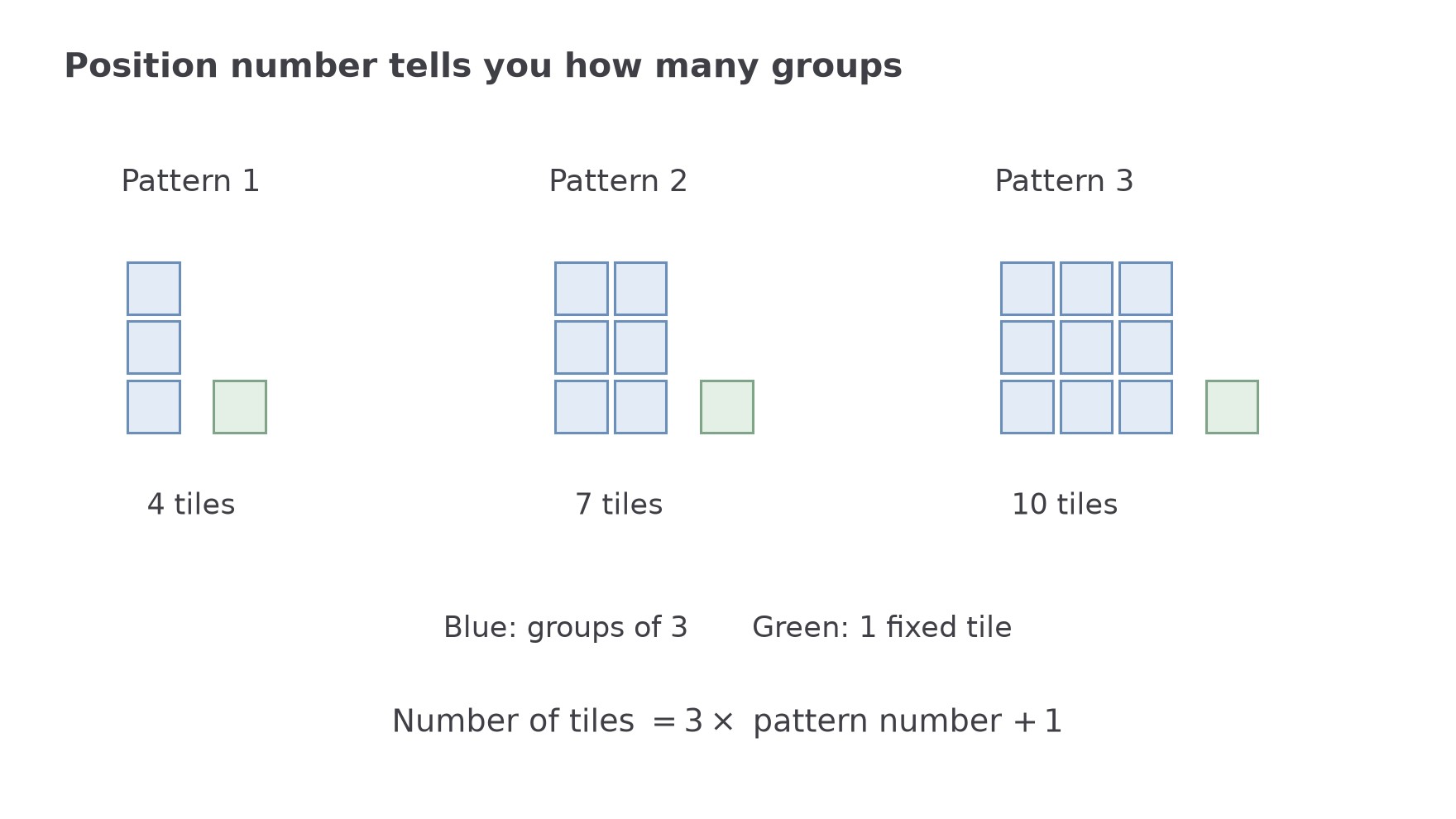
You can count tiles. The given rule “multiply the position by , then add ” also produces those counts.
Position-to-term rule
A rule that takes a term's position as its input and gives the value of that term. The letter usually means the position, starting at unless told otherwise. For example, gives the terms .
Substitution does the calculation. The rule uses the position each time, rather than feeding the last answer back into the rule. A rule in is also called an nth-term rule.
Worked example 3: a rule matching a picture
Question. The number of tiles in Pattern is . Work out the number in Patterns , and . Non-calculator.
Plan. Substitute each pattern number for , multiplying before adding.
Why this step? The input is , not the previous tile count. Eight groups of three tiles make , with one fixed tile left over.
Answer. , and tiles.
Check. From Pattern to Pattern there are six moves, each adding : .
The next example changes only the final operation in the rule. It subtracts one, so the terms are two less than before.
Worked example 4: subtracting after multiplying
Question. A sequence has position-to-term rule . Work out the first three terms and the eighth term. Non-calculator.
Plan. Substitute , , and for .
Why this step? The first three inputs are , regardless of the values the sequence produces.
Answer. The first three terms are . The eighth term is .
Check. Each answer is less than the matching answer from .
A position rule supplied in a question is given in the question; it is not on the formulae sheet. Read any stated starting position carefully.
Watch out
Wrong: use automatically for the first term. Right: use , unless the question explicitly starts the sequence at or another value.
Change the multiplier in the position rule, keeping the final subtraction.
Triangular, square and cube numbers
Some sequences take their names from the shapes their objects can make.
Build a triangle with one dot in its first row, two in its second row, three in its third row, and so on. Adding the next row gives the next triangular number. Square numbers count square arrays; cube numbers count solid cubes built from small unit cubes.
Triangular, square and cube numbers
The positive triangular numbers begin , adding , then , then , and so on. Square numbers are : . Cube numbers are : , for positive integer .
These lists start at . The number is also a square and a cube; it is included only if the sequence's stated starting point includes it. A square number need not have a square-looking final digit: . A cube number need not end in : .
| Position | |||||
|---|---|---|---|---|---|
| Triangular number | |||||
| Square number | |||||
| Cube number |
The opening puzzle has a neat answer. A triangle with five rows has dots. Turn a four-row triangle of dots around and it fills the other half of a -by- square.
[DIAGRAM: asset_name: Neighbouring triangles make a square; asset_slug: aqa8300_a15_triangles_square; caption: The triangular numbers 15 and 10 fit together to make the square number 25; description: On the left a triangular arrangement of 15 blue dots has rows of 1, 2, 3, 4 and 5 dots. In the middle a separate reversed triangle of 10 green dots has rows of 4, 3, 2 and 1 dots. On the right a 5 by 5 array combines the blue lower-left triangle with the green upper-right triangle, with 15 plus 10 equals 25 printed below.]
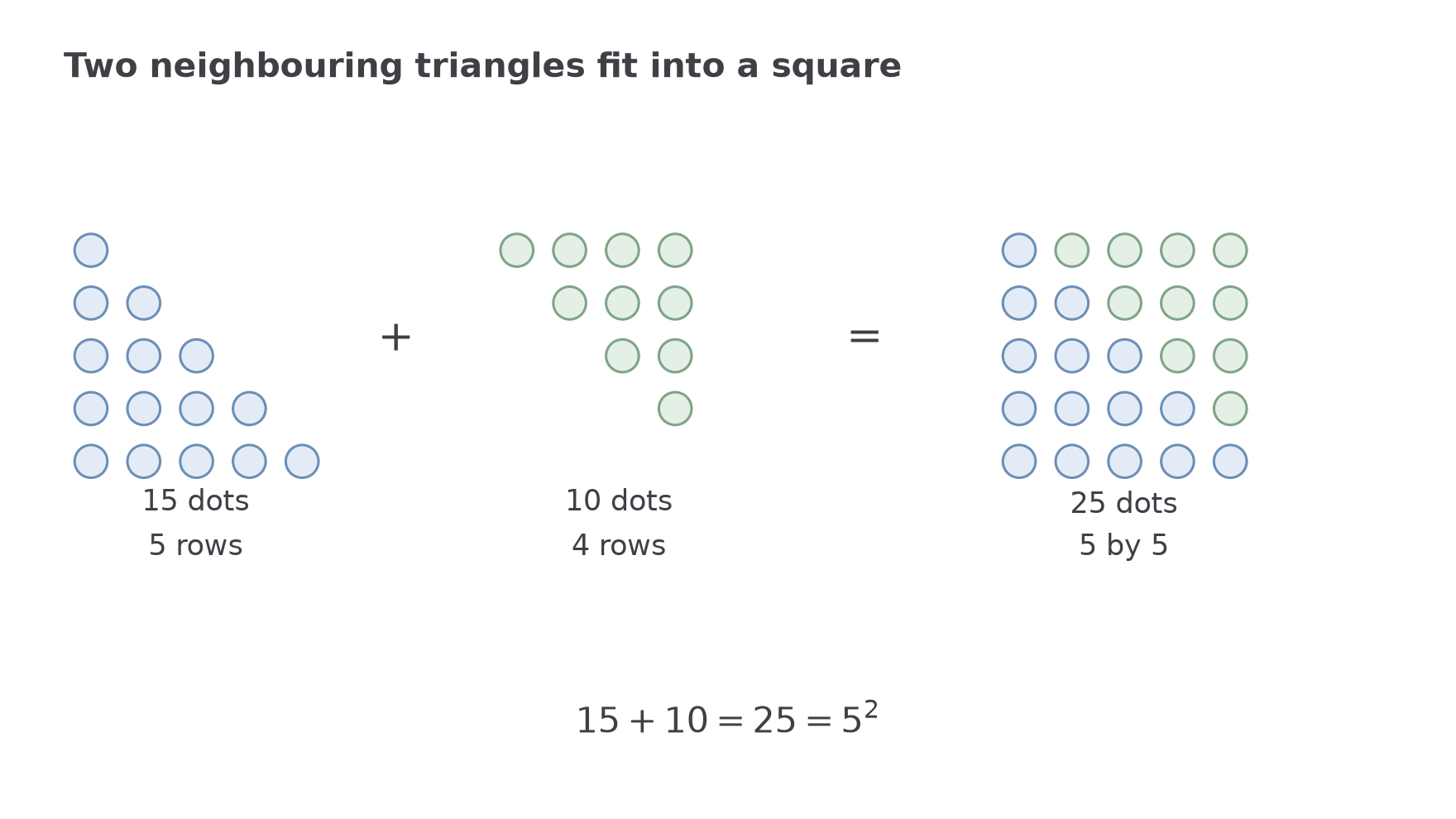
This happens for every pair of neighbouring triangular numbers: one has rows to , and the other fills the gaps of down to . Together they make rows of dots. You do not need a formula for triangular numbers here; counting the rows explains the pattern.
Key idea
Triangular numbers grow by adding the next whole-number row. Square and cube numbers come from raising the position to the second and third powers. These patterns are not on the formulae sheet: learn them.
A number can belong to more than one family. For instance, is triangular, square and cube, and is both triangular and square. Use the calculation, not just the name of one list.
Continue this lesson.
You’re previewing NovaLearn without an account. Create a free account to read the rest.
Create free account