N12 - Fractions and percentages of amounts
A fraction or percentage can tell you what to do to an amount: take half, take three fifths, or take thirty per cent. You will use these instructions as multipliers and choose the right whole when a problem involves a group inside a group.
Fractions as operators
There are pupils in a year group. Three fifths of them cycle to school, and one quarter of those cyclists wear a reflective band. How many cyclists wear a band? The word “of” appears twice: each time, it tells you which amount to work on. We will return to the second step after making the first one secure.
You already know
A denominator tells you how many equal parts make one whole; a numerator tells you how many of those parts to take. Multiplying by a fraction means dividing by its denominator and multiplying by its numerator.
To find of , divide into five equal parts. Each part is . Taking three of those parts gives . Here the fraction is an instruction that acts on the amount.
Operator
A rule that acts on an input amount to produce an output amount. As a fraction operator, means “multiply by ”. For example, of is . It does not mean subtract from .
You can multiply first and divide afterwards, but dividing first often keeps the numbers smaller. Both orders give the same answer.
A fraction of an amount
For a whole-number denominator ,
The amount being divided is the whole named after “of”.
Not on the formulae sheet: learn it.
The first example uses a proper fraction, so the answer should be smaller than the positive amount you start with.
Worked example 1: taking three equal parts
Question. Work out of . Do not use a calculator.
Plan. Find one fifth by dividing by , then take three fifths.
Why this step? Divide by the denominator, , because five equal parts make the whole. Dividing by the numerator would make the wrong-sized parts.
Answer.
Check. Three fifths is more than a half and less than one whole. The answer is between and .
The next example changes only the numerator, from to . There are now more than five fifths, so the output is larger than the input.
Worked example 2: an improper fraction operator
Question. Work out of . Do not use a calculator.
Plan. Keep the same fifth, , and take seven of them.
Why this step? An operator greater than makes a positive amount larger. The word “fraction” does not mean the answer must be smaller.
Answer.
Check. , so the answer is .
Compare the fraction with before doing any arithmetic. It gives you a useful size check.
Watch out
Wrong: of . This reverses the two jobs. Right: .
The next amount has the same denominator but a different number of parts to take.
Percentages without a calculator
A percentage is a fraction with denominator , so it can also act on an amount.
Percentage
“Per cent” means “out of one hundred”. As an operator, means multiply by , which is . For example, of an amount means half of it, not added to it.
Start with easy pieces. To find , divide by ; to find , divide by . Halving gives . These pieces combine to make less familiar percentages without a calculator.
Useful percentage pieces
For any amount,
The last line divides by , then by : it halves .
Not on the formulae sheet: learn it.
Choose pieces that add to the requested percentage. Work out their amounts before adding them.
Worked example 3: building thirty-five per cent
Question. Work out of . Do not use a calculator.
Plan. Use , building both pieces from .
Why this step? is half of , so halve , not . Halving the original amount would give .
Answer.
Check. is between and . The answer is between and .
The next example changes only the percentage to . Keep the same and pieces; choose a different multiple of .
Worked example 4: reusing the same pieces
Question. Work out of . Do not use a calculator.
Plan. Add and of the same amount.
Why this step? Both percentages refer to the original . The is not taken from the amount.
Answer.
Check. , and .
The arithmetic must follow the meaning of the percentage, rather than the digits in its name.
Watch out
Wrong: of . That calculation finds one fifth, which is . Right: is half of , so it is .
Show your easy pieces in a non-calculator solution. A correct method can still earn marks if the final addition slips.
Percentage multipliers
A decimal multiplier takes the place of all those separate percentage pieces in one multiplication.
For of , you need of . The fraction equals , so multiply by . The is the multiplier: the number by which you multiply the original amount.
A percentage of an amount
For a percentage ,
The multiplier is . This also works when is a decimal, such as .
Not on the formulae sheet: learn it.
There is a neat reversal hidden in this rule: of and of are both . Each is . Swapping the two numbers leaves the product unchanged. It can turn an awkward calculation into an easy one.
Worked example 5: using a decimal multiplier
Question. A mixture has mass . of its mass is flour. Work out the mass of flour. A calculator may be used.
Plan. Divide the percentage by , then multiply the full mass by that decimal.
Why this step? Multiplying by takes hundredths of the mass. Multiplying by would give times too much.
Answer.
Check. of is , so is a sensible slightly smaller answer.
The next example changes only the percentage, to one with a decimal part. Dividing by still means moving the digits two places right.
Worked example 6: a decimal percentage
Question. A mixture has mass . of its mass is flour. Work out the mass of flour. A calculator may be used.
Plan. Use as the multiplier, keeping all its decimal places.
Why this step? The percentage has a decimal already, but it still needs dividing by . The multiplier is , not or .
Answer.
Check. , and .
You can use fraction, percentage or decimal notation for the same operator. Choose the form that makes the calculation easiest.
Watch out
Wrong: . Right: . Half a per cent is one two-hundredth of an amount; of it is a half.
Before pressing equals, compare the multiplier with . These percentages are less than , so the mass of flour must be less than the full mass.
Taking a fraction or percentage of a group
In a problem with several groups, the most important choice is the amount that each operator acts on.
Return to the opening year group. First, acts on all pupils and gives cyclists. Then , or , acts on those cyclists. It does not act on the whole year group.
[DIAGRAM: asset_name: Two operators and two different inputs; asset_slug: aqa8300_n21_subgroup_operators; caption: The second operator acts on 144 cyclists, not on all 240 pupils; description: Three boxes connected left to right. The first says all pupils, 240. An arrow labelled times three fifths leads to a blue box saying cyclists, 144. A second arrow labelled times one quarter, also 25 per cent, leads to a sage box saying cyclists with bands, 36. Beneath the first arrow the text reads first input 240, while beneath the second it reads second input 144.]
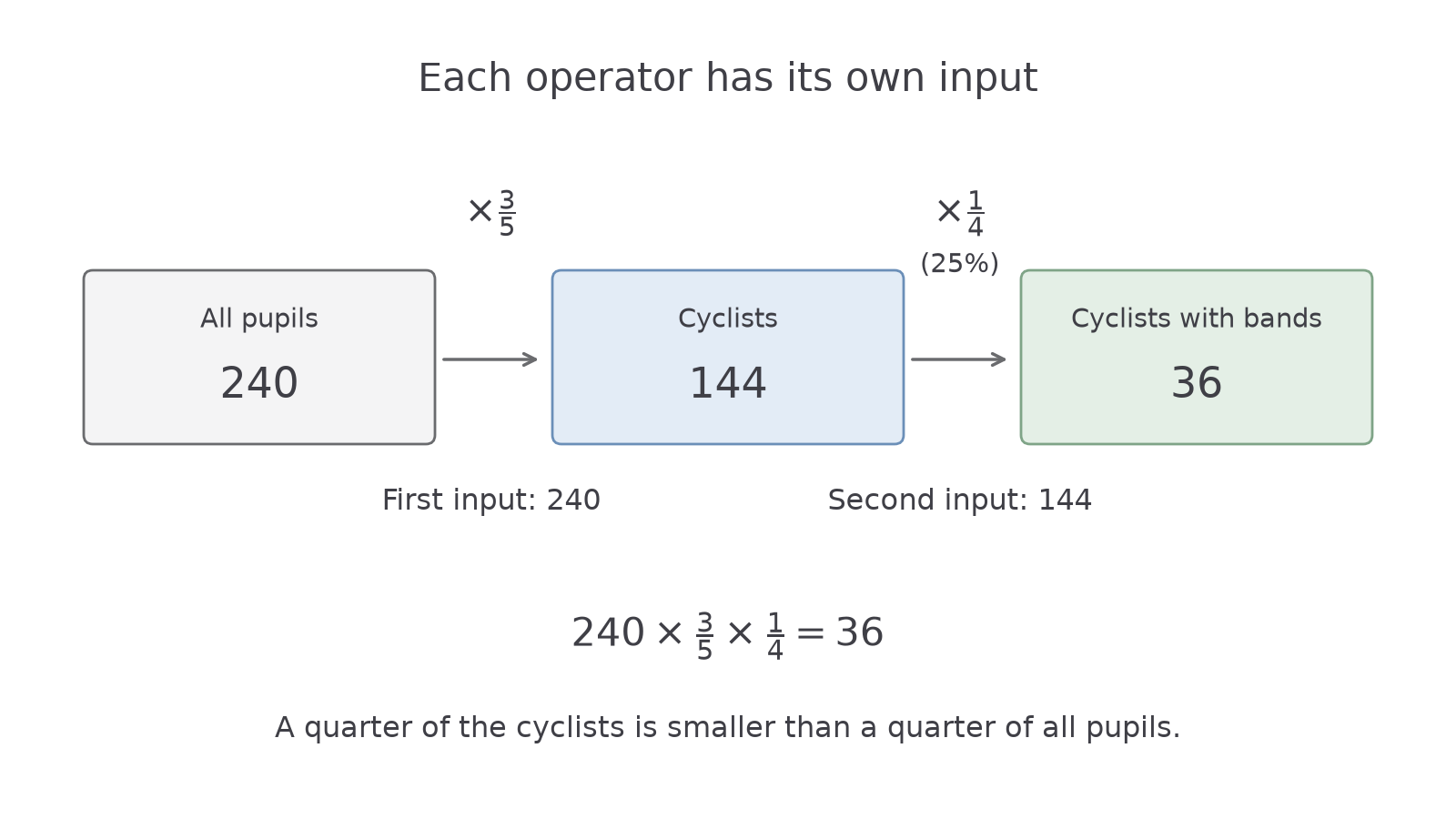
The steps can be written as . It is often clearer to calculate and label the intermediate amount first. For positive fractions smaller than , the final subgroup must be smaller than either group it came from.
Worked example 7: a quarter of the cyclists
Question. There are pupils in a year group. cycle to school. of the cyclists wear a reflective band. Work out how many cyclists wear a reflective band. Do not use a calculator.
Plan. Find the cyclists first, then take a quarter of that group.
Why this step? “Of the cyclists” names the input for . Using again would count a quarter of the wrong group.
Answer. cyclists wear a reflective band.
Check. , and , so both stages reverse correctly.
The next example changes only which group the percentage describes. You must now find the pupils who do not cycle before applying .
Worked example 8: a quarter of the other group
Question. There are pupils in a year group. cycle to school. of the pupils who do not cycle wear a reflective band. Work out how many pupils who do not cycle wear a reflective band. Do not use a calculator.
Plan. Subtract the cyclists from the whole year group, then take a quarter of the remaining pupils.
Why this step? The percentage is unchanged, but its input is now , not . A percentage on its own does not tell you an amount.
Answer. pupils who do not cycle wear a reflective band.
Check. , and .
Adding the two operator values does not apply one to the result of the other.
Watch out
Wrong: a quarter of three fifths of a group means taking of it. Right: take first, then of that result. The combined fraction is .
Before calculating the final question, underline the words that name the input for .
Quick Recap
- A fraction operator divides an amount into equal parts, then takes the required number of parts.
- Build non-calculator percentages from useful pieces such as , and .
- The multiplier for of an amount is .
- Each “of” names an input. A percentage of a subgroup acts on that subgroup, not automatically on the original whole.
In the opening year group, of is cyclists, and of is cyclists with bands.