A12 - Graphs of sin, cos and tan (Higher)
Sine, cosine and tangent continue beyond the acute angles inside right triangles. You will recognise, sketch and interpret their graphs for angles in degrees, including negative angles and angles larger than a full turn. Their repeating patterns let a small set of exact values describe infinitely many points.
The sine graph and angles of any size
A calculator gives and . Is it ignoring the extra , or do those turns really leave the value unchanged? A moving point on a circle explains the pattern.
You already know
For acute angles, sine and cosine come from right-triangle ratios. You know the exact values at . Coordinate graphs pair each input with an output.
Imagine a circle of radius , centred at the origin. Start at . Measure a positive angle anticlockwise from the positive -axis; measure a negative angle clockwise. After turning through angle , the point has coordinates . In the first quadrant, dropping a perpendicular makes a right triangle with hypotenuse , so this agrees with the ratios you already know. The circle extends the meaning to every angle.
[DIAGRAM: asset_name: Circle coordinates extend sine and cosine; asset_slug: aqa8300_g23_circle; caption: Sine is the vertical coordinate and cosine is the horizontal coordinate of the point on a unit circle; description: Equal-scale axes and a circle of radius 1 with point P at angle 150 degrees measured anticlockwise from the positive x-axis. A radius OP and clear angle arc are shown, with dashed perpendiculars to the axes. Coordinates are labelled cosine 150 equals minus square root 3 over 2 and sine 150 equals one half. The negative horizontal coordinate is blue and positive vertical coordinate sage.]
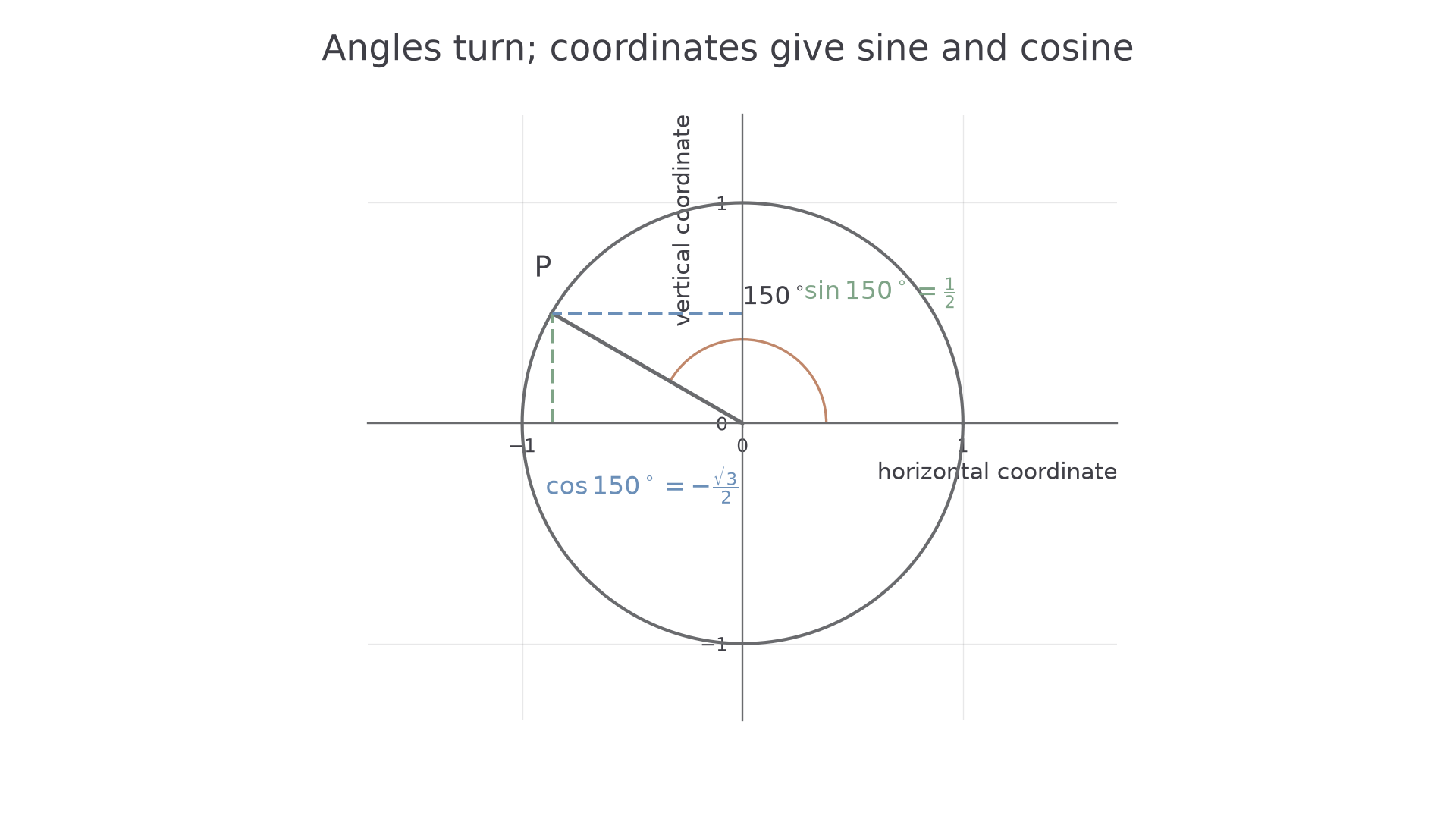
The vertical coordinate rises from to , falls through to , then returns to during one full turn. Sine is positive above the horizontal axis and negative below it.
Period
A function is periodic when its output pattern repeats after a fixed positive input interval. Its period is the smallest such interval. For sine, adding returns the moving point to the same position.
The graph records that vertical motion. Smooth curves join the key points; straight segments would miss its shape near the turning points.
[DIAGRAM: asset_name: Sine repeats every 360 degrees; asset_slug: aqa8300_g23_sine; caption: The sine wave crosses zero at multiples of 180 degrees and repeats after every full turn; description: A smooth y equals sin x graph from minus 360 to 720 degrees, with horizontal ticks every 90 degrees, vertical ticks minus 1,0,1, and labelled degree axis. Key points over one cycle 0,0;90,1;180,0;270,minus1;360,0 are highlighted. A double-headed arrow marks the 360 degree period.]
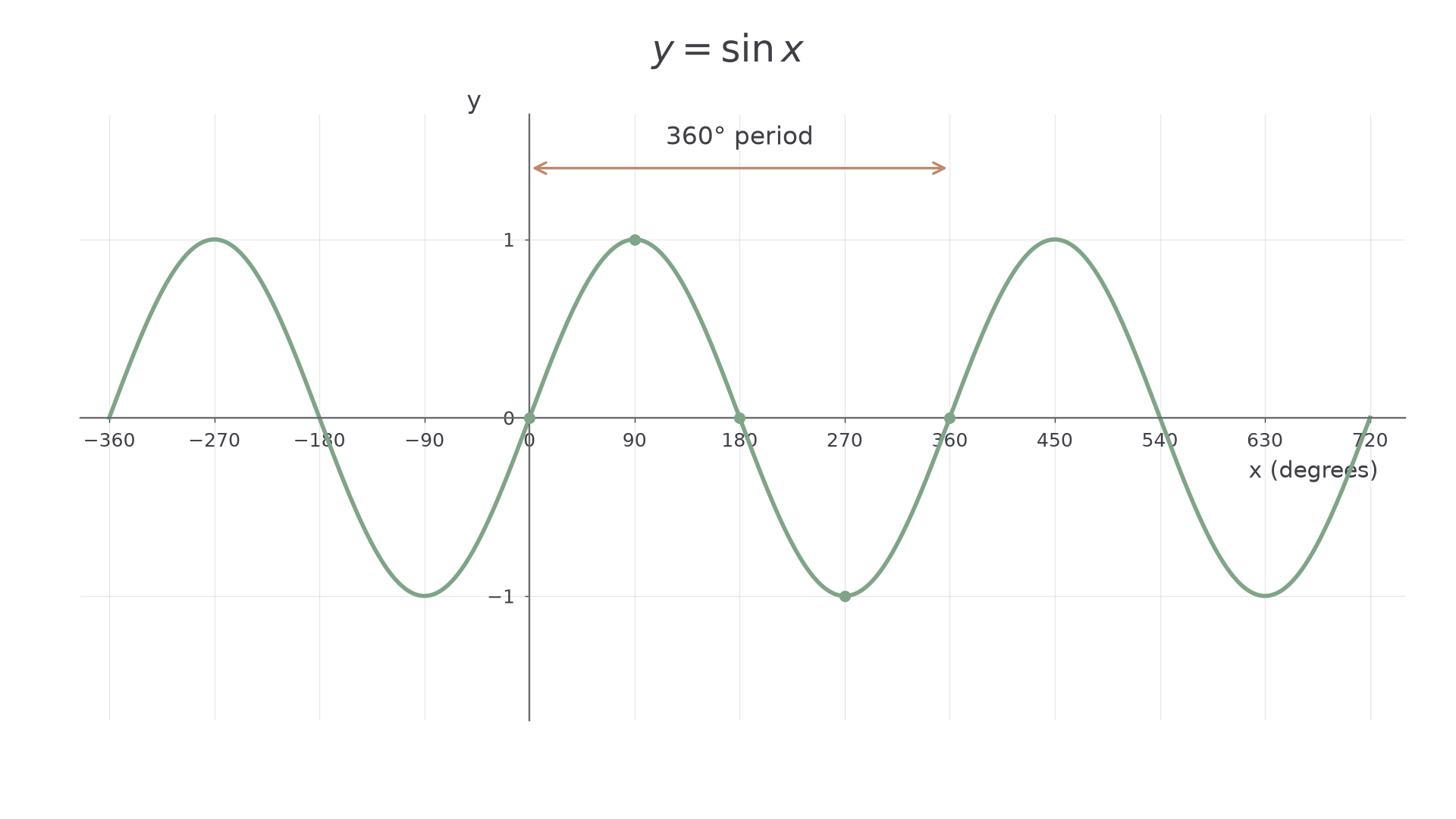
For a sketch, mark the key points first, then draw a smooth wave with horizontal tangents at its maximum and minimum.
Sine graph facts
For , with in degrees,
One cycle passes through . Inputs are angles in degrees; outputs are ratios, not angles.
Not on the formulae sheet: learn it.
Use a full turn to bring an angle into a cycle whose position you recognise.
Worked example 1: beyond one turn
Question. Non-calculator. Work out .
Plan. Remove one full turn and use an exact value.
Why this step? One full turn changes the angle travelled, but not the final vertical coordinate.
Answer. .
Check. lies between and , on the positive rising section of the next cycle.
Change the angle to a negative one. Add a full turn instead of subtracting one.
Worked example 2: a clockwise turn
Question. Non-calculator. Work out .
Plan. Find the equivalent position between and , then use its height and sign.
Why this step? At , the point is past the negative horizontal axis. Its height has magnitude and is negative.
Answer. .
Check. The sine graph is below its axis between and . Reflecting a rotation across the horizontal axis reverses the sine's sign.
A graph's input scale matters: a full cycle occupies degrees, whatever physical width it occupies on the page.
Watch out
Wrong: “Sine cannot be negative because a side length cannot be negative.” Right: the right-triangle ratio describes acute angles. For wider rotations, sine is a signed coordinate and can be negative.
Use full turns and the circle's quadrant to check the signs.
The cosine graph
Cosine records the horizontal coordinate of the same moving point. It starts at , reaches after a quarter-turn, then after half a turn. It is positive on the right half of the circle and negative on the left.
[DIAGRAM: asset_name: Cosine begins at its maximum; asset_slug: aqa8300_g23_cosine; caption: Cosine has the same wave shape as sine but starts at 1 when the angle is zero; description: A smooth y equals cos x graph from minus 360 to 720 degrees, with degree ticks every 90 and vertical ticks minus 1,0,1. Highlighted points over a cycle are 0,1;90,0;180,minus1;270,0;360,1. A faint dashed sine curve gives a labelled comparison, and a double arrow shows one 360 degree cycle.]
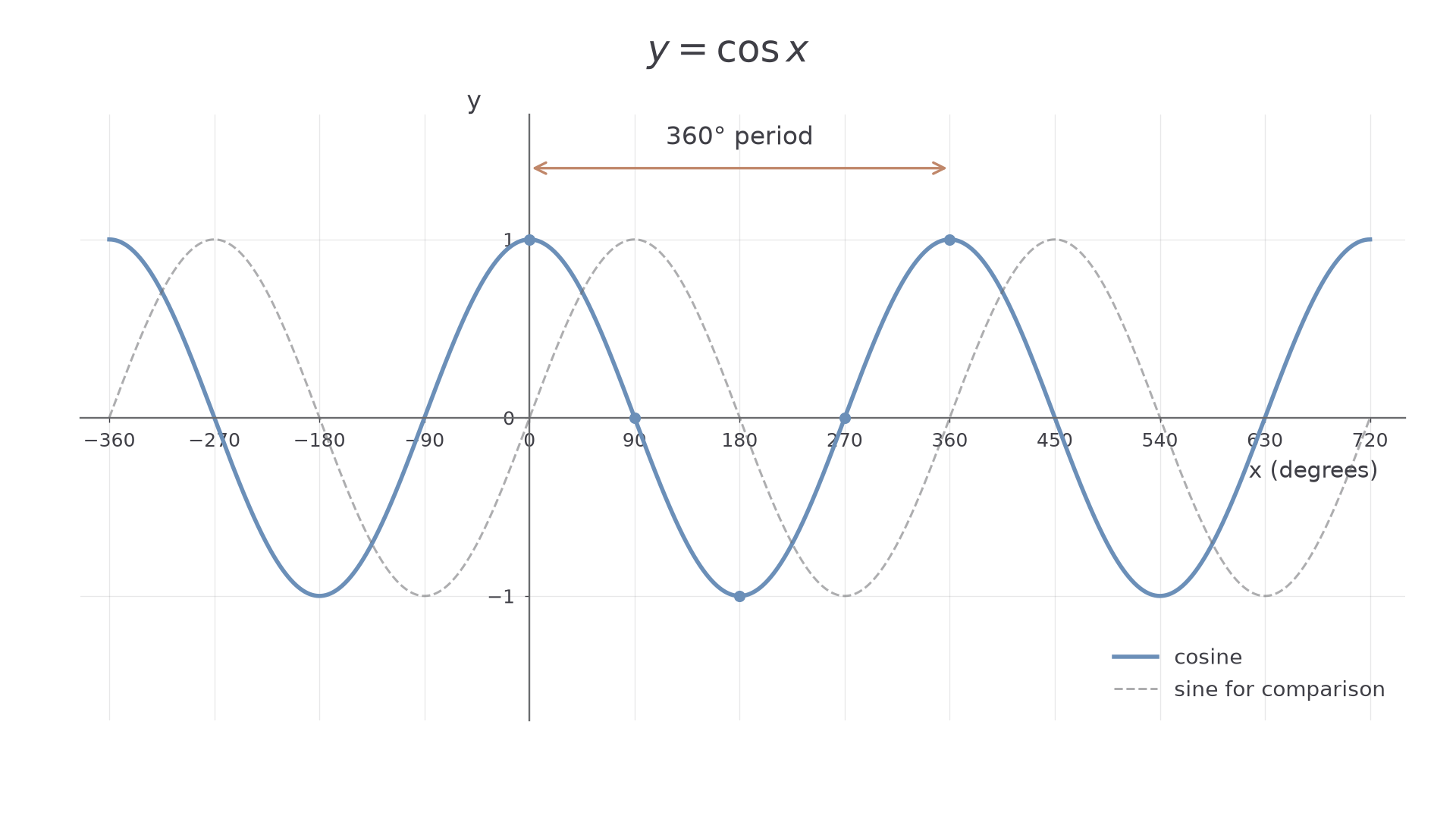
A surprising connection is visible here: the two different triangle ratios make the same wave, a quarter-turn apart. Cosine at any angle equals sine later. You can see this from the moving point's two perpendicular coordinates or compare the graphs.
Cosine graph facts
For , with in degrees,
One cycle passes through . Cosine is symmetric about the vertical axis: .
Not on the formulae sheet: learn it.
Continue this lesson.
You’re previewing NovaLearn without an account. Create a free account to read the rest.
Create free account