N1, N2 - Equivalent fractions, mixed numbers and ordering
Fractions describe equal parts of a whole, but the same amount can have many different fraction names. You will use N2 to make equivalent fractions, simplify them and change between improper fractions and mixed numbers. You will then use N1 to compare and order fractions, including negative fractions, without relying on rounded decimals.
Equal parts and equivalent fractions
Two identical bottles are filled to and of their capacities. Which holds more? Comparing just the top numbers or just the bottom numbers will not settle it. We need a way to describe both amounts using equal-sized parts.
You already know
A whole can be divided into equal parts. Multiplying or dividing both numbers in a division by the same non-zero number leaves its value unchanged. Common multiples help you choose a shared scale.
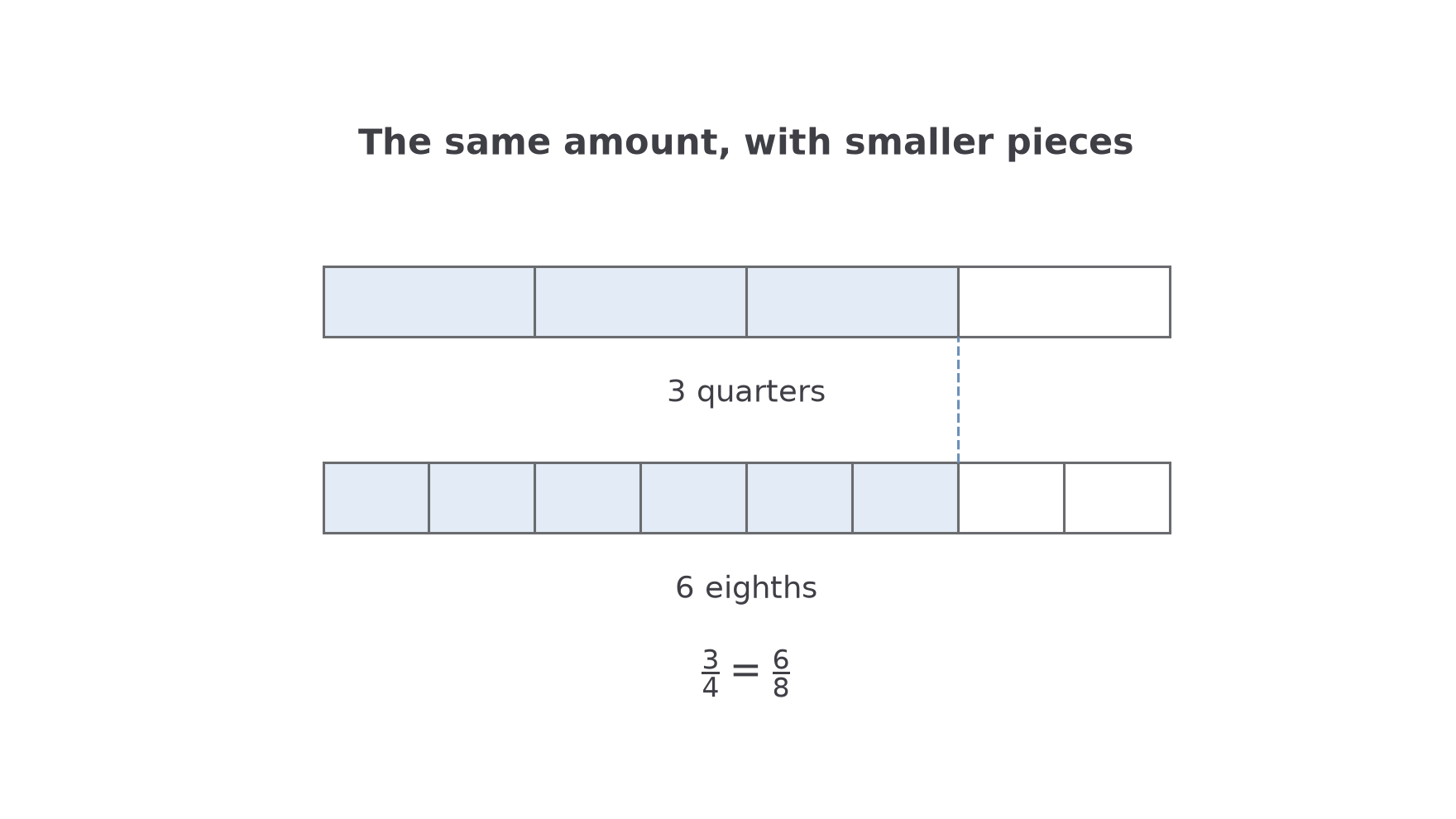
If a bar is split into equal parts and are shaded, the shaded fraction is . Split every quarter into two equal pieces: now of pieces are shaded. The shaded amount has not changed.
[DIAGRAM: asset_name: Three quarters is six eighths; asset_slug: aqa8300_n06_equivalent_strips; caption: Splitting every quarter in two changes 3 shaded parts out of 4 into 6 shaded parts out of 8, with the same shaded length; description: Two equal-length horizontal strips aligned at both ends. The upper is split into four equal boxes, three filled pale blue. The lower is split into eight equal boxes, six filled pale blue. Dashed lines connect the boundary at three quarters in each strip. Labels show 3 quarters and 6 eighths.]
Numerator, denominator and equivalent fractions
In , the numerator counts parts and the denominator tells how many equal parts make one whole. The denominator cannot be zero. Equivalent fractions have the same value, such as and . Not an example: and , which name different amounts.
The pieces must be equal in size, and comparisons of amounts need the same whole. Half of a large cake can exceed three quarters of a small cake; that does not make greater than .
Making an equivalent fraction
For and ,
Multiply both numerator and denominator by the same number. You can also divide both by the same non-zero common factor.
Not on the formulae sheet: learn it.
A missing denominator or numerator is a scaling question: find what happened to one, then do the same to the other.
Worked example 1: scaling to a denominator of 20
Question. Complete .
Plan. Find the multiplier that changes to , then apply it to .
Why multiply both? Each original fifth becomes four twentieths; the fifths therefore become twentieths.
Answer. .
Check. Dividing and by returns .
The next example changes only the target denominator. The scale factor must be found again.
Worked example 2: scaling to a denominator of 35
Question. Complete .
Plan. Change to , then make the same change to the numerator.
Why not reuse the previous multiplier? The target parts are now thirty-fifths, so there are in each fifth, not .
Answer. .
Check. and .
Equivalent fractions have the same point on a number line. This is why a common denominator can later help you compare them.
Watch out
Wrong: , from adding to the top and bottom. Right: scaling means multiplying or dividing both by the same factor. Adding the same amount does not preserve a fraction's value.
Keep the denominator , but change the starting fraction.
Fractions in simplest form
A fraction is simpler when its top and bottom have no common factor greater than . The amount stays the same; only the way you count its parts changes.
For example, , because dividing the top and bottom by groups the small parts into larger equal pieces. The fraction is equivalent too, but is not yet simplest: both numbers still divide by .
Simplest form
A fraction with integer numerator and positive integer denominator is in simplest form when their highest common factor is , ignoring a minus sign. For example, and are in simplest form. Not an example: , because divides both numbers.
To finish in one step, divide both numbers by their HCF. You may instead use smaller common factors repeatedly, provided you keep going until none remains. The simplification method is not on the formulae sheet: learn it.
Worked example 3: simplifying in one step
Question. Write in its simplest form.
Plan. Find the HCF of and , then divide both by it.
Why divide by ? It removes all shared prime factors at once.
Answer. .
Check. and have HCF , and multiplying both by restores .
The next example changes only the denominator. The common factor happens to remain , but the fraction's value changes.
Worked example 4: the same numerator, a different whole split
Question. Write in its simplest form.
Plan. Divide the numerator and denominator by their HCF.
Why is the answer now ? The same parts are counted out of , rather than ; each part is smaller.
Answer. .
Check. and have no common factor above ; and .
A negative sign stays with the value: . A zero numerator gives zero when the denominator is non-zero, so . A zero denominator is never allowed. The fraction is , since one complete set of seven sevenths makes a whole.
Watch out
Wrong: , from dividing only the numerator by . Right: . Every simplification step changes both numbers by the same factor.
Change the denominator once more and finish the simplification completely.
Proper fractions, improper fractions and mixed numbers
Five quarters mean one complete whole and one quarter left: . Fractions can describe more than one whole, and mixed numbers give another way to write that same amount.
Proper fraction, improper fraction and mixed number
For positive fractions, a proper fraction has numerator smaller than denominator, so its value is below . An improper fraction has numerator at least as large as denominator, so its value is at least . A mixed number combines a whole number with a proper fraction. For example, is proper, is improper, and is mixed. The fraction is improper and equals .
To turn an improper fraction into a mixed number, count complete groups of the denominator. The remainder is still measured in parts of that same denominator. To go back, turn each whole into that many parts, then add the remaining parts. These conversion methods are not on the formulae sheet: learn them.
Worked example 5: improper fraction to mixed number
Question. Write as a mixed number.
Plan. Count complete groups of four quarters and keep the remainder as quarters.
Why keep the denominator ? The leftover pieces are still quarters; grouping complete wholes does not resize them.
Answer. .
Check. wholes use quarters; quarters altogether.
The next example changes only the direction of conversion. Start with the mixed form and recover the improper fraction.
Worked example 6: mixed number to improper fraction
Question. Write as an improper fraction.
Plan. Change each whole to four quarters and add the three extra quarters.
Why multiply the whole number by the denominator? The denominator counts the parts in each whole, so wholes contain parts.
Answer. .
Check. gives remainder , returning .
A negative mixed number means the negative of the entire amount. Thus , not . You can convert its positive size first, then restore the negative sign. For instance, .
Watch out
Wrong: . That counts only two quarters instead of two wholes. Right: .
Use the same counting-of-parts idea with fifths.
Comparing fractions with a common denominator
Two fractions are easy to compare when their pieces have the same size. Five twelfths is more than three twelfths because there are more of the same parts.
A larger denominator by itself does not mean a larger fraction. One third is greater than one fifth: a whole split into three equal parts gives larger pieces than a whole split into five. To compare fractions with different numerators too, change them to a common denominator, a shared multiple of the original denominators. The LCM usually gives the smallest convenient denominator.
The rule is simple: for fractions with the same positive denominator, compare the numerators. The common-denominator comparison method is not on the formulae sheet: learn it.
Worked example 7: denominators with a common factor
Question. Which is greater, or ? Give a reason.
Plan. Use the LCM of and , which is .
Why use ? Both fractions can be written exactly in twenty-fourths, so no rounded decimal is needed.
Answer. , because twenty-fourths is greater than twenty-fourths.
Check. The difference is only one twenty-fourth; the fractions should be close, with just larger.
The next example changes only the second fraction. A different denominator still fits the same common scale of .
Worked example 8: the same first fraction, a new comparison
Question. Which is greater, or ? Give a reason.
Plan. Change both fractions to twenty-fourths again.
Why can the comparison change? The first fraction is fixed, but contains one more twenty-fourth than it does.
Answer. .
Check. , which is greater than the in the previous example.
The bottle question now has a short exact answer: and , so the bottle filled to holds more. The bottles must have the same capacity for that comparison of actual amounts.
Watch out
Wrong: “ is greater than because .” The numerators count different-sized parts. Right: compare and , giving .
Keep the first fraction and change the second again.
Ordering positive and negative fractions
A negative fraction lies to the left of zero. Compare its distance from zero using equivalent fractions, then remember that the further-left point is the smaller number.
You already know
Every negative number is smaller than zero, and every positive number is larger than zero. Among negative numbers, a larger distance from zero gives a smaller number. You now know how to compare fractional distances exactly.
For example, and . Their negative versions are and ; the first lies further left.
[DIAGRAM: asset_name: Negative fractions in twelfths; asset_slug: aqa8300_n06_negative_fractions; caption: Minus three quarters is minus nine twelfths and lies to the left of minus two thirds, which is minus eight twelfths; description: A number line from minus 1 to 0 with twelve equal intervals. Blue and clay points mark minus nine twelfths and minus eight twelfths, labelled minus three quarters and minus two thirds. All twelfth ticks are visible, with zero and minus 1 labelled and an arrow pointing right labelled larger.]
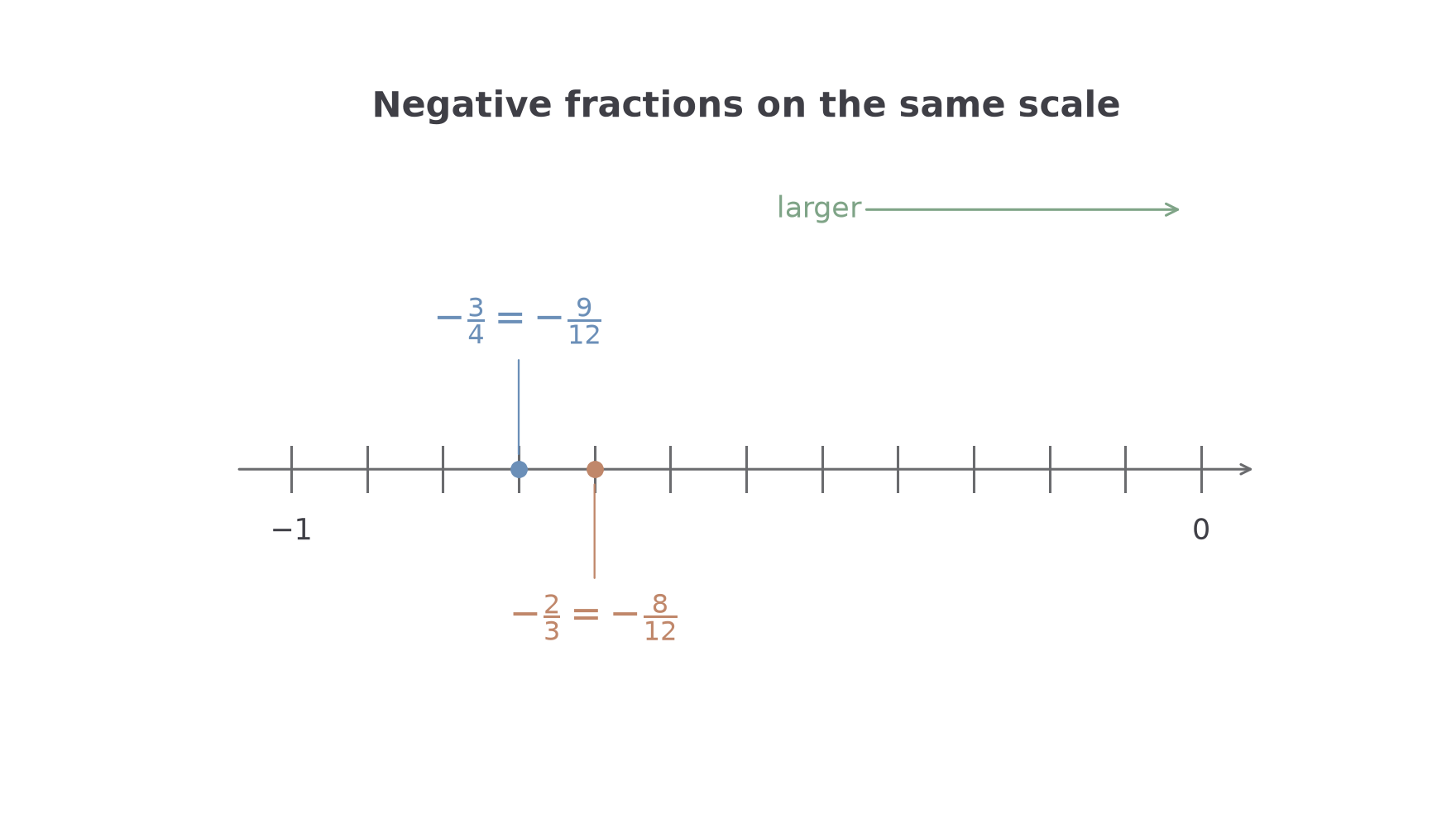
Using one positive common denominator lets you compare signed numerators directly. Thus gives . This signed-fraction method is not on the formulae sheet: learn it.
Worked example 9: comparing two negative fractions
Question. Complete the statement using , or : .
Plan. Write both fractions in twelfths and compare their signed numerators.
Why does the larger positive size give the smaller negative value? It places the point further left of zero.
Answer. .
Check. The number line places one twelfth to the left of .
The next example changes only the size of the list. Add another negative fraction and a positive fraction, keeping the common denominator .
Worked example 10: ordering a mixed-sign list
Question. Write these numbers in order of size. Start with the smallest number.
Plan. Write all four in twelfths and sort their signed numerators.
Why put the positive fraction last? Every negative fraction is below zero, while is above it.
Answer. , , , .
Check. Reading the first three as distances from zero gives descending sizes: , , .
Here is a useful surprise about denominators: , yet . Larger denominators can appear in a rising list or a falling list. What happens to the numerator matters too.
Watch out
Wrong: because . The negative comparison runs the other way. Right: , since when both are in twelfths.
The next list uses eighths. Return the original fraction forms in the requested order.
Quick Recap
- Equivalent fractions have the same value: multiply or divide top and bottom by the same non-zero number.
- Divide by the HCF to reach simplest form in one step.
- For improper and mixed forms, count complete wholes and keep the remaining parts in their original size.
- Compare fractions using a common positive denominator, then compare their numerators.
- For negative fractions, further left means smaller; compare signed numerators on the same scale.
Of the two identical bottles, the one filled to holds more, because .