G19 - Similar areas and volumes (Higher)
Connect the length, area and volume ratios of similar shapes and solids. You will square or cube a length factor, reverse those steps with roots, and choose which kind of scale a context needs.
Area scale factors
A small jug holds . A second jug has a similar interior, larger in every internal length. Does it hold just , or rather more? The extra width and depth matter as well as the extra height.
You already know
Similar shapes have equal corresponding angles and one factor for all corresponding lengths. Compare measurements in the same units and keep the ratio direction consistent. Length scale factors may be fractional.
Start with a rectangle by , with area . Doubling both lengths gives by , with area . The area has multiplied by , not , because two length factors have doubled.
[DIAGRAM: asset_name: Doubling lengths quadruples area; asset_slug: aqa8300_g24_area_scaling; caption: A factor of 2 in each direction makes 4 times as many unit squares; description: Equal-scale grids show a 3 cm by 2 cm rectangle containing 6 unit squares and a similar 6 cm by 4 cm rectangle containing 24 unit squares. Blue marks the smaller rectangle and sage the larger one. Labels give length factor 2 and area factor 4. The same unit-square size is used in both.]
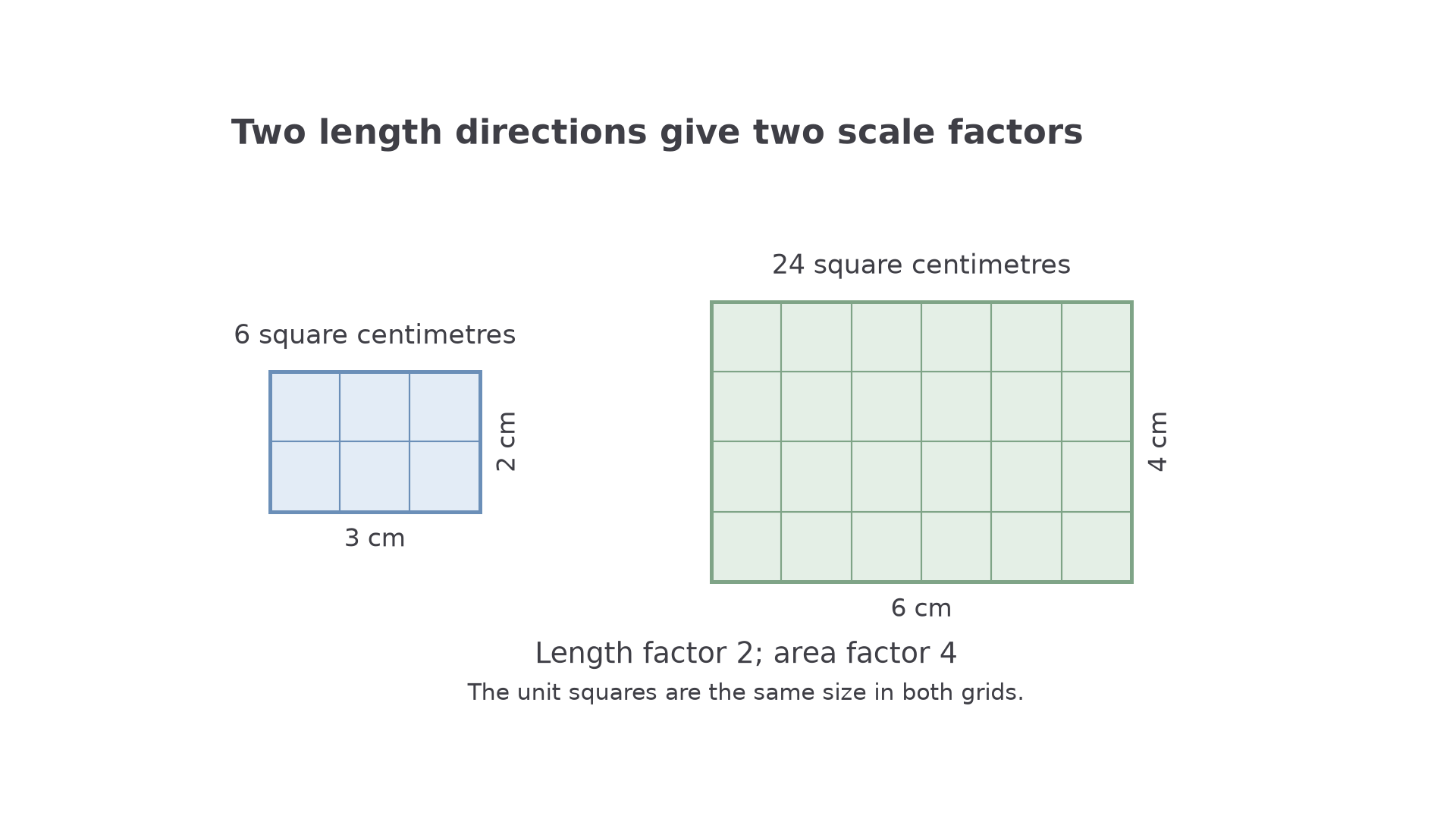
The same reasoning works for triangles: . Circles give . A more complicated shape can be split into pieces, each gaining the same area factor.
Similar area scale factor
For similar shapes with positive length scale factor ,
If corresponding lengths are in ratio , corresponding areas are in ratio . The rule also applies to corresponding surface areas of similar solids.
Not on the formulae sheet: learn it.
Use an actual pair of matching lengths to find , rather than taking a ratio of unrelated measurements.
Worked example 1: enlarging an area
Question. Non-calculator. Two similar triangles have corresponding side lengths and . The smaller triangle has area . Work out the larger area.
Plan. Find the length factor, square it, then scale the smaller area.
Why this step? Both the triangle's base and its perpendicular height grow by , so the area gains that factor twice.
Answer. .
Check. , the square of the length ratio .
Worked example 2 reverses the direction: the known area belongs to the larger shape. Use a factor less than , then square that factor.
Worked example 2: finding a smaller area
Question. Calculator allowed. Two similar panels have corresponding lengths and . The larger panel has area . Work out the smaller area.
Plan. Use the length factor from larger to smaller.
Why this step? Squaring gives , not . Both the numerator and denominator describe length changes.
Answer. .
Check. , so the smaller area is of the larger one.
Similarity is essential. Two unrelated rectangles can have equal perimeters while their areas differ; a perimeter ratio alone does not make them similar.
Watch out
Wrong: “The sides are times as long, so the area is times as large.” Right: the area factor is . First decide whether the quantity is a length or an area.
Choose the correct factor for another pair of triangles.
Volume scale factors
A volume involves three length directions, so similar solids gain three copies of the length factor.
A cube of side has volume . A cube of side has volume . The length factor is , but the volume factor is .
[DIAGRAM: asset_name: Three directions contribute to volume scaling; asset_slug: aqa8300_g24_volume_scaling; caption: A length factor of 3 over 2 produces a volume factor of 27 over 8; description: Two isometric cubes on a consistent drawing scale have edges 2 cm and 3 cm. Unit grid lines divide their visible faces. Labels state volumes 8 cubic centimetres and 27 cubic centimetres, with length factor 3 over 2 and volume factor 27 over 8. The cube edges are blue and sage respectively.]
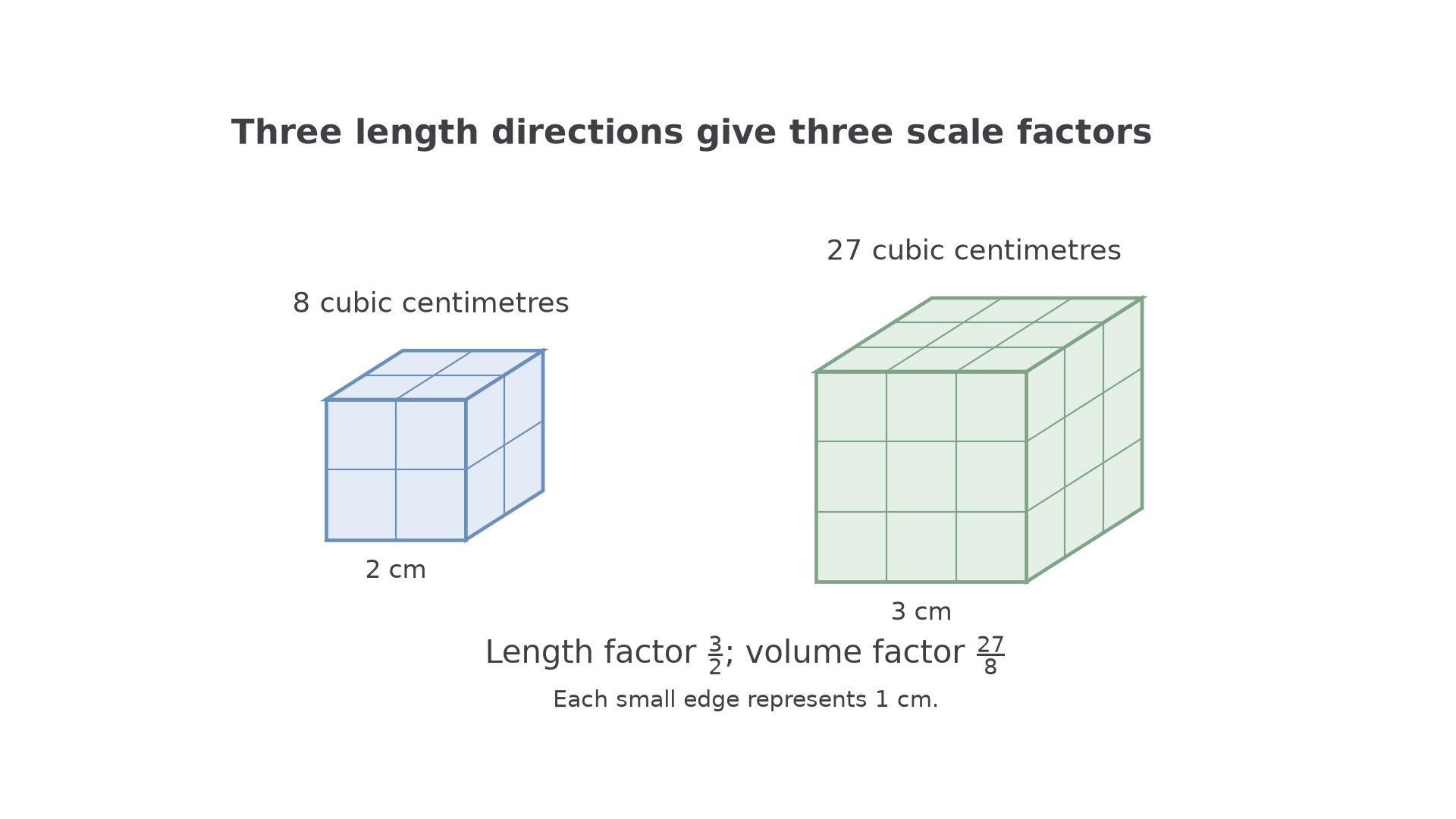
For a prism, the cross-section area gains , then its length gains another . The volume therefore gains . Sphere and cone formulae show the same three length factors. Similarity scales the whole solid, including any matching hollows or openings.
Similar volume scale factor
For similar solids with positive length scale factor ,
If corresponding lengths are in ratio , volumes are in ratio .
Not on the formulae sheet: learn it.
Do not substitute an area factor for . The cube acts on the length factor.
Worked example 3: enlarging a solid
Question. Non-calculator. Two similar solids have heights and . The smaller solid has volume . Work out the larger volume.
Plan. Cube the height ratio, then multiply the smaller volume.
Why this step? The height ratio gives the common factor for width and depth too, since the solids are similar.
Answer. .
Check. . The volume grows more rapidly than the height.
Worked example 4 changes the direction to a reduction. A smaller solid has a volume factor smaller than its length factor.
Worked example 4: reducing a capacity
Question. Non-calculator. Two containers have similar interiors with internal heights and . The larger container has internal volume . Work out the smaller capacity.
Plan. Use the factor from the larger interior to the smaller interior, then cube it.
Why this step? A capacity is an internal volume. The internal dimensions must scale together; outside heights alone would be insufficient if wall thicknesses changed the interior shape.
Answer. , or .
Check. , and is less than two thirds of , as a three-direction reduction predicts.
Return to the jug. A increase in every internal length means , not . Its capacity is . That is more than triple the original capacity.
Watch out
Wrong: “A length increase means a volume increase.” Right: the volume factor is , so the increase is . The factor includes the original whole as well as the increase.
Use a fractional length factor for another reduction.
Continue this lesson.
You’re previewing NovaLearn without an account. Create a free account to read the rest.
Create free account