A12 - Cubic, reciprocal and exponential graphs
Some curves pass through the origin; others get close to an axis without ever reaching it. In A12 you will recognise, sketch and interpret simple cubic and reciprocal graphs. The Higher part adds exponential graphs, whose equal steps multiply the height instead of adding to it.
Recognising and sketching cubic graphs
Can a smooth graph get closer and closer to both axes without ever touching either? A reciprocal graph can. First compare it with a cubic, which goes straight through the origin.
You already know
Substitute an input into a rule to find its output. A graph consists of the points that satisfy the rule. Put a negative input in brackets before raising it to a power.
For , the inputs give heights . Unlike squaring, cubing keeps a negative input negative: . The curve rises from bottom left to top right. It flattens at the origin but keeps rising through it; the origin is not a maximum or minimum.
Cubic function
A function whose highest power of is , such as or . The coefficient of must be non-zero. For example, is cubic; is quadratic.
The basic cubic's shape and its value rule are not on the formulae sheet: learn them. A sketch shows the overall shape, crossings and important points. An accurately plotted graph also uses a consistent scale and calculated coordinates. Draw a smooth curve in either case.
Worked example 1: the basic cubic
Question. Complete a table for at . Describe the sketch and its axis crossings. Non-calculator.
Plan. Cube each whole input, then use the signs and the zero value to describe the curve.
Why this step? The opposite signs on either side of zero tell you that the curve crosses the axis, rather than turning back at it.
Answer. A smooth rising S-shaped curve through the five points. It crosses both axes at .
Check. Opposite inputs give opposite outputs: pairs with .
Change only the coefficient of the cubic term from to . Cube first, then apply the outside minus.
Worked example 2: a negative cubic term
Question. Complete the same table for . Describe the sketch and its axis crossings. Non-calculator.
Plan. Negate each height in the previous table, keeping its input unchanged.
Why this step? The minus is outside the power. It changes the output's sign after the input has been cubed.
Answer. Heights , in that order. The curve falls from top left to bottom right and crosses both axes at .
Check. The point satisfies .
[DIAGRAM: asset_name: Basic cubic shapes and a cubic with three crossings; asset_slug: aqa8300_a26_cubics; caption: Cubics can cross once or three times; the basic cubic flattens without turning at the origin; description: Three coordinate panels show y equals x cubed, y equals minus x cubed, and y equals x cubed minus x. The first two have their five table points marked. The third crosses the x-axis at minus 1, 0 and 1 and has two changes of direction. Each panel has labelled axes and a smooth curve.]
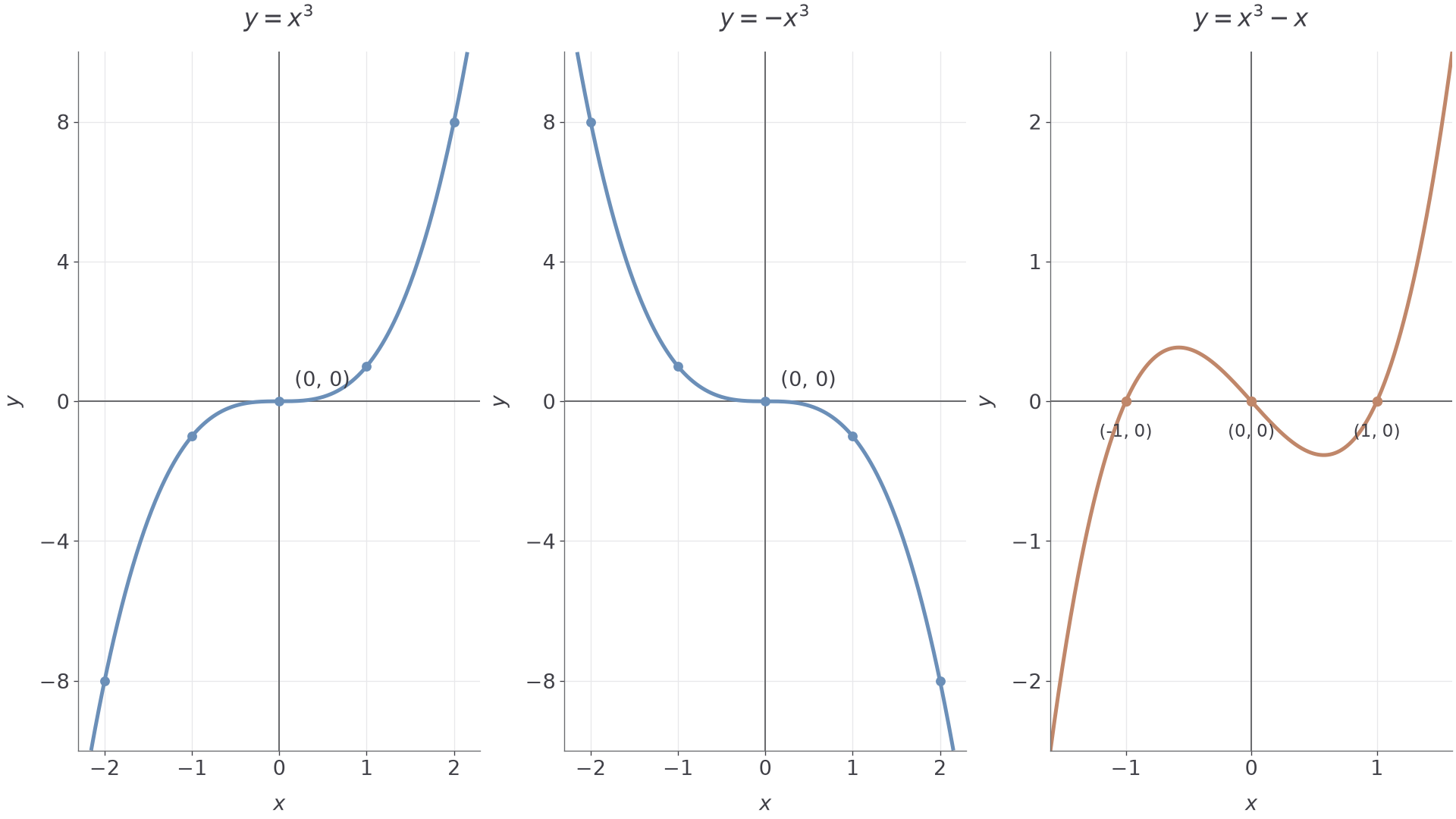
Not every cubic is the basic S. The third panel is : at , its height is zero. Between those crossings it turns twice. Recognise the cubic term, then use the actual table or graph; do not give every cubic the same number of crossings or turns.
Watch out
Wrong: , copied from the rule for squares. Right: . An odd number of negative factors gives a negative product.
Try the negative cubic with a different coefficient. Its direction stays the same.
The reciprocal graph and its missing input
The rule asks for the reciprocal of the input. At , the height is ; at , it is only . The curve gets closer to the horizontal axis as the input grows, but the height never becomes zero.
Asymptote
A straight line that a branch of a curve approaches arbitrarily closely. For , both coordinate axes are asymptotes: the branches approach them but never meet them. This particular graph has no point at , because division by zero is undefined.
On the positive side, making smaller towards zero makes very large. On the negative side, both coordinates are negative. These give two separate branches: one above and right of the origin, one below and left. Do not draw a line through the gap at zero.
The reciprocal graph
Every point satisfies . There are no axis crossings. The axes and are asymptotes.
Not on the formulae sheet: learn it.
The points spread out unevenly: halving the input doubles the height. Choose a few small inputs as well as larger ones so the steep section is visible.
Worked example 3: the positive branch
Question. Work out the heights of at . Write down when . Non-calculator.
Plan. Divide by each input, then use for the requested height.
Why this step? The same product condition connects every pair of coordinates, including the point read backwards from its height.
Answer. Heights ; when , . Sketch a smooth decreasing positive branch through these points, staying clear of both axes.
Check. .
Now change only the signs of the inputs and the requested height. The negative branch follows the same reciprocal rule.
Continue this lesson.
You’re previewing NovaLearn without an account. Create a free account to read the rest.
Create free account