A22 - Solving linear inequalities
An inequality can have a whole range of answers. You will solve linear inequalities, show their solutions on number lines, and decide which whole-number values are allowed. Most steps work like solving equations, with one important change when you multiply or divide by a negative number.
Reading a solution set on a number line
A lift can carry at most . Its passengers and luggage already have mass . How much more mass can go in? Is the boundary amount allowed? An inequality gives both the limit and the answer to that last question.
You already know
means is less than ; includes . Likewise, means greater than and means greater than or equal to. Values increase as you move right on a number line.
For , numbers such as , and work, but itself does not. For , the boundary works as well. Both include decimals and fractions unless a question restricts to integers.
Solution set and boundary
The solution set contains every value that makes an inequality true. A boundary separates allowed from disallowed values. A strict inequality, or , excludes its boundary. An inclusive inequality, or , includes it.
On a number line, use an open circle for an excluded boundary and a filled circle for an included boundary. An arrow shows that the solution continues without an end in that direction. A segment between two boundary circles shows a bounded range.
[DIAGRAM: asset_name: Open and filled boundary circles; asset_slug: aqa8300_a12_number_lines; caption: The circle decides whether an endpoint belongs to the solution; the line decides which values belong; description: Three number lines. Top x greater than 2 has an open circle at 2 and a right arrow. Middle x greater than or equal to 2 has a filled circle at 2 and a right arrow. Bottom minus 1 less than x less than or equal to 3 has an open circle at minus 1, a filled circle at 3 and a coloured segment between them.]
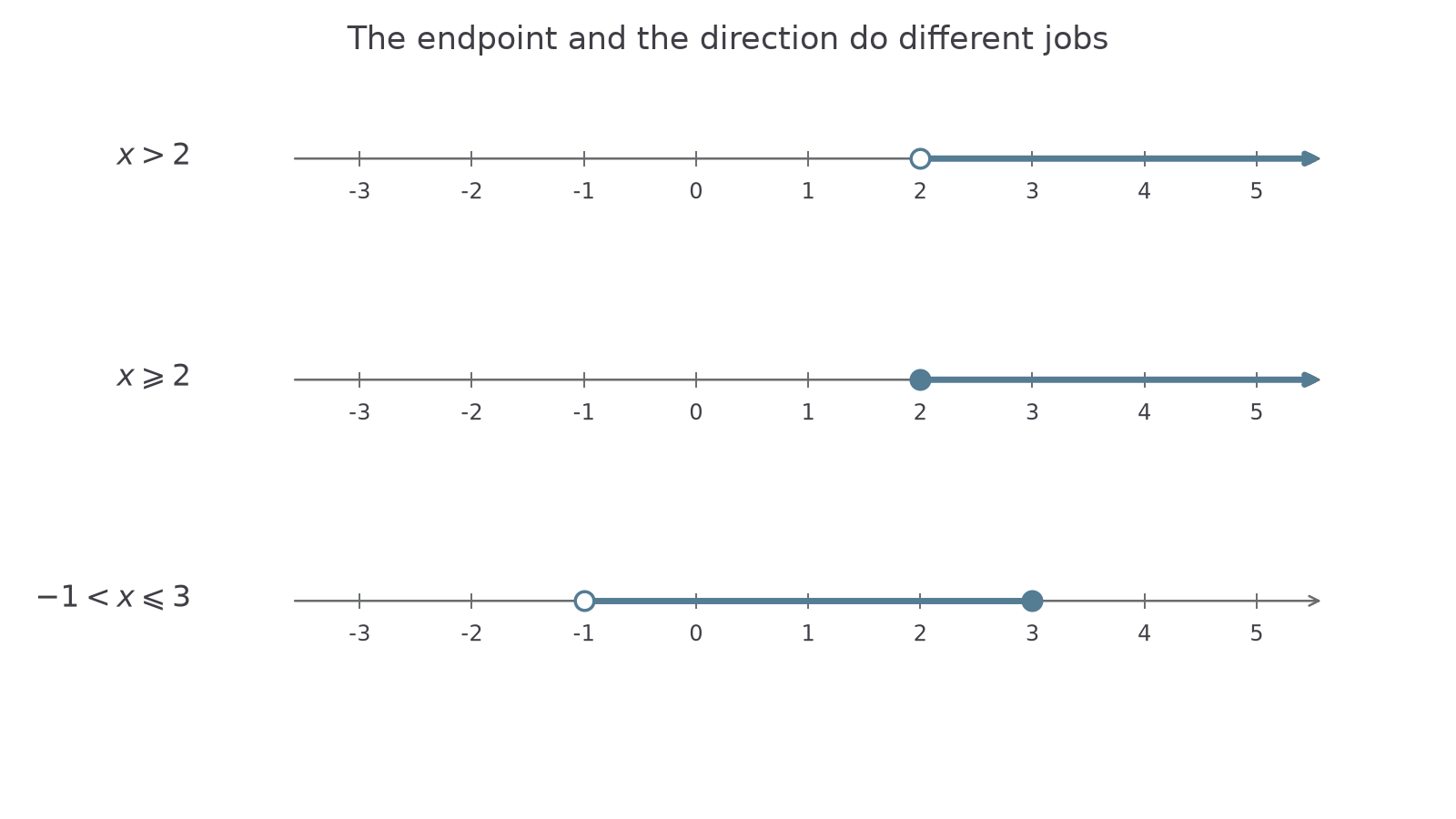
The bottom line means and , written together as . The numbers are in increasing order. These number-line conventions are not on the formulae sheet: learn them.
There are infinitely many solutions between and , although there is no integer strictly between them. For example, , , and the continuing pattern all lie there. Between any two different numbers you can choose their midpoint, so you cannot run out of numbers to insert.
Key idea
A solution is usually a range of values, not just its boundary. Read both the circle and the direction or segment.
Check an excluded endpoint carefully in the following question.
Solving with addition and positive division
You can add or subtract the same number on both sides of an inequality without changing its direction. Multiplying or dividing by the same positive number also keeps the direction. These operations preserve the order of the values on a number line.
Start with . Adding gives . Dividing both original numbers by gives . Neither operation reverses which is smaller.
Operations that keep the direction
For a positive number ,
The same principles apply to , and . Subtraction is addition of a negative number.
Not on the formulae sheet: learn it.
These non-calculator examples undo an addition, then a positive multiplication. Keep an inequality sign in every line.
Worked example 1: a strict inequality
Question. Solve . Describe its number-line representation.
Plan. Subtract , then divide by the positive coefficient .
Why this step? Positive division preserves order, so the sign stays .
Answer. : an open circle at with an arrow to the left.
Check. gives , true; gives , false. The boundary is correctly excluded.
Change only the sign to an inclusive one. The boundary calculation stays the same, but the boundary is now allowed.
Worked example 2: including the boundary
Question. Solve . Describe its number-line representation.
Plan. Use the same inverse operations while keeping the inclusive sign.
Why this step? Equality was allowed at the start, so it remains allowed after the same operations on both sides.
Answer. : a filled circle at with an arrow to the left.
Check. At , the original gives , true. At , it gives , false.
Solving the corresponding equation finds the boundary. It does not tell you which side of it is allowed unless you retain the inequality.
Watch out
Wrong: replacing by , then answering . That is the excluded boundary. Right: preserve the sign and answer .
Use the same steps with a new coefficient and boundary.
Continue this lesson.
You’re previewing NovaLearn without an account. Create a free account to read the rest.
Create free account