N13 - Metric units and conversions
A measurement needs a number and a unit. In N13 you will choose sensible units, convert length, mass, time and money, and handle square and cubic units. You will also connect litres to cubic centimetres and use an imperial conversion when it is supplied.
Converting length and mass
One tank is labelled and another is labelled litres. Do they hold the same amount? The numbers look very different. We will settle this by counting how many small units fit into a larger one.
You already know
Multiplying by makes a number a hundred times as large; dividing by undoes it. The measurement stays the same when you change its unit.
A pencil might be long, a person might have mass , and a journey might be . Temperature can be measured in degrees Celsius, such as . Choosing a sensible unit avoids awkward numbers. A pencil measured in kilometres would have a tiny decimal length.
Unit
A standard amount used to measure a quantity. Metres measure length; kilograms measure mass. For example, is a length. The number alone does not tell you a length.
The prefixes help: kilo means a thousand, centi means a hundredth, and milli means a thousandth. Learn the following exact relationships.
Length and mass conversions
Use these for measurements of length or mass, not for square or cubic units.
Not on the formulae sheet: learn it.
Smaller units give a larger number of units. That size check tells you whether to multiply or divide.
Worked example 1: converting into smaller units
Question. Convert to centimetres. Non-calculator.
Plan. There are centimetres in each metre, so multiply by .
Why multiply? A centimetre is smaller than a metre, so you need more of them to cover the same length.
Answer. .
Check. , so is sensible.
The second example reverses the direction: the target unit is larger. The count must become smaller.
Worked example 2: converting into larger units
Question. Convert to metres. Non-calculator.
Plan. Group the centimetres into hundreds.
Why divide? Each metre uses up of the centimetres.
Answer. .
Check. , returning to the starting value.
The same decision works for mass, using its own conversion factor.
Watch out
Wrong: . This divides by . Right: , so the mass is .
Try the reverse conversion with a new quantity. Always write the requested unit.
Time, money and decimal quantities
Not every unit changes in steps of ten: an hour has minutes.
For example, hours means one hour and half an hour, which is minutes. It does not mean one hour and fifty minutes. Time written as a decimal is different from a clock reading such as 1:50.
Time and money conversions
For a decimal amount, multiply or divide the whole quantity by the relevant conversion factor.
Not on the formulae sheet: learn it.
First use the familiar factor for money.
Worked example 3: a decimal amount of money
Question. Write pence in pounds. Non-calculator.
Plan. Divide by the number of pence in one pound.
Why divide? Pounds are larger units, so the number decreases.
Answer. £3.65.
Check. Three pounds is pence; the remaining pence gives £3.65.
Now change the conversion factor from to . The same grouping idea works for time.
Worked example 4: minutes as decimal hours
Question. Write minutes as a decimal number of hours. Non-calculator.
Plan. Divide by , because each hour is a group of minutes.
Why divide the remainder by ? It is a fraction of an hour, not a decimal fraction of minutes.
Answer. hours.
Check. minutes.
A clock-style answer and a decimal answer can describe the same duration, but their digits have different meanings.
Watch out
Wrong: hours minutes is hours. Right: , so it is hours. In money, write £4.20 rather than £4.2 when showing an amount in pounds and pence.
Units such as , and pounds per hour are compound units: they combine units. Read the slash as “per”. Their calculations come later; here, keep the units clear in each conversion.
Converting square units
A square metre contains far more than square centimetres: there are rows as well as columns.
Imagine a square with sides . Each side is , so its area is square centimetres.
[DIAGRAM: asset_name: Length and area conversion factors; asset_slug: aqa8300_n16_square_units; caption: Both side lengths change by a factor of 100, so the area factor is 100 squared; description: A square of side one metre is labelled 100 centimetres along its horizontal and vertical sides. Fine subdivisions show 100 rows and 100 columns, with stronger lines every ten. A separate magnified single square is labelled one square centimetre. The total inside the large square reads 100 times 100 equals 10 000 square centimetres.]
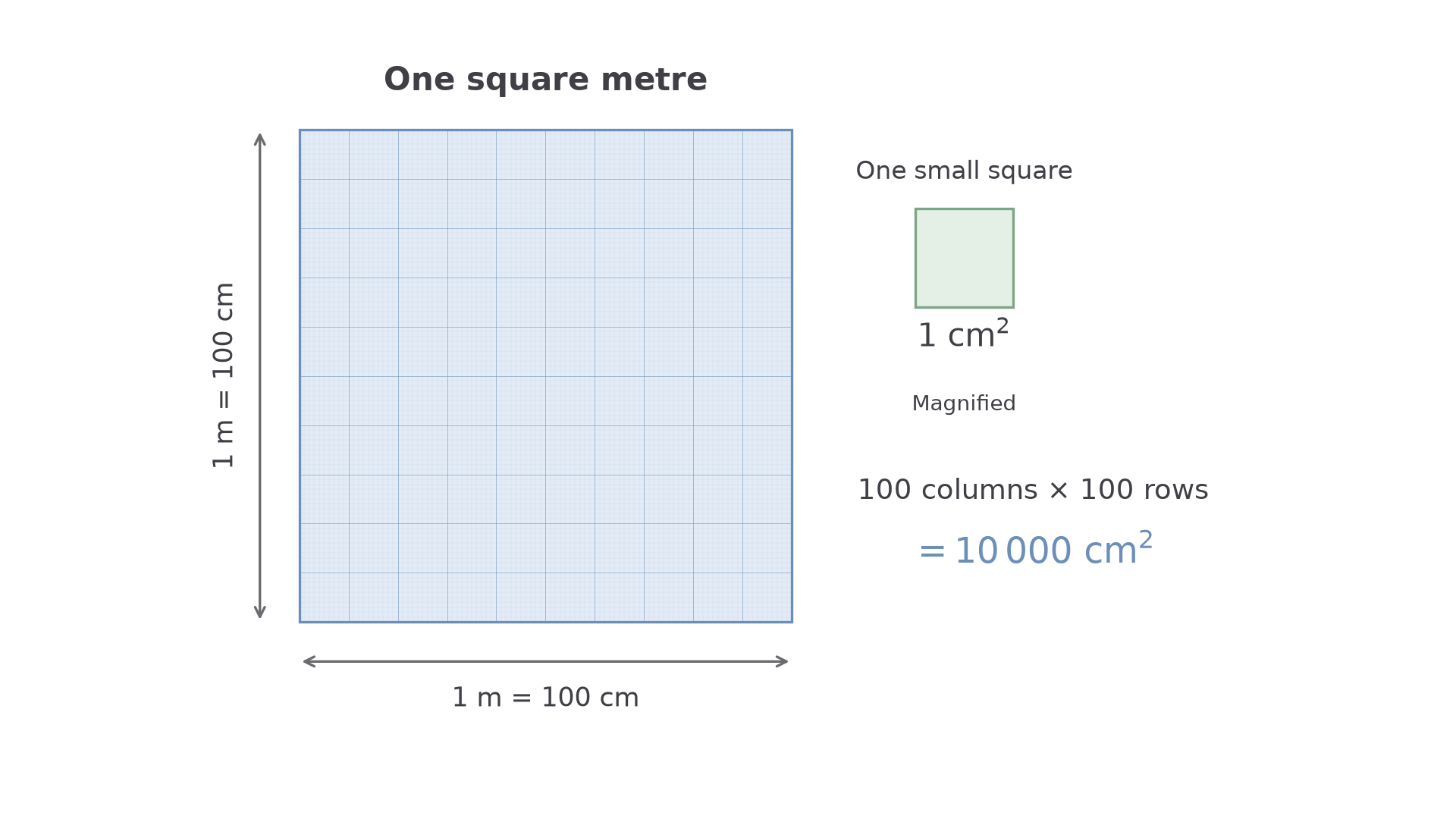
Square-unit conversion factors
If one length unit contains of a smaller unit, its square contains of the smaller square units. In particular,
These relationships convert area, not length.
Not on the formulae sheet: learn it.
Convert the units after identifying whether the quantity is a length, an area or a volume.
Worked example 5: square metres to square centimetres
Question. Convert to square centimetres. Non-calculator.
Plan. Multiply by , the number of square centimetres in each square metre.
Why square the factor? Area counts units in two directions.
Answer. .
Check. It is less than , as is less than one square metre.
The next example reverses the direction. Use the same factor, but divide.
Worked example 6: square centimetres to square metres
Question. Convert to square metres. Non-calculator.
Plan. Divide by .
Why divide? One square metre contains of the starting units.
Answer. .
Check. .
The small superscript changes the conversion factor dramatically.
Watch out
Wrong: . That applies the length factor only once. Right: .
For the next conversion, use the factor for two directions again.
Cubic units and capacity
A cube has three length directions, so its conversion factor is used three times.
A cube with side has side . It contains cubic centimetres. There is a useful surprise here: a cube only wide holds a litre, and a metre cube holds litres.
Volume and capacity conversions
For cubic units, cube the length factor. Litres and millilitres measure capacity, the volume a container can hold.
Not on the formulae sheet: learn it.
Keep “cubic centimetres” and “millilitres” linked: they are two ways to express the same volume.
Worked example 7: cubic centimetres to litres
Question. A container holds . Write this capacity in litres. Non-calculator.
Plan. Each litre is , so divide by .
Why this factor? A litre contains cubic centimetres, not a million.
Answer. litres.
Check. litres is millilitres, which is .
The second example changes the starting unit to cubic metres. This time each starting unit contains litres.
Worked example 8: cubic metres to litres
Question. A tank holds . Write its capacity in litres. Non-calculator.
Plan. Multiply the number of cubic metres by .
Why multiply? A litre is smaller than a cubic metre, so the count increases.
Answer. litres: the two tank labels in the opening question describe the same capacity.
Check. ; dividing by gives litres.
Volume and capacity share some conversion factors, but not all of them.
Watch out
Wrong: . Right: it is , which is litres. Name the target unit before choosing the factor.
Change the tank's capacity and apply the same method.
Using a supplied conversion
For an imperial-to-metric conversion, use the relationship supplied in the question.
You do not need to memorise a miles-to-kilometres or inches-to-centimetres conversion for this specification. A supplied relationship may be an approximation, so keep its stated meaning. Put both quantities into the same units before comparing them.
Worked example 9: miles to kilometres
Question. Use miles to convert miles to kilometres. Non-calculator.
Plan. Count groups of miles, then replace each group by .
Why start with division by ? The supplied relationship matches each group of miles to .
Answer. , using the supplied conversion.
Check. The kilometre count is larger because a kilometre is shorter than a mile.
The next example reverses the direction. Start by grouping the kilometres into eights.
Worked example 10: kilometres to miles
Question. Use miles to convert to miles. Non-calculator.
Plan. Divide by , then multiply by .
Why reverse the operations? This time you start with the kilometre side of the relationship.
Answer. miles, using the supplied conversion.
Check. .
Both examples use a relationship given in the question. It is not on the formulae sheet; a required imperial-to-metric conversion will be given in the question.
Watch out
Wrong: multiply by in both directions. Right: changes miles to kilometres; changes kilometres to miles. The reverse conversion must undo the first.
The tank puzzle used a metric relationship you learn. This journey uses a relationship you are given. In both cases, the unit tells you what the number means.
Quick Recap
- A smaller unit gives a larger count for the same measurement.
- Square the length factor for area; cube it for volume.
- litre is millilitres or , and is litres.
- Time uses groups of ; money uses pence per pound.
- Use the imperial conversion supplied in the question, reversing it when needed.
The opening tank labels agree: litres.