N1, N2 - Place value, ordering and inequality symbols
Every digit in a number is worth an amount that depends on the column it sits in. In this lesson you will read place value, multiply and divide by 10, 100 and 1000, use one known calculation to find others, and put decimals and negative numbers in order using inequality symbols. These ideas sit underneath every calculation you will do at GCSE, on both tiers.
The value of a digit
A digit's value depends on the column it is in, and that one idea runs through this whole lesson.
Here is the question the lesson will answer. The lowest temperature ever recorded in the UK is . The Met Office lists it three times: at Braemar in Aberdeenshire on 11 February 1895 and 10 January 1982, and at Altnaharra in the Highlands on 30 December 1995. Suppose a weather station reads one winter night. Is that a new record? Plenty of people say yes, "because 15 is bigger than 2". Keep your own answer in mind: by the end of Part 6 you will settle it in one line.
Columns and their values
Start with a number you can picture. In , the 3 means three hundreds, the 5 means five tens and the 2 means two ones:
The columns carry on to the right of the decimal point, getting ten times smaller each time: tenths, hundredths, thousandths. The chart shows the number .
[DIAGRAM: asset_name: Place-value chart for 40 352.718; asset_slug: aqa8300_n01_place_value_chart; caption: The value of each digit in 40 352.718, with each column worth ten times the column on its right; description: A place-value chart with nine columns from ten thousands to thousandths and a decimal point between ones and tenths. The digits 4, 0, 3, 5, 2, 7, 1 and 8 sit in blue boxes, except the 0 in the thousands column, which is highlighted in clay as a placeholder. Green arrows labelled times 10 run from each column to the column on its left. Below each digit is its value: 40 000, 0, 300, 50, 2, 0.7, 0.01 and 0.008.]
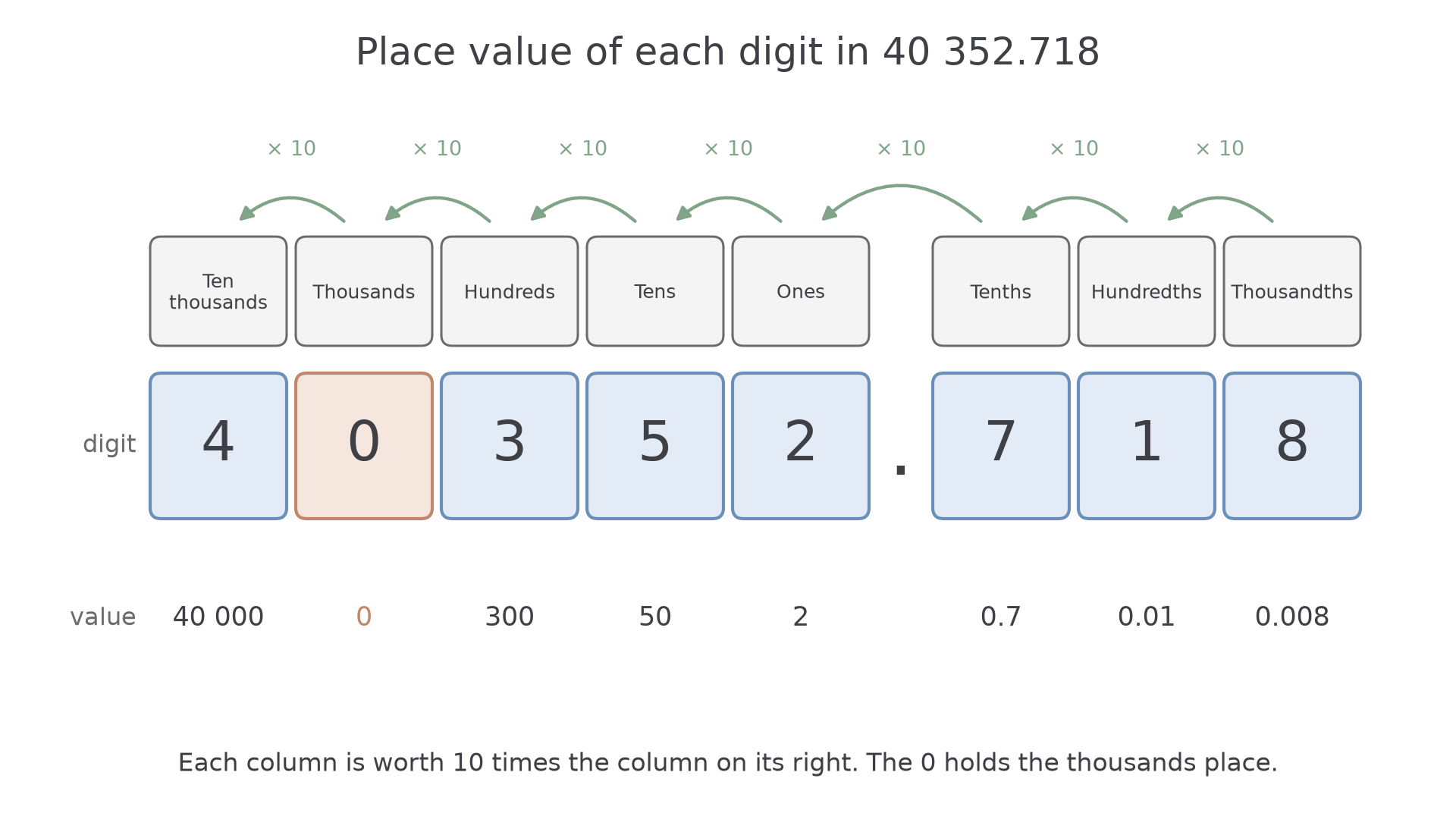
Reading the bottom row of the chart from left to right:
So the 7 is worth seven tenths, , and the 8 is worth eight thousandths, . There is no "oneths" column: the first column after the decimal point is always tenths.
Each column is worth ten times the column on its right. Ten hundreds make a thousand, ten tenths make one, and ten thousandths make a hundredth. That is why our number system is called a base-ten, or decimal, system.
Place value
The value a digit has because of the column it is in. For example, in the digit 3 has place value and the digit 1 has place value . Not an example: the digit 3 on its own, which tells you nothing until you know its column.
Zero holds a place
The 0 in the thousands column of is worth nothing, but it does an important job. Delete it and you get : the 4 slides into the thousands column and is now worth only , not . A zero keeps every other digit in its proper column.
Zeros at the end of a decimal are different. , and are all equal, because those extra zeros come after the last non-zero digit and push nothing into a new column.
Very large and very small numbers
A thousand is , a million is (a thousand thousands) and a billion is (a thousand millions). Exam papers write numbers with five or more digits in groups of three, separated by a small space and never by commas: is two and a half million. Four-digit numbers such as are written without a space.
At the other end of the chart, in the 4 is in the thousandths column, so it is worth .
Key idea
A digit's value is the digit times the value of its column. One column to the left is worth ten times as much; one column to the right is worth a tenth as much.
Small decimals matter outside exams too. UK prescribing guidance tells doctors to write half a millilitre as , never , and three milligrams as , never . A decimal point that is missed or misread makes a dose ten times too big.
Multiplying and dividing by 10, 100 and 1000
Multiplying by 10 makes every digit worth ten times as much, so every digit moves one column to the left.
You already know
From Part 1, each column is worth ten times the column on its right. From primary school, and .
Take . Multiplying by 100 is multiplying by 10 twice, so every digit moves two columns left. The 4 ones become 4 hundreds and the 7 tenths become 7 tens. The ones column is now empty, so a 0 goes there to hold the place:
Dividing by 100 does the opposite: every digit moves two columns right. The 4 ones become 4 hundredths and the 7 tenths become 7 thousandths, with zeros holding the ones and tenths columns:
[DIAGRAM: asset_name: Digits moving when multiplying and dividing by 100; asset_slug: aqa8300_n01_digit_shift; caption: Multiplying by 100 moves every digit two columns left and dividing by 100 moves every digit two columns right, while the decimal point stays put; description: Two place-value panels with columns hundreds, tens, ones, tenths, hundredths and thousandths and a dashed line marking the fixed decimal point. Top panel, 4.7 times 100 equals 470: green arrows move the 4 from ones to hundreds and the 7 from tenths to tens, and a clay 0 fills the ones column. Bottom panel, 4.7 divided by 100 equals 0.047: green arrows move the 4 from ones to hundredths and the 7 from tenths to thousandths, and clay zeros fill the ones and tenths columns.]
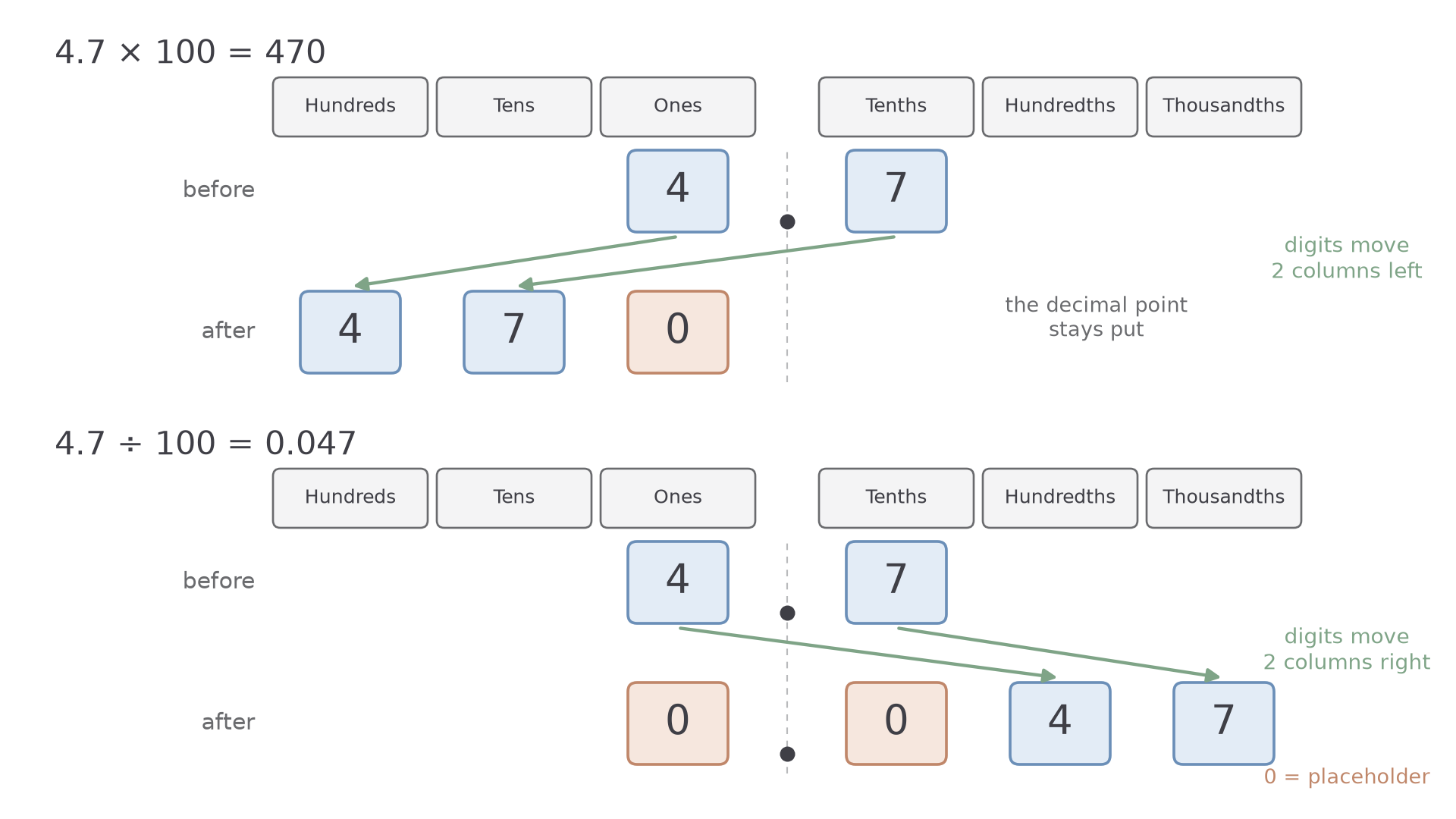
The decimal point never moves; the digits move past it. You may have been told to "move the decimal point" instead. It gives the same answer, but thinking about the digits explains why it works and protects you from the "add a zero" mistake below.
Multiplying and dividing by 10, 100 and 1000
The number of zeros tells you how many columns to move. The decimal point stays where it is; put a 0 in any empty column between the digits and the decimal point.
Not on the formulae sheet: learn it.
Here is the method first on a decimal that gets bigger, then on a whole number that has to become a decimal.
Worked example 1: multiplying a decimal by 100
Question. Work out
Plan. Multiplying by 100 moves every digit two columns left.
Why this step? The 0 moves too. It held the tenths place in and now holds the tens place in . Without it you would wrongly write .
Answer.
Check. , and is close to
The next example changes one thing: it divides, so the digits move right, past the decimal point, and you need zeros in front of them.
Worked example 2: dividing a whole number by 1000
Question. Work out
Plan. Dividing by 1000 moves every digit three columns right.
Why this step? Count the moves for the 4: tens to ones, ones to tenths, tenths to hundredths. Nothing lands in the ones or tenths columns, so they need zeros.
Answer.
Check. , because the digits move three columns back to the left
The most common slip with powers of ten comes from a shortcut that only works for whole numbers.
Watch out
"To multiply by 10, add a zero" fails for decimals. Wrong: . That zero changes nothing, because . Right: every digit moves one column left, so .
Multiplying by is the same as dividing by 10, because is one tenth: . In the same way, multiplying by is the same as dividing by 100, and dividing by is the same as multiplying by 10. Spotting a hidden power of ten like this saves a lot of work.
Using one fact to find another
If you know one multiplication fact, place value gives you many more for free, with no new long multiplication.
You already know
From Part 2, dividing by 10 moves every digit one column right. Multiplication and division undo each other: if , then .
Suppose you know that . Since is , the product must be ten times smaller than . Make both numbers ten times smaller and the product is ten times smaller twice:
For multiplication a quick count agrees: and have one decimal place each, so has two decimal places, .
Division behaves differently. Dividing both numbers by the same amount leaves the answer unchanged, because you are asking the same "how many times does it fit?" question on a smaller scale:
The last line surprises many people: fits into ten times as often as does, because it is ten times smaller.
Scaling a known fact
If , then
Not on the formulae sheet: learn it.
On AQA papers, a fact you are allowed to use is introduced with the words "You are given that". The first example uses one in a multiplication.
Worked example 1: a product of two decimals
Question. You are given that . Work out
Plan. Compare each number with the fact, then change in the same way.
Why this step? Each number is ten times smaller than in the fact, so the product is ten times smaller twice, which is times smaller.
Answer.
Check. Estimate: , so is sensible, while and are not
Worked example 2 keeps the same fact but changes one thing: it asks for a division. The rule changes too, because dividing both numbers by the same amount leaves the answer alone.
Worked example 2: a division from the same fact
Question. You are given that . Work out
Plan. Turn the fact into a division, then compare each number with it.
Why this step? fits into exactly as many times as fits into , because both numbers have been scaled down by the same amount.
Answer.
Check.
The commonest error here is to treat a division as if it were a multiplication.
Watch out
Counting decimal places works for multiplication, not division. Wrong: " has two decimal places, so ." Dividing by a number less than 1 must give an answer bigger than , so is impossible. Right: .
A size check like that catches most slips, and it matters most on one-mark questions, where there is no working to earn method marks.
Exam tip
On a one-mark "Work out" question only the answer is marked, so a dropped zero costs the mark. Examiners' reports mention answers with a missing final zero. Set the zeros aside first: for , work out , then put both zeros back to get , not .
Comparing and ordering decimals
To compare decimals, compare them column by column from the left; the first column where they differ decides, however many digits each number has.
Which is bigger, or ? Many people pick "because 75 is bigger than 8". But the 8 in and the 7 in are both in the tenths column. Writing as (an extra zero at the end changes nothing) lines the columns up:
| Number | Ones | Tenths | Hundredths |
|---|---|---|---|
| 0 | 8 | 0 | |
| 0 | 7 | 5 |
Eight tenths is more than seven tenths, so is bigger. In money, of a pound is 80p and of a pound is 75p. The number line tells the same story: is only halfway from to .
[DIAGRAM: asset_name: 0.75 and 0.8 on a number line; asset_slug: aqa8300_n01_decimal_number_line; caption: 0.75 lies halfway between 0.7 and 0.8, so it is less than 0.8; description: A number line from 0.7 to 0.9 with small ticks every hundredth and labels at 0.7, 0.75, 0.8, 0.85 and 0.9. A blue point and label mark 0.75 and a clay point and label mark 0.8 written as 0.80. A blue double arrow below shows that 0.75 is halfway from 0.7 to 0.8, and a green arrow points right with the word larger.]
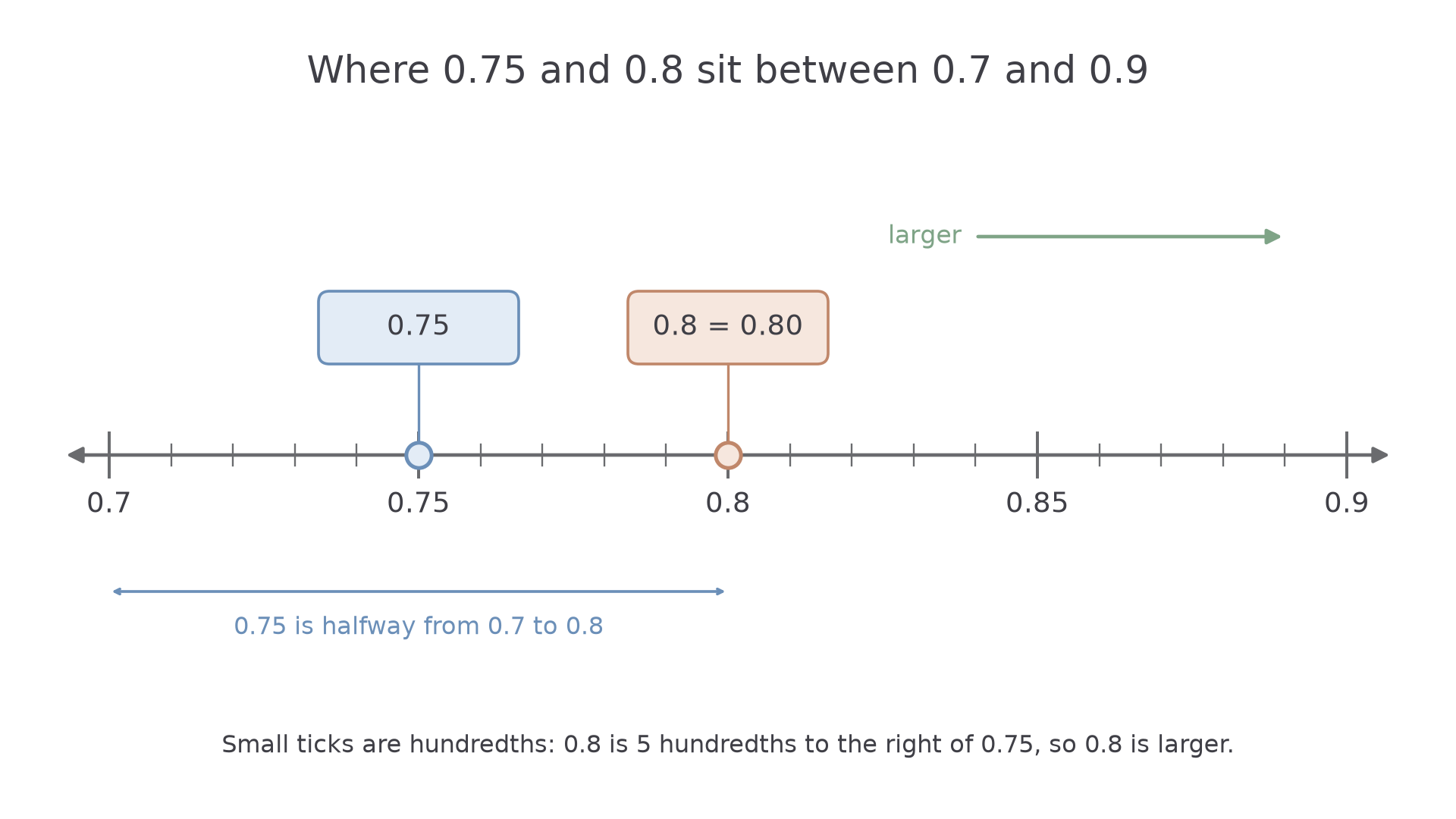
The method, step by step:
- Write the numbers under each other with the decimal points lined up.
- Add zeros at the end so that every number has the same number of decimal places. This does not change any value.
- Compare from the left. The first column where the digits differ decides the order.
Worked example 1: comparing two decimals
Question. Which is greater, or ? Give a reason.
Plan. Give both numbers two decimal places, then compare the columns from the left.
Why this step? The first column that differs is the tenths, and 6 tenths is more than 5 tenths. The 8 hundredths cannot make up the gap, because 8 hundredths is less than 1 tenth.
Answer. is greater, because it has 6 tenths and has only 5 tenths.
Check. In money, £2.60 is more than £2.58
Worked example 2 changes one thing: there are four numbers to put in order, and one of them has a zero in the tenths column, which is easy to misjudge.
Worked example 2: ordering four decimals
Question. Write these numbers in order of size. Start with the smallest number.
Plan. Give every number three decimal places, then sort column by column from the left.
Why this step? Three numbers tie on 6 tenths, so look at their hundredths: has 0, has 1 and has 2. That puts them in the order , , .
Answer. , , ,
Check. On a number line, is close to 0, and the other three all lie between and , with furthest right
The trap in that example is a famous one, and it catches strong students who rush.
Watch out
Longer is not larger. Wrong: " is bigger than because 618 is bigger than 62." That compares the digits as if they were whole numbers. Right: , and 2 hundredths is more than 1 hundredth, so is the bigger number.
Ordering questions on AQA papers are usually worth 2 marks, and the marks are shared out in a particular way.
Exam tip
AQA gives 2 marks for a fully correct order. A list that is not fully correct can still earn 1 mark if it starts with the right smallest number or ends with the right largest number, or if it is completely correct but written largest first. Underline "smallest" or "largest" in the question before you write your answer.
Symbols for comparing numbers
Six symbols let you write a comparison in a few characters, and each one has an exact meaning.
| Symbol | Read it as | A true example |
|---|---|---|
| is equal to | ||
| is not equal to | ||
| is less than | ||
| is greater than | ||
| is less than or equal to | and | |
| is greater than or equal to | and |
To remember and , notice that the wide, open end faces the larger number and the narrow point faces the smaller one. You can read a comparison in either direction, but turning it round flips the symbol: says exactly the same as .
The bar under and adds "or equal to", so the boundary value is allowed. AQA prints these two symbols with a sloping bar, as here. You may see them elsewhere with a flat bar; they mean the same thing.
Inequality
A statement that one value is less than, greater than, less than or equal to, or greater than or equal to another, written with , , or . For example, and . Not an example: , which says that two values are equal.
Statements about an unknown number
A letter can stand for a number you do not know. The inequality means that is 3 or any number below 3: , , and all fit. So if all you know is , the statement " is 1" may be true, but you cannot say that it is true. The statement " could be 3" is true, because the bar allows equality.
The strict symbols leave the boundary out. means that is positive; zero itself is not allowed, because zero is neither positive nor negative. If , the smallest possible value of is 5. If , there is no smallest value at all: , and all work, and you can always find one closer to 5.
Two symbols can be used together. means that is greater than 2 and less than 5: read it as " is between 2 and 5", with neither end allowed. A bar at one end lets that end in, so if is an integer and , then is , , or . Multiplying every part by the same positive number keeps the statement true, so gives .
When a question asks you to complete a statement "using one of these symbols", write the symbol itself. AQA does not give the mark for words such as "less than" in place of .
Key idea
The symbol opens towards the larger number. A bar underneath means "or equal to", so the boundary value is included; without the bar it is left out.
Here is how to check a claim such as "if , then is less than 4". Every value that is allowed to take (3, 2.9, 0.25 and every number below them) is less than 4, so the claim is true. For "if , then is 1", the value 1 works but 2 does not, so the claim only may be true.
Problem-solving
To decide whether a statement about is true, may be true or not true, try the boundary value and a few other allowed values, including some far from the boundary. If every allowed value makes it true, it is true; if only some do, it may be true; if none do, it is not true.
Errors in comparisons usually come from one of the traps you have met: longer-is-larger, thinking a final zero changes a value, or forgetting that a bar allows equality.
Ordering negative numbers
On a number line, numbers get bigger as you move right and smaller as you move left, and that stays true on the far side of zero.
You already know
From Part 4, how to compare decimals column by column. From Part 5, means "is less than". A temperature of is five degrees below freezing.
A negative number is a number less than zero. Look at and on the number line. is further left, so it is the smaller number, even though 8 is bigger than 3:
[DIAGRAM: asset_name: Integers on a number line; asset_slug: aqa8300_n01_integer_number_line; caption: Minus 8 is further from zero than minus 3, so it is further left and smaller; description: A number line from minus 10 to 4 with blue points at minus 8 and minus 3 and a grey point at 0. Clay double arrows above the line show that minus 8 is 8 away from 0 and minus 3 is 3 away from 0. Green arrows below the line point left labelled smaller and right labelled larger. A note reads minus 8 is less than minus 3, because 8 degrees below freezing is colder than 3 degrees below freezing.]
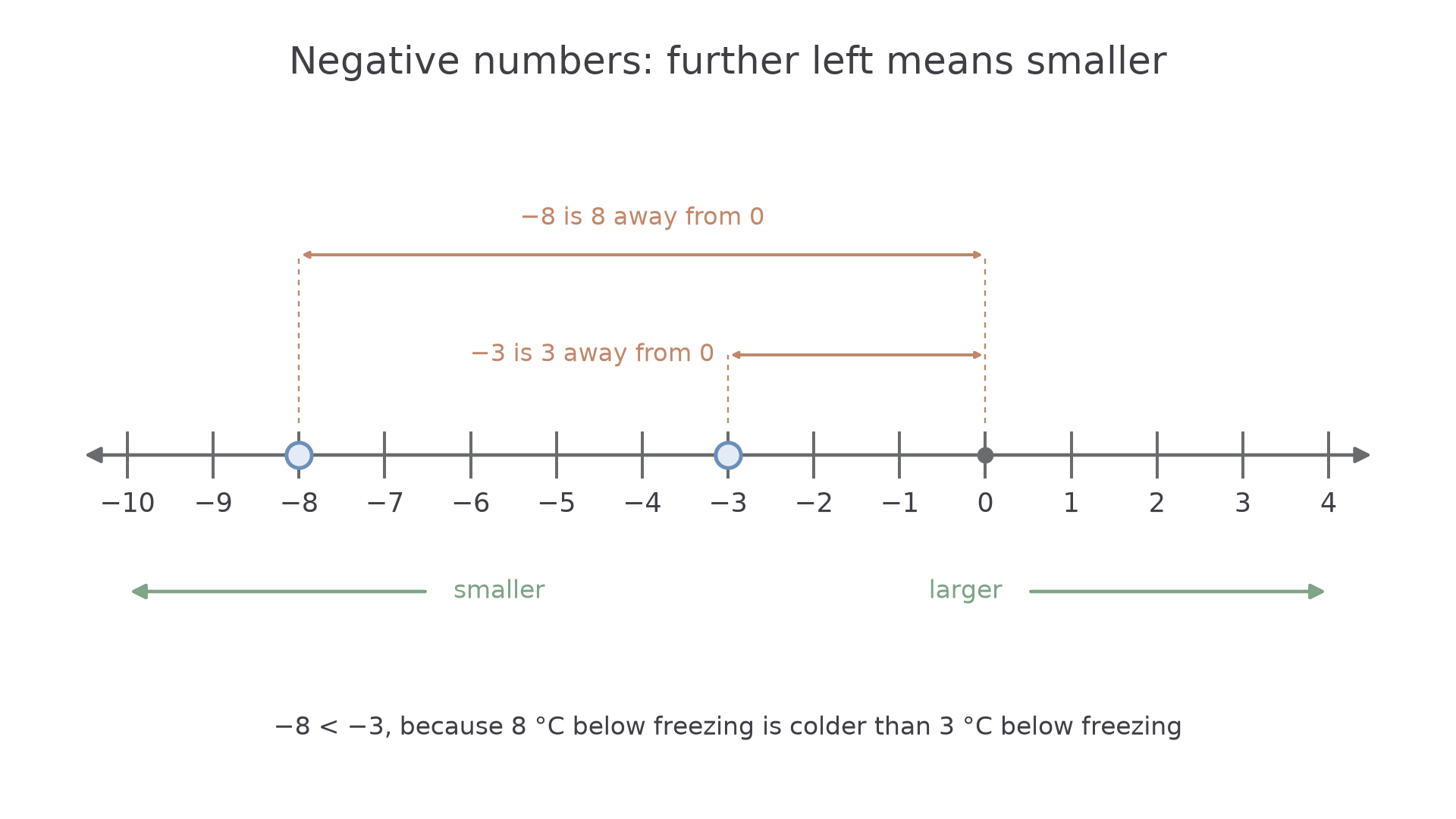
This matches temperatures: is colder than . For negative numbers, distance from zero works backwards: the further a negative number is from zero, the smaller it is. Zero is bigger than every negative number and smaller than every positive number.
So to order negative numbers, order their distances from zero, then reverse that order.
Integer
A whole number that is positive, negative or zero. For example, , and are integers. Not an example: or , which are not whole numbers.
Worked example 1 orders integers; worked example 2 orders decimals.
Worked example 1: ordering temperatures
Question. Here are four temperatures in degrees C.
Write the temperatures in order, starting with the coldest.
Plan. Coldest means smallest, which means furthest left on the number line. Deal with the negatives first.
Why this step? Both and are below zero, but is 11 degrees below, so it is the colder of the two.
Answer. , , ,
Check. Reading the list along the number line from left to right, each number is to the right of the one before
Worked example 2 changes one thing: the numbers are negative decimals, so you need Part 4's column method as well as the reverse-the-order rule.
Worked example 2: ordering negative decimals
Question. Write these numbers in order of size. Start with the smallest number.
Plan. Compare how far the negative numbers are from zero using columns, reverse that order, then put the positive number last.
Why this step? is the furthest from zero, so it is the furthest left and the smallest. is only just below zero, so it is the largest of the negatives.
Answer. , , ,
Check. is just left of zero and is just right of it, so these two belong at the end of the list
The error examiners report most often when students order negative numbers is easy to avoid once you can see it.
Watch out
Do not order negative numbers by their digits. Wrong: , , , . This list treats as bigger than because 9 is bigger than 2. Right: is furthest left, so the order is , , , .
A ten-second sketch prevents that error, and the other common slip of putting 0 before the negative numbers.
Problem-solving
Before writing an ordered list, sketch a number line, mark 0 and place each number on it roughly. Then read the numbers off from left to right. Negatives go to the left of 0, and the further a negative number is from zero, the further left it goes.
Back to the record
Now settle the opening question. Is colder than the record of ?
[DIAGRAM: asset_name: The UK record and a reading of minus 27.15; asset_slug: aqa8300_n01_record_zoom; caption: Minus 27.15 is to the right of minus 27.2 on the number line, so it is warmer than the UK record; description: A number line from minus 27.30 to minus 27.00 with small ticks every hundredth. A clay point labelled UK record minus 27.2 degrees C and a blue point labelled new reading minus 27.15 degrees C are 0.05 apart, with the new reading to the right. Green arrows below the line point left labelled colder and right labelled warmer. A note reads that minus 27.15 is warmer and would not be a new record.]
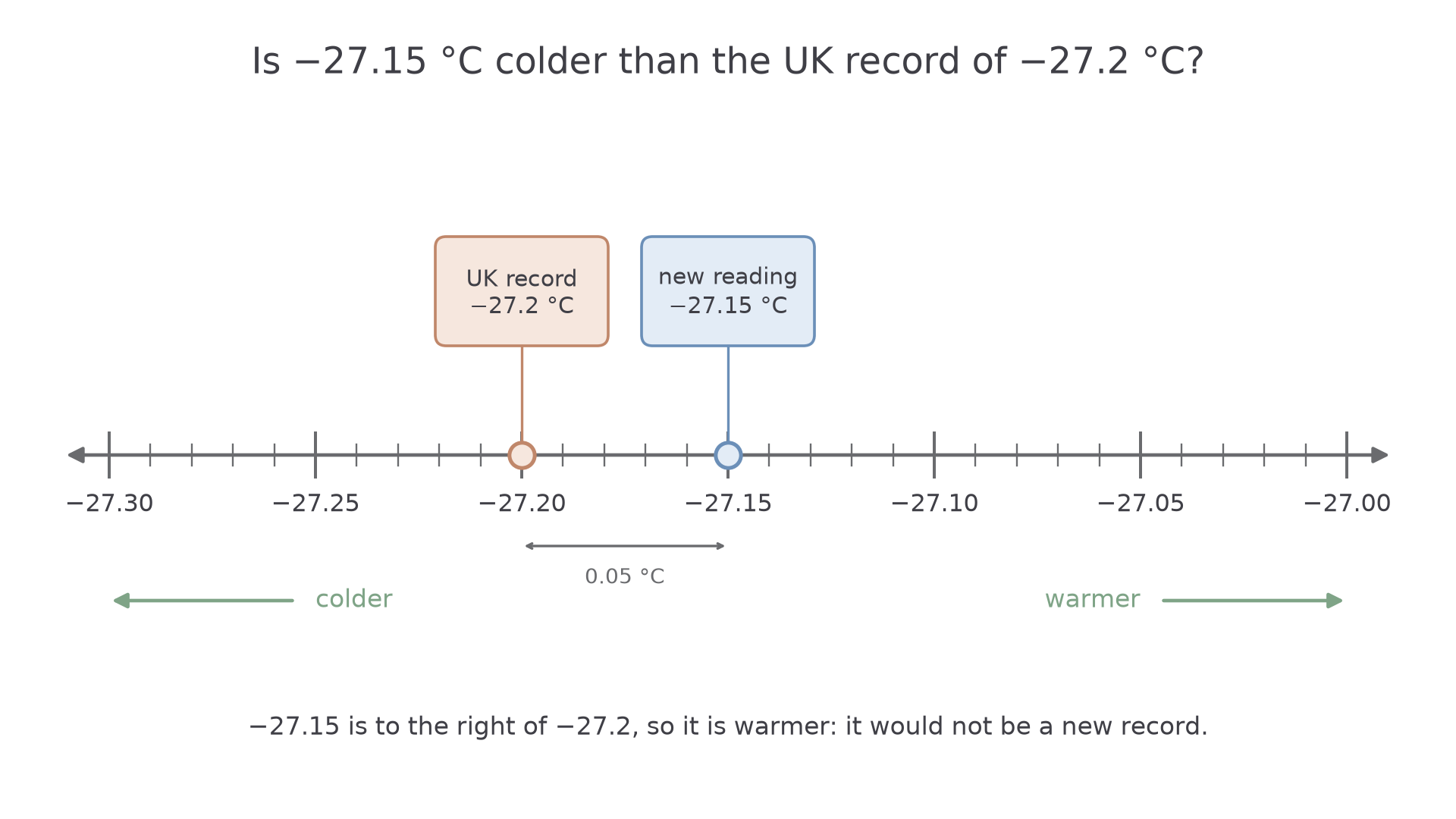
So is warmer than the record, by degrees, and it would not be a new record. The tempting answer, "yes, because 15 is bigger than 2", makes both of this lesson's classic mistakes at once: it compares 15 hundredths with 2 tenths as if they were whole numbers, and it forgets that for negative numbers, further from zero means smaller.
Quick Recap
- A digit's value depends on its column. Each column is worth ten times the column on its right, and a zero holds an empty place.
- Multiplying by 10, 100 or 1000 moves every digit 1, 2 or 3 columns left; dividing moves them right. The decimal point stays put.
- From one known fact you can find many more. In a multiplication the answer changes the same way as the numbers; in a division, scaling both numbers the same way leaves the answer unchanged.
- Compare decimals column by column from the left, after adding zeros to line them up. For negative numbers, further from zero means smaller.
- and open towards the larger number; and include the boundary value.
The opening question: is warmer than , so it would not break the UK record.