G1, G2 - Geometric terms and constructions
Use G1's geometric language to read, label and draw shapes accurately. Then use G2's ruler-and-compass constructions to make exact midpoints, right angles and angle bisectors, including an angle of .
Points, lines and shapes
Can you find the exact middle of a line without reading the halfway mark on a ruler? Two pairs of equal compass arcs can do it. First, you need a language for saying precisely what you have made.
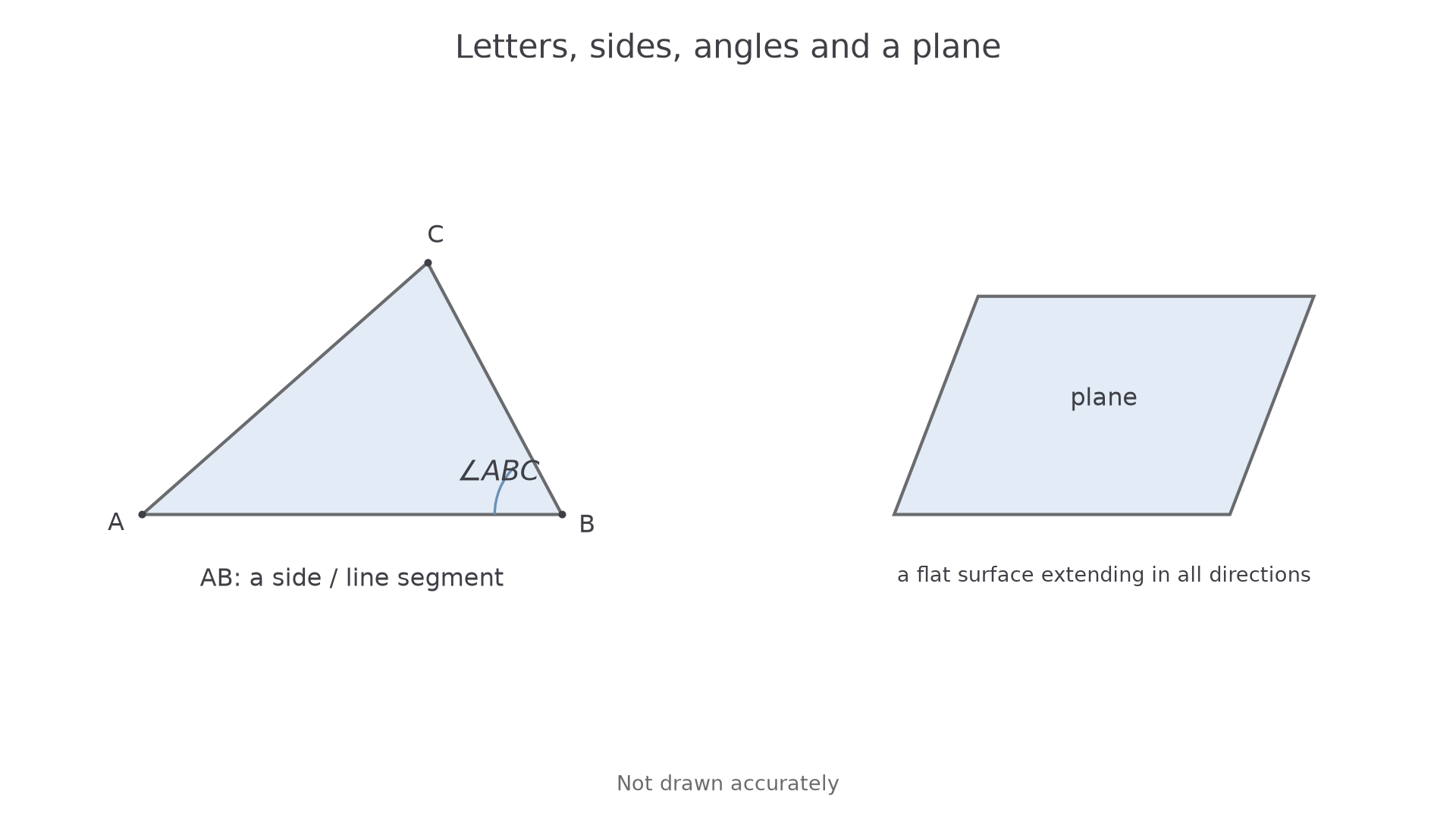
A point marks a position and has no size. A line is straight and extends indefinitely in both directions; a line segment has two endpoints. A plane is a flat surface extending in all directions. A vertex is a corner; vertices is its plural. In a solid, an edge is where two faces meet. A cube has eight vertices and twelve edges, even when a drawing hides some of them.
[DIAGRAM: asset_name: Geometric language; asset_slug: aqa8300_g01_language; caption: The middle letter identifies the vertex of an angle; description: A labelled triangle ABC shows side AB and angle ABC at B. Beside it a shaded flat patch represents part of a plane.]
Parallel and perpendicular
Parallel lines lie in the same plane and never meet, however far they are extended. Perpendicular lines meet at a right angle, . For example, opposite edges of a rectangular page are parallel; adjacent edges are perpendicular. Two lines which cross at are not perpendicular.
An arrow mark on each of two lines means that they are parallel. Matching short ticks mean equal lengths; matching angle arcs mean equal angles. A small square means a right angle. These marks carry information: the apparent shape of a sketch does not.
A polygon is a closed plane shape made from straight line segments. A circle is not a polygon. A regular polygon has all sides equal and all interior angles equal. An equilateral triangle and a square are regular; a rectangle with unequal neighbouring sides is not.
A line of reflection symmetry folds a shape onto itself. Rotational symmetry means it fits itself after a turn smaller than a full turn. The order counts the matching positions in one full turn, including the starting position. A non-square rectangle has two reflection lines and rotation order two. A sloping parallelogram can have rotation order two but no reflection lines. Symmetry and regularity are different tests.
Key idea
A geometric statement comes from its definition, measurements or given marks. A shape looking regular or a line looking perpendicular is not enough.
A tilted square keeps all its properties. Turning the page changes your view, not the mathematics.
Read labels and draw from words
In angle , the middle letter is the vertex. The arms point from towards and . Angle names the same angle, but angle is at a different vertex.
The side opposite vertex is . When lower-case side letters are used, is opposite angle , opposite , and opposite . A diagonal joins non-neighbouring vertices of a polygon. Label a polygon's vertices in order around its boundary so that names its four sides unambiguously.
Worked example 1: turn a description into a sketch
Question. Sketch triangle with , , and a right angle at . Label the side opposite .
Plan. Put the stated right angle at the middle letter, then attach the given lengths to its two arms.
- Draw a horizontal segment , with left of : this is the first named side.
- Draw vertically upwards from : this makes perpendicular to .
- Join to , label the two lengths, and add a right-angle square at : all the given information is now recorded.
Why this step? Both named sides contain , so they must meet at the stated right angle.
Answer. The side opposite is , which may also be labelled .
Check. does not touch ; the right-angle square is at , not .
The second example changes the vertex named in the description. Keep following the letters rather than copying the orientation.
Worked example 2: move the right angle
Question. Sketch triangle , with , , and angle . Name the side opposite .
Plan. Make the corner where the two given sides meet.
- Draw : its endpoints fix the first side.
- At , draw perpendicular to : the middle letter of identifies the right-angle vertex.
- Join to and label all given facts: this closes the triangle.
Why this step? The length belongs on a side touching , not on the opposite side.
Answer. is opposite .
Check. joins the other two vertices. There is exactly one right-angle square, at .
A sketch records relationships. An accurate drawing also uses the stated lengths and measured or constructed angles. If a question says “Not drawn accurately”, use its labels in calculations instead of measuring it.
Watch out
Wrong: put angle at because is written first. Right: put it at , the middle letter.
Picture the corner before naming the opposite side.
Construct a perpendicular bisector
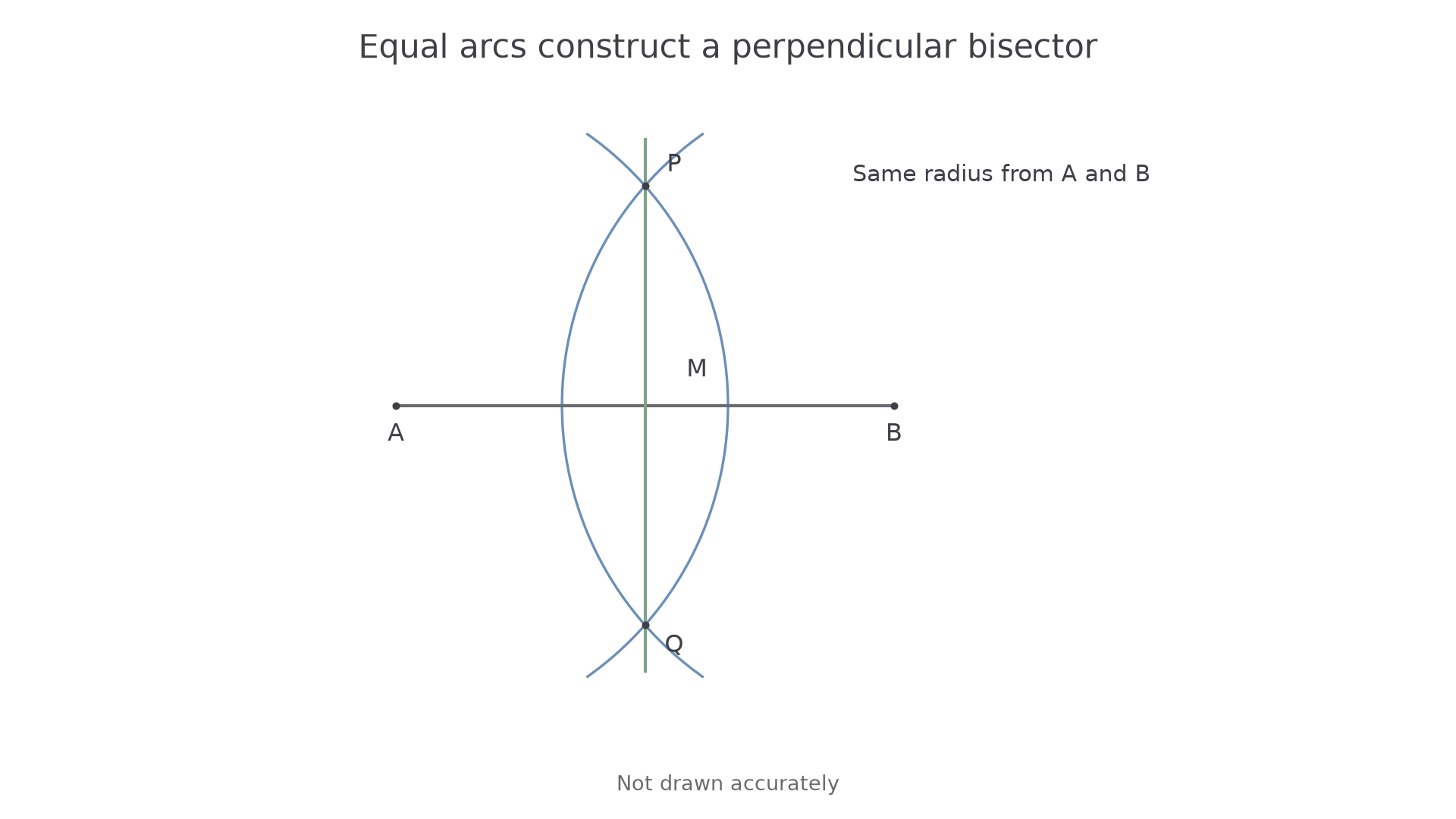
Open your compasses more than halfway along a segment. Equal arcs from its two ends meet above and below it. Joining those crossings gives an exact middle line.
Perpendicular bisector
A line which cuts a line segment into two equal lengths and meets it at . For example, the perpendicular bisector of an segment passes through its midpoint. A line through the midpoint at another angle bisects the segment but is not its perpendicular bisector.
Every crossing of the equal-radius arcs is equally far from both endpoints. The two crossings sit on the line midway between them. These construction facts are not on the formulae sheet: learn them.
[DIAGRAM: asset_name: Perpendicular bisector construction; asset_slug: aqa8300_g01_bisector; caption: Equal compass settings from A and B locate two points on the perpendicular bisector; description: Segment AB is crossed by equal-radius blue arcs above and below. Their crossings P and Q are joined by a sage perpendicular line through midpoint M.]
Worked example 3: bisect a segment
Question. Use a ruler and compasses to construct the perpendicular bisector of .
Plan. Make two pairs of equal-radius arcs, then join their crossings.
- Draw : the segment is the starting object.
- Set the compasses to , which is more than half of : the arcs will cross.
- From , draw arcs above and below . Without changing the setting, repeat from : matching radii give equal distances.
- Name the crossings and , and draw the straight line : it crosses at midpoint .
Why this step? Keeping the radius the same makes both crossings equally far from and .
Answer. is the perpendicular bisector, with .
Check. , and the constructed line meets at a right angle. Leave the construction arcs visible.
The segment in the second example is longer. The method stays the same; only the minimum useful compass opening changes.
Worked example 4: choose a suitable opening
Question. Construct the perpendicular bisector of . A student suggests an opening of . Explain the problem and complete the construction.
Plan. Compare the opening with half the segment, then use a larger equal setting from both endpoints.
- An opening of is too small: the two arcs cannot reach each other.
- Use from both and : this is greater than .
- Join the crossings above and below the segment: their line is its perpendicular bisector.
Why this step? A radius exactly equal to half the segment gives only one touching point. Two crossings are needed to define the new line.
Answer. Use , for example. Each half of is .
Check. Both endpoint settings are equal and .
The ruler joins points; it does not replace the compass arcs with a measured guess.
Exam tip
When asked to use ruler and compasses, leave the arcs visible. A line drawn through a measured midpoint does not show the required construction.
Now judge an opening for a different segment.
Construct a perpendicular from or at a point
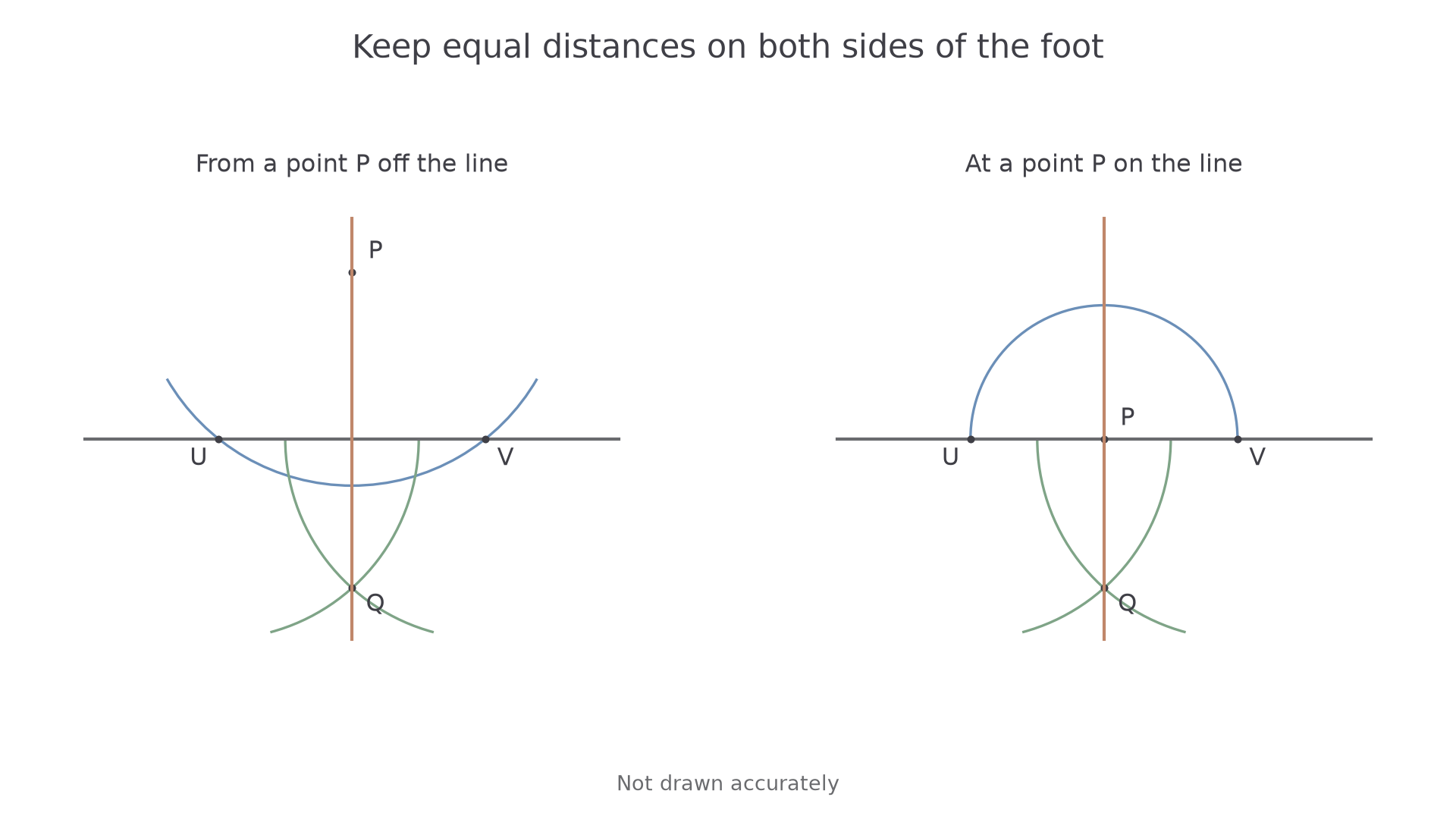
A perpendicular bisector also builds a right angle through a chosen point. First create two points on the given line which are equally far from the chosen point.
[DIAGRAM: asset_name: Perpendicular from and at a point; asset_slug: aqa8300_g01_perpendiculars; caption: Equal distances PU and PV make P lie on the perpendicular bisector of UV; description: Two panels show a point P above a line and a point P on a line. An arc from P marks U and V equally far away on the line. Equal arcs from U and V meet at Q, and PQ is perpendicular to the line.]
Continue this lesson.
You’re previewing NovaLearn without an account. Create a free account to read the rest.
Create free account