G3 - Angle facts and parallel lines
Use angle sums and equal-angle relationships to work out missing angles. Learn the precise reasons for angles on straight lines, around points and between parallel lines, so you can explain each step without measuring a sketch.
Straight lines and full turns
Two straight railway tracks are parallel. A road crosses them, making an angle of with one track. Can you work out all the angles at both crossings from that one number? Yes: a few angle facts do all the work.
You already know
Perpendicular lines meet at . Parallel lines in the same plane never meet. Use given angle labels and marks, rather than measuring a diagram labelled “Not drawn accurately”.
An angle measures a turn between two rays. A right angle is a quarter-turn; a straight angle is a half-turn. Put two adjacent angles against the same straight line, with no gap or overlap, and together they fill that half-turn.
[DIAGRAM: asset_name: Basic angle relationships; asset_slug: aqa8300_g02_angle_basics; caption: Adjacent angles on a straight line total 180 degrees; angles around a point total 360 degrees; vertically opposite angles are equal; description: Three panels show a straight angle divided into a and b, a full turn divided into a, b and c, and two crossing straight lines with matching opposite angles.]
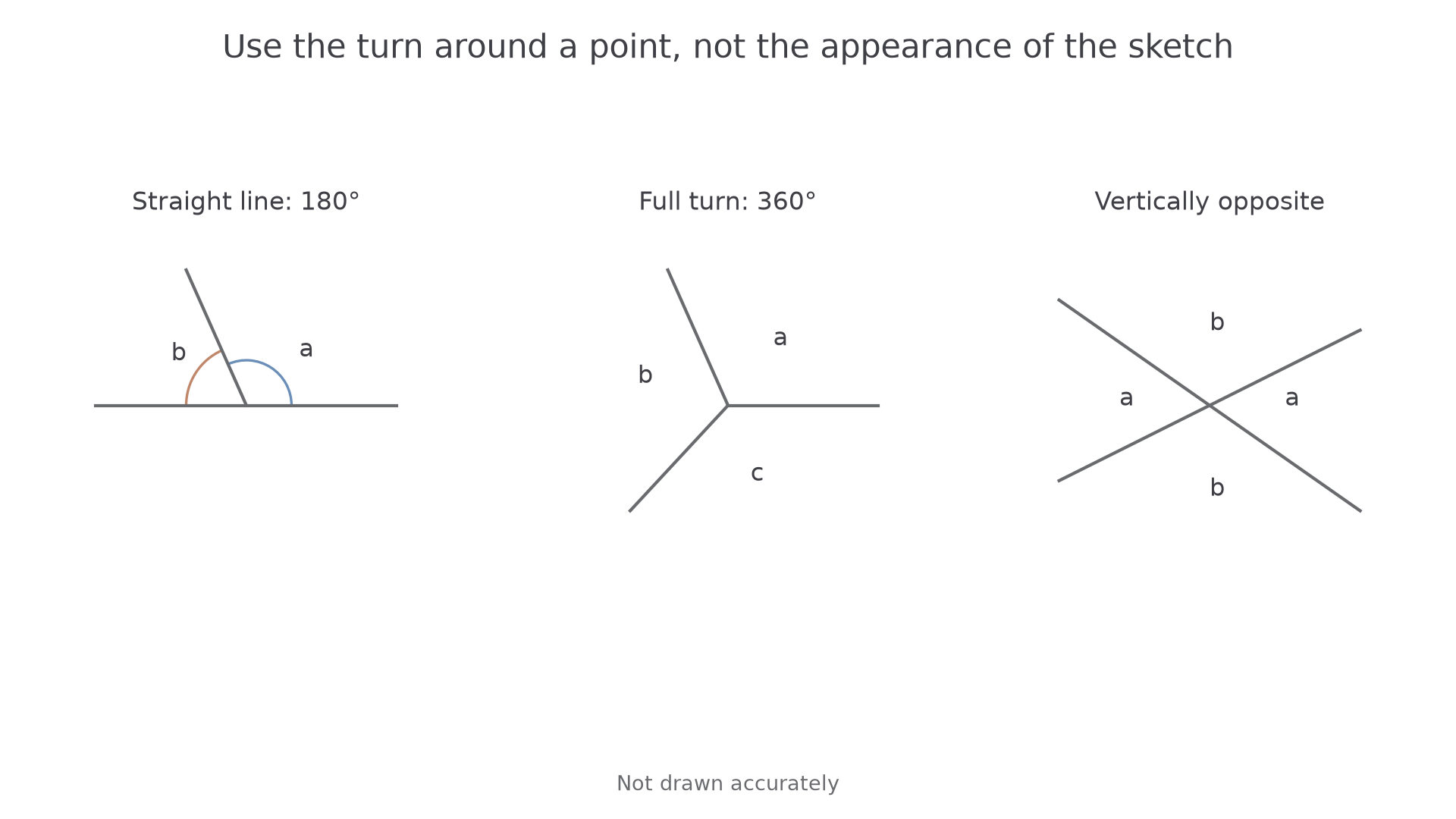
Angles on a line and around a point
Adjacent angles filling a straight angle sum to . Angles filling one full turn around a point sum to .
The angles must fill the stated straight angle or full turn without gaps or overlaps.
Not on the formulae sheet: learn it.
You choose the total by looking at what the angles fill, rather than by counting how many labels appear.
Worked example 1: a straight line, non-calculator
Question. Two adjacent angles on a straight line are and . Work out .
Plan. Subtract the known angle from the straight-angle total.
Why this step? The two angles together make a half-turn, so the correct total is .
Answer. , so the missing angle is .
Check. .
The second example changes the total turn: the angles now go all the way around a point.
Worked example 2: a full turn, non-calculator
Question. Three angles around one point are , and . Work out .
Plan. Add the known angles, then subtract from a full turn.
Why this step? All three angles fill the whole space around the point, not just one side of a straight line.
Answer. , so the angle is .
Check. .
Two angles adding to are complementary; two adding to are supplementary. Those words describe the total, even if the angles are not next to each other.
Watch out
Wrong: use for every collection of angles. Right: a straight angle totals ; a complete turn totals .
A labelled reflex angle is greater than . It can still be found by subtracting the smaller angle from a full turn.
Vertically opposite angles
When two straight lines cross, opposite angles are equal. “Vertically” here means across the vertex; it does not mean pointing towards the top of the page.
Suppose one angle is . Its neighbour is . The angle opposite the first is then . Subtracting the same neighbouring angle from explains the equality.
Vertically opposite angles
When two straight lines intersect, each pair of vertically opposite angles is equal.
The two pairs alternate as you go around the intersection.
Not on the formulae sheet: learn it.
The equal angles touch only at their common vertex. Adjacent angles share a ray and generally have different sizes.
Worked example 3: cross the vertex, non-calculator
Question. Two straight lines cross. One angle is . Work out the angle vertically opposite it and either adjacent angle.
Plan. Copy the opposite angle, then use a straight-line total for a neighbour.
Why this step? Equality applies across the vertex, not beside the given angle.
Answer. The opposite angle is ; each adjacent angle is .
Check. .
The second example changes the given angle from acute to obtuse. The neighbouring angles become the acute ones.
Worked example 4: an obtuse angle, non-calculator
Question. Two straight lines intersect. One angle is . Work out the other three angles.
Plan. Use the opposite equality first, then subtract from .
Why this step? Crossing lines give two equal pairs, not four equal angles unless the lines are perpendicular.
Answer. The other angles are , and , in order around the point.
Check. .
An intersection of two straight lines therefore has at most two different angle sizes. At a right-angle crossing, even those two sizes coincide.
Watch out
Wrong: all four angles are equal because the lines cross. Right: opposite angles are equal; neighbouring angles sum to .
Give both the value and the named reason when the question asks for them.
Corresponding angles on parallel lines
A transversal is a straight line which crosses two or more other lines. If those other lines are parallel, matching corner positions at the two crossings have equal angles.
Imagine sliding the top crossing down the transversal without turning it. The direction of the parallel line stays the same. That is why the matching angle stays the same too.
Continue this lesson.
You’re previewing NovaLearn without an account. Create a free account to read the rest.
Create free account