P8 - Tree diagrams and combined events
A probability tree records both the possible paths and the chance of each step. You will calculate independent and dependent combined events, decide when to multiply and when to add, and use complements and overlapping events without double counting.
When events are independent
A bag contains red and blue counters. You choose two counters at random. Does putting the first counter back change the chance of two reds? We will compare the two experiments after learning to read their trees.
You already know
A complete outcome follows one path through a listing tree. Mutually exclusive end outcomes are separate cases, so their probabilities can be added. The probability of not is .
If you replace the first counter and mix the bag, the second selection starts with the original red and blue counters. Knowing the first colour does not change the chance of the second colour. If you keep the first counter out, it changes what is left.
Independent events
Two events are independent if knowing that one happens does not change the probability of the other. For example, a fair coin toss and a separate fair die roll are normally modelled as independent. Two selections without replacement from a mixed-colour bag are generally dependent.
Independence is an assumption about the experiment, not a reward for having a large number of trials. Two spinners are modelled as independent when how one lands does not affect how the other lands. Weather on consecutive days should not automatically be treated as independent.
Mutually exclusive means something different. On one die roll, “” and “” cannot happen together. They are not independent: knowing the result is rules out . On two separate independent rolls, the first being does not rule out the second being .
Key idea
Check what changes between stages. Replacement and mixing can restore the original chances; without replacement, work out the new chances from what remains.
The meanings of independent and mutually exclusive are not on the formulae sheet: learn them. A tree should express the stated model, rather than silently assume independence.
Multiplying along independent paths
A branch probability describes the chance of taking that branch from its own starting point.
For the opening bag, the first split has red and blue . With replacement and mixing, each second split has those same probabilities. At each split, the outgoing probabilities add to .
[DIAGRAM: asset_name: Independent counter tree with replacement; asset_slug: aqa8300_p03_independent_tree; caption: Replacement restores the same probabilities at both second-stage splits; description: A two-stage probability tree for a bag with 3 red and 2 blue counters, with replacement and mixing. Both first and second selections have red probability 3/5 and blue probability 2/5. End paths RR, RB, BR and BB have probabilities 9/25, 6/25, 6/25 and 4/25.]
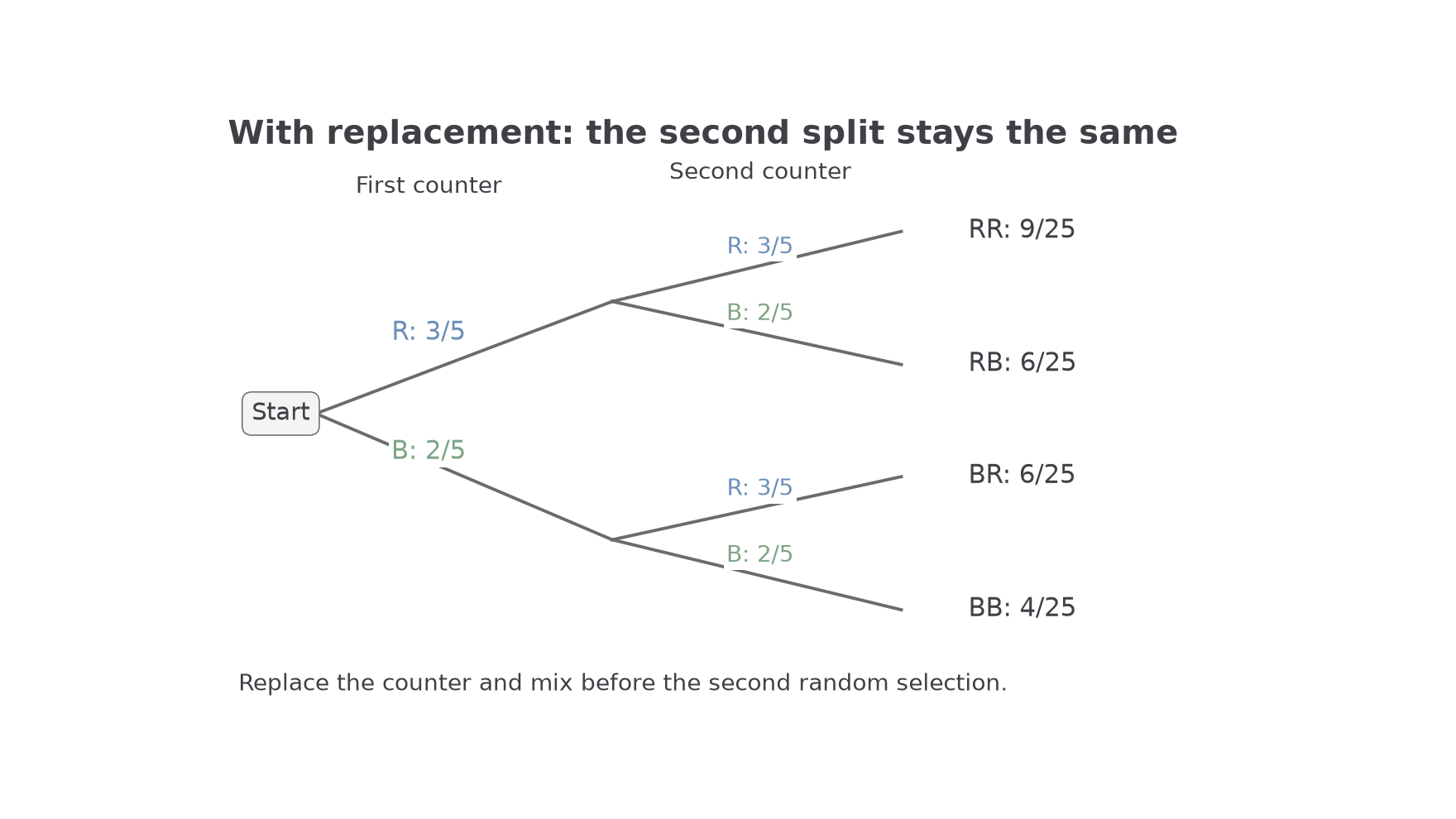
Imagine equally likely ordered pairs of individual counters: choosing any of first and any of second. There are choices of red first and choices of red second, giving red-red pairs. Multiplication expresses this “a fraction of a fraction” idea.
Independent events together
If and are independent,
For more independent stages, multiply the probability from every stage on the required path.
This independent special case is not printed separately on the formulae sheet: learn it. The Higher sheet gives the general conditional multiplication rule.
Do not add two branches from different stages when you want both events. Multiplication follows one complete path.
Worked example 1: two reds with replacement
Question. A bag contains red and blue counters. A counter is chosen at random, replaced, and the bag mixed before a second selection. Work out the probability of two reds. Non-calculator.
Plan. Follow the red-red path and multiply its two branch probabilities.
Why is the second fraction still ? Replacement restores all counters, including all reds.
Answer. .
Check. Two reds is less likely than a red first: .
The next example changes only the second required colour. The tree itself stays the same.
Worked example 2: red then blue
Question. In the same with-replacement experiment, work out the probability of red first and blue second. Non-calculator.
Plan. Follow the red-blue path.
Why is order important? This asks for red then blue, not either possible order of different colours.
Answer. .
Check. The two paths starting red add to , the chance of red first.
A missing probability on a binary split is found by subtracting the other probability from . At a split with three branches, subtract the sum of the other two.
Watch out
Wrong: for red then blue. That adds probabilities from different stages. Right: multiply along that path, giving .
The next bag changes the counts and reverses the required order.
Adding paths and using complements
An event such as “different colours” may be reached by more than one complete path.
For the bag with red and blue counters, with replacement, different colours means or . These are mutually exclusive complete outcomes: one trial cannot finish in both. Multiply within each path, then add the path probabilities.
Combining separate paths
For mutually exclusive complete outcomes,
For a three-stage path, multiply all three branch probabilities before adding it to other paths.
Not on the formulae sheet as a tree rule: learn it. It follows from the sheet's addition rule when the events do not overlap.
“Exactly one”, “at least one” and “both” select different paths. Decide which paths belong before calculating.
Worked example 3: exactly one red
Question. The bag contains red and blue counters. Two random selections are made with replacement and mixing. Work out the probability of exactly one red. Non-calculator.
Plan. Calculate red-blue and blue-red separately, then add.
Why not include ? Exactly one red excludes a second red.
Answer. .
Check. All four paths sum to .
The next example changes only “exactly one” to “at least one”. A complement avoids adding three paths.
Worked example 4: at least one red
Question. In the same with-replacement experiment, work out the probability of at least one red. Non-calculator.
Plan. Subtract the probability of no reds, , from .
Why is no red the complement? With two selections, every outcome has either zero reds or at least one red, with no overlap.
Answer. .
Check. Adding the included paths gives .
Continue this lesson.
You’re previewing NovaLearn without an account. Create a free account to read the rest.
Create free account