N5 - Systematic listing and the product rule
A list is useful only if you can trust that nothing is missing. You will organise choices in lists, tables and branching diagrams, decide when order matters, and count possibilities without repeats. The final part introduces the product rule for Higher tier.
Lists, tables and branching diagrams
You have a blue top, a red top, and black, grey and navy trousers. How can you be certain you have found every outfit, rather than just six outfits that came to mind?
Start with the blue top and pair it with each pair of trousers. Only when that row is finished do you change to the red top. The order of your search makes the list reliable.
You already know
You can add groups and read a table by its row and column headings. Here, each outfit must contain exactly one top and one pair of trousers.
Use two-letter labels: the first letter names the top and the second names the trousers. A table gives every pairing its own cell.
| Top | Black trousers | Grey trousers | Navy trousers |
|---|---|---|---|
| Blue | BB | BG | BN |
| Red | RB | RG | RN |
A branching diagram records the same search. Each completed path is one outfit; branches are choices, not probabilities.
[DIAGRAM: asset_name: Listing six outfits with branches; asset_slug: aqa8300_n05_outfit_tree; caption: Finish all three trouser choices for one top before moving to the next top; description: Blue and red top boxes each branch to black, grey and navy trouser boxes. Six labelled endpoints show blue with black, grey and navy, then red with black, grey and navy.]
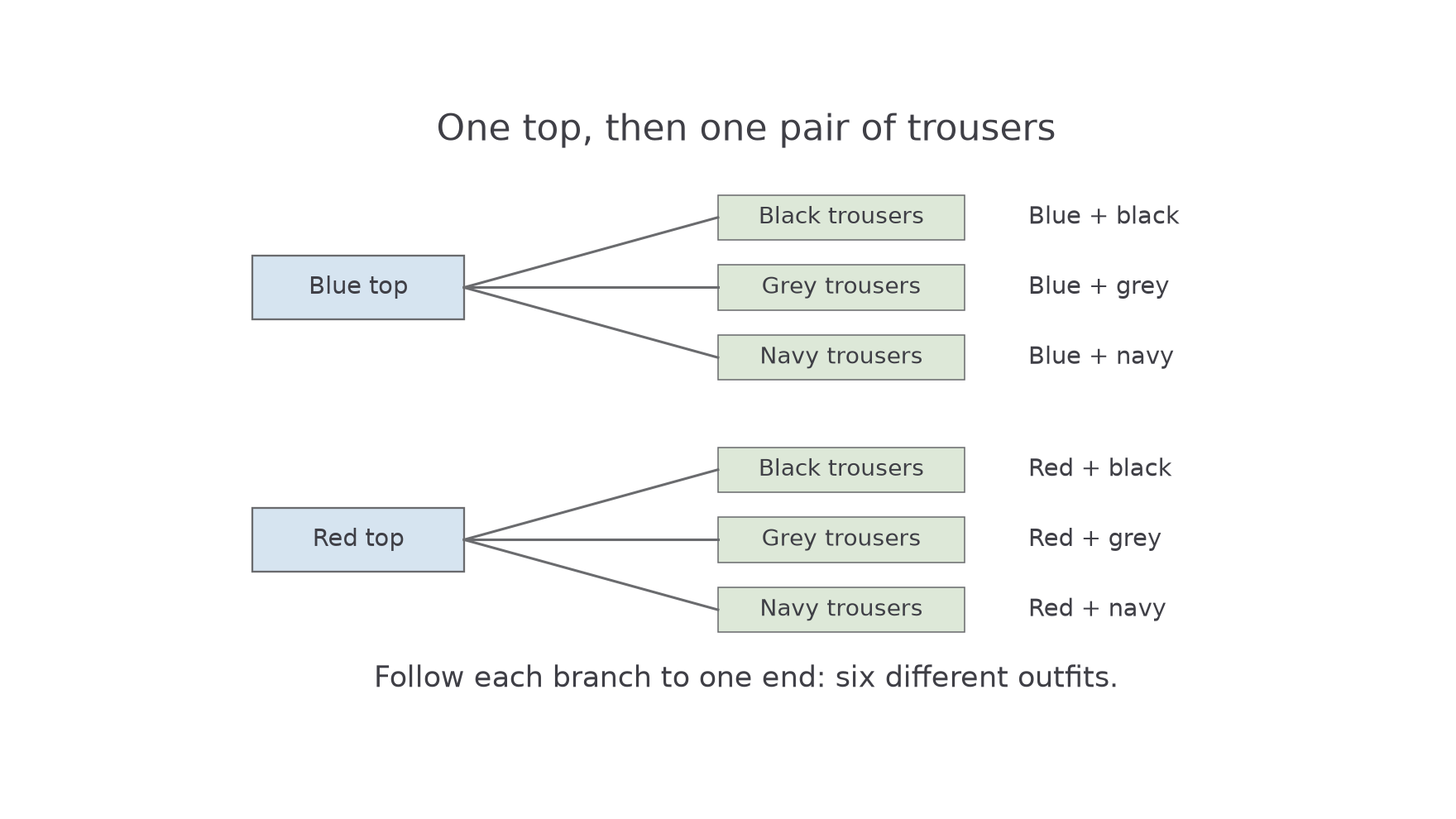
Systematic listing
Listing possibilities in a fixed order so that every allowed possibility appears once. For example, fix the first choice and work through the second choices in order. A collection of guesses with no way to check completeness is not systematic.
The written list should make its organisation visible. This is especially useful when a question says “List all”. A total alone does not list anything.
Worked example 1: a complete table
Question. A café offers apple or orange juice, and a cheese or tomato sandwich. List all possible meals containing one juice and one sandwich. Non-calculator.
Plan. Fix the juice, then list every sandwich before changing juice.
Why this order? It gives each juice a complete row, so a missing meal leaves a visible gap.
Answer. Apple and cheese, apple and tomato, orange and cheese, orange and tomato.
Check. Each of the two juice rows contains both sandwiches. No meal appears twice.
Change just one feature: add a third sandwich. Every juice row must now include that extra choice.
Worked example 2: one more choice
Question. The café now offers cheese, tomato or egg sandwiches, with the same apple or orange juice. List all possible meals. Non-calculator.
Plan. Keep the same row order and put three sandwich choices in each row.
Why this step? The egg choice creates one new meal in each row, not just one new meal overall.
Answer. , , , , , , where the first letter is the juice and the second is the sandwich.
Check. There are six distinct labels, and every allowed juice–sandwich pairing occurs.
Changing a category means checking the whole list, rather than attaching one extra answer at the end.
Watch out
Wrong: adding only when egg is introduced. That misses . Right: revisit each juice row whenever a sandwich option changes.
Try the same organisation with different categories. Include a key if you shorten the words.
Order, repeats and restrictions
Before you list, decide what counts as a different answer and what is allowed.
For a two-digit code, and are different: the positions matter. For a pair of pizza toppings, cheese with onion is the same selection as onion with cheese. Those are two descriptions of one choice.
Distinct possibilities
Possibilities that the question treats as different. A code is usually ordered, so reversing its digits may change it. A group of people or a selection of toppings is usually unordered, so rearranging the same members does not make a new selection.
The restriction “no repeats” has a separate job. A code made from , and , without repeated digits, cannot include . Start with the smallest first digit, then finish its row.
Worked example 3: ordered choices without repetition
Question. List all two-digit numbers made from , and . A digit cannot be used twice. Non-calculator.
Plan. Fix the tens digit, then use each different digit in the units position.
Why keep and ? Their tens digits differ, so they are different numbers.
Answer. , , , , , .
Check. Every answer has two different allowed digits; each possible tens digit has its own finished row.
Change only the meaning of the choice: select a pair of digit cards instead of making a number. Order now does not matter, so the reversed entries must disappear.
Worked example 4: unordered selections
Question. Three cards show , and . List all selections of two different cards. Non-calculator.
Plan. Write the smaller card first, so that each pair has just one description.
Why use the smaller card first? It removes duplicates without losing any possible pair.
Answer. , , .
Check. Each selection leaves out exactly one of the three cards, giving three selections.
There is a useful surprise here: choosing three toppings from four gives exactly as many selections as choosing one topping to leave out. Both give four. A shorter description can make completeness much easier to see.
Watch out
Wrong: listing AB and BA as two different pairs of friends. Swapping the names does not change the pair. Right: fix one name order and count each pair once. For a code, however, AB and BA usually are different.
A condition may remove some entries rather than change their order. For an even number, for example, only even final digits survive. Make the full organised list first if that is clearer, then cross out the forbidden entries.
The product rule for counting (Higher)
When every first choice has the same number of possible second choices, a long list can be counted as equal-sized rows.
In the opening outfit table, each of two tops has three trouser choices. That is . Multiplication writes the same count as . With more stages, count the choices available at each stage, then multiply.
Product rule for counting
If there are choices at the first stage and, for each of these, choices at the second stage, then
For several stages, multiply their numbers of choices. Each complete outcome must be counted once, and the number available at each stage must be the same along every branch being counted.
Not on the formulae sheet: learn it.
The choices need not stay available after being used. With no repetition, the counts can decrease from one stage to the next, provided they decrease in the same way for every branch.
Worked example 5: repeated symbols allowed
Question. A three-letter code uses only , , , and . Letters may repeat. Work out the number of codes. Non-calculator.
Plan. Count the choices for each position, then multiply.
Why not add the three fives? Each first letter has a complete set of later choices. The stages combine; they are not alternative lists.
Answer. codes.
Check. Fixing the first letter gives endings. There are five such groups, so altogether.
Change one condition: letters cannot repeat. A used letter now leaves the pool.
Worked example 6: repeated symbols forbidden
Question. The same five letters make three-letter codes with no repeated letter. Work out the number of codes. Non-calculator.
Plan. Remove one available letter after each position is filled.
Why is the second count always four? Whichever first letter was chosen, exactly one of the five letters has been used.
Answer. codes.
Check. For each first letter there are endings. Also , as banning repeats must reduce the count.
If different first choices leave different numbers of endings, separate the cases. For example, using , , and for a two-digit even number without repetition: final digit leaves three first digits, but final digit leaves only two, because a two-digit number cannot begin with . The total is , matching , , , , .
Watch out
Wrong: two-digit numbers from , , , without repetition. This includes numbers beginning with zero. Right: the first digit has three choices and the second has three remaining choices, giving .
The opening puzzle has its answer: the table or branches prove the list is complete, while the product rule gives a fast count. Use a list to check a small product-rule problem whenever possible.
Quick Recap
- Fix the first choice and finish its row before moving on. Lists, tables and branches can record the same search.
- Check whether order matters and whether repetition is allowed.
- For unordered selections, choose a fixed writing order to prevent duplicates.
Every outfit in the opening question appears once in a finished row: there are six, with none missing.