G16, G17 - Perimeter and area of 2D shapes
Perimeter measures the boundary; area measures the surface inside it. G16 gives the area methods for triangles, parallelograms and trapezia. G17 brings these together with rectangles to find perimeters and areas of composite shapes, including shapes with missing lengths.
Perimeters and missing lengths
A rectangular sheet is by . Cut a smaller rectangle from its top-right corner. Must the perimeter get smaller? Keep that picture in mind: removing some area need not remove any perimeter.
You already know
Opposite sides of a rectangle are equal and each corner is a right angle. Lengths must use the same unit before you add them. Substitution puts known values into a formula.
Imagine tracing an outline with your finger. The distance your finger travels is the perimeter. Include every exposed edge once. A line drawn across the inside to help a calculation is not part of the boundary.
Rectangle perimeter and area
For a rectangle with length and width , measured in matching units,
Perimeter uses length units; area uses square units.
Not on the formulae sheet: learn it.
For a square, all four sides have the same length , so these give and . These results are also not on the formulae sheet: learn them. A perimeter calculation adds lengths; multiplying two lengths usually indicates an area calculation.
Worked example 1: a rectangular boundary
Question. A rectangle is long and wide. Work out its perimeter. Non-calculator.
Plan. Add two lengths and two widths.
Why not ? That gives the area inside, not the distance around.
Answer. .
Check. Following all four edges gives .
Change one feature: cut a rectangle from a corner. Find each missing edge by comparing the total horizontal or vertical lengths.
Worked example 2: a corner cut-out
Question. A rectangle measures across and up. A -wide, -high rectangle is removed from its top-right corner. Work out the new perimeter. Non-calculator.
Plan. Walk round the six outside edges, finding the two remaining edge lengths first.
Why include the inward step? It is now an exposed edge of the sheet.
Answer. .
Check. The original perimeter was . Two removed lengths, and , have been replaced by two equal lengths inside the corner.
That settles the opening puzzle: this corner cut reduces the area by , but leaves the perimeter unchanged. Moving those two boundary pieces inward has not changed their lengths. A hole cut from the middle would behave differently: its edge would add a new boundary.
Watch out
Wrong: subtract from the original perimeter and stop. That ignores the new edges beside the cut-out. Right: trace the whole remaining boundary.
Use the same corner-cut idea with new dimensions.
Triangles and parallelograms
A triangle's area is half the area of a parallelogram with the same base and perpendicular height.
Take a sloping parallelogram. Cut off the triangular piece at one end and move it to the other: it fits into a rectangle with the same base and height. No area is lost. A diagonal of a parallelogram then splits it into two equal-area triangles.
[DIAGRAM: asset_name: Triangle and parallelogram perpendicular heights; asset_slug: aqa8300_gd_triangle_parallelogram; caption: A triangle has half the area of a parallelogram with the same base and perpendicular height; description: A triangle and a sloping parallelogram each have base 10 cm and perpendicular height 7 cm. Sage dashed heights meet the horizontal bases at marked right angles. The sloping side is distinguished from the height. Not drawn accurately.]
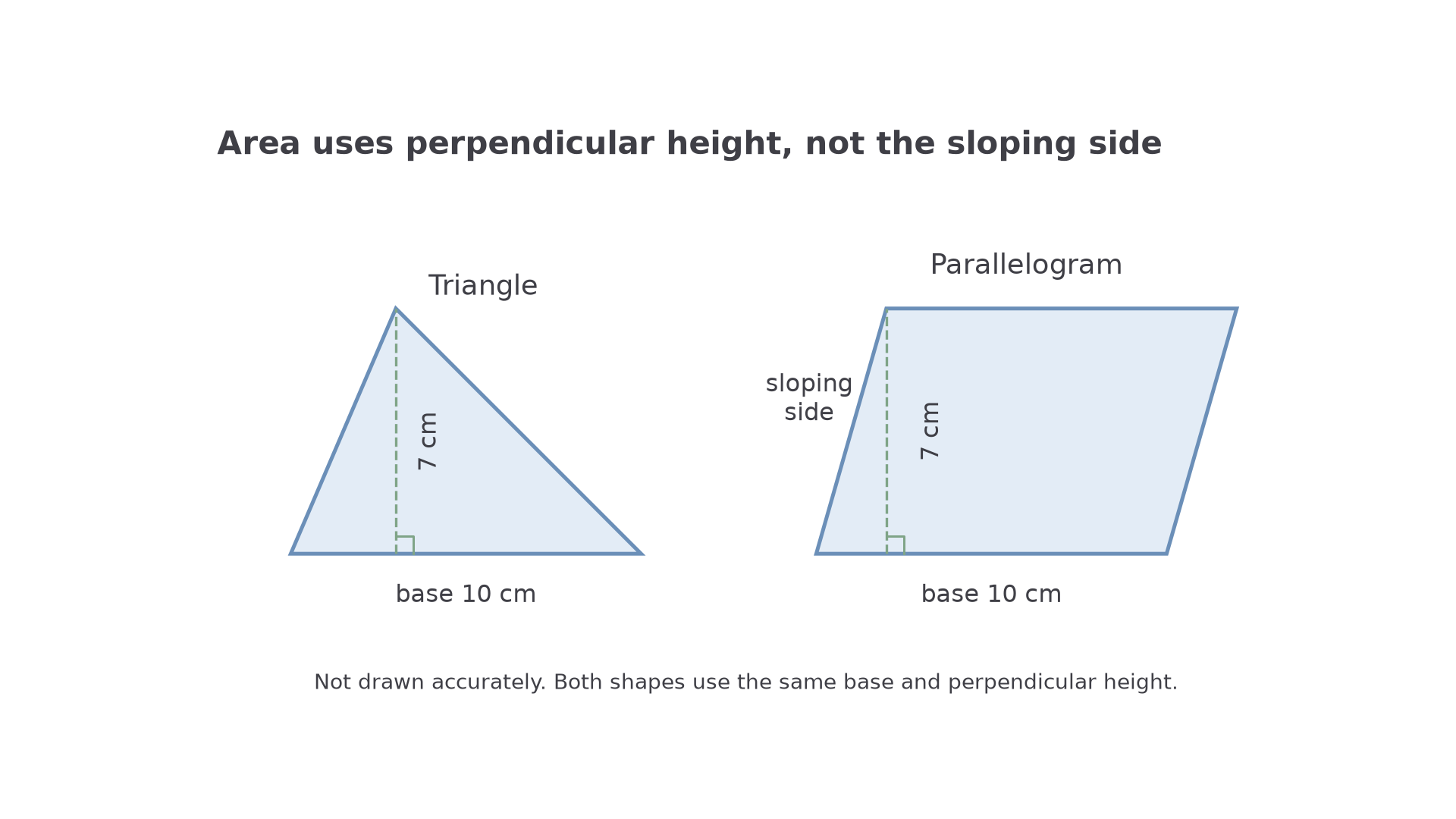
Triangle area
For base and perpendicular height ,
The height meets the base, or the line of the base, at a right angle.
Not on the formulae sheet: learn it.
The base need not be the bottom edge of the page. Any side can be chosen, provided its matching perpendicular height is used. In an obtuse triangle, that height may fall outside the triangle.
Parallelogram area
For base and perpendicular height ,
The sloping side is not usually the perpendicular height.
Not on the formulae sheet: learn it.
The two formulae differ by one factor: a triangle fills half as much area for a given base and height.
Worked example 3: a triangular sign
Question. A triangular sign has base and perpendicular height . Work out its area. Non-calculator.
Plan. Multiply base by perpendicular height, then halve.
Why halve? Two copies of the triangle make a parallelogram with this base and height.
Answer. .
Check. A by rectangle has area , twice this answer.
Change only the shape to a parallelogram. Keep the base and perpendicular height the same so you can see what the factor does.
Worked example 4: a sloping panel
Question. A parallelogram has base and perpendicular height . Work out its area. Non-calculator.
Plan. Multiply the base by the perpendicular height.
Why is there no halving? The entire parallelogram rearranges into a rectangle of this base and height.
Answer. .
Check. This is twice the area of the triangle in Worked example 3.
The height is a distance between parallel lines, so it must be perpendicular to them.
Watch out
Wrong: use the sloping side instead of the height. Right: find the length marked at a right angle to your chosen base. The side's slope does not add extra area.
One of the next measurements is deliberately unnecessary.
Continue this lesson.
You’re previewing NovaLearn without an account. Create a free account to read the rest.
Create free account