G25 - Vector geometry proofs (Higher)
Use vectors to prove that lines are parallel, points lie on one straight line, or an intersection divides a line in a particular ratio. You will replace measurements from a picture with routes that work for every shape satisfying the conditions. Clear arrows and a final geometric reason turn vector algebra into a proof.
Routes with labelled vectors (Higher)
Draw any convex quadrilateral and join the midpoints of its four sides in order. Must the new shape be a parallelogram, even when the original has no parallel sides? It looks like a job for a ruler. Vectors will let you put the ruler away.
You already know
Vectors add head to tail. Reversing an arrow negates the vector, and a scalar multiplies its length, reversing its direction when negative. A proof needs an argument covering every allowed case, rather than a convincing example.
First practise choosing a route. If , and , the route from to can go backwards to , then forwards to :
You reach the same endpoint as the direct arrow. A detour changes the path, but not the displacement.
Position vector
A position vector describes a point relative to a chosen origin . If , then is the position vector of . The origin need not be the bottom-left corner of a diagram or lie on coordinate axes.
Letters let one calculation cover many triangles. Keep the arrow direction visible before replacing it with a letter.
[DIAGRAM: asset_name: Two routes between the same points; asset_slug: aqa8300_g29_triangle_routes; caption: The route from A to B goes backwards along OA, then forwards along OB; description: A scalene triangle OAB with O at0comma0, A at6comma1 and B at2comma5. Blue arrows run O to A labelled2a and O to B labelled3b. A sage arrow runs A to B labelled3b minus2a. A small route statement below says A to O to B. Not drawn accurately.]
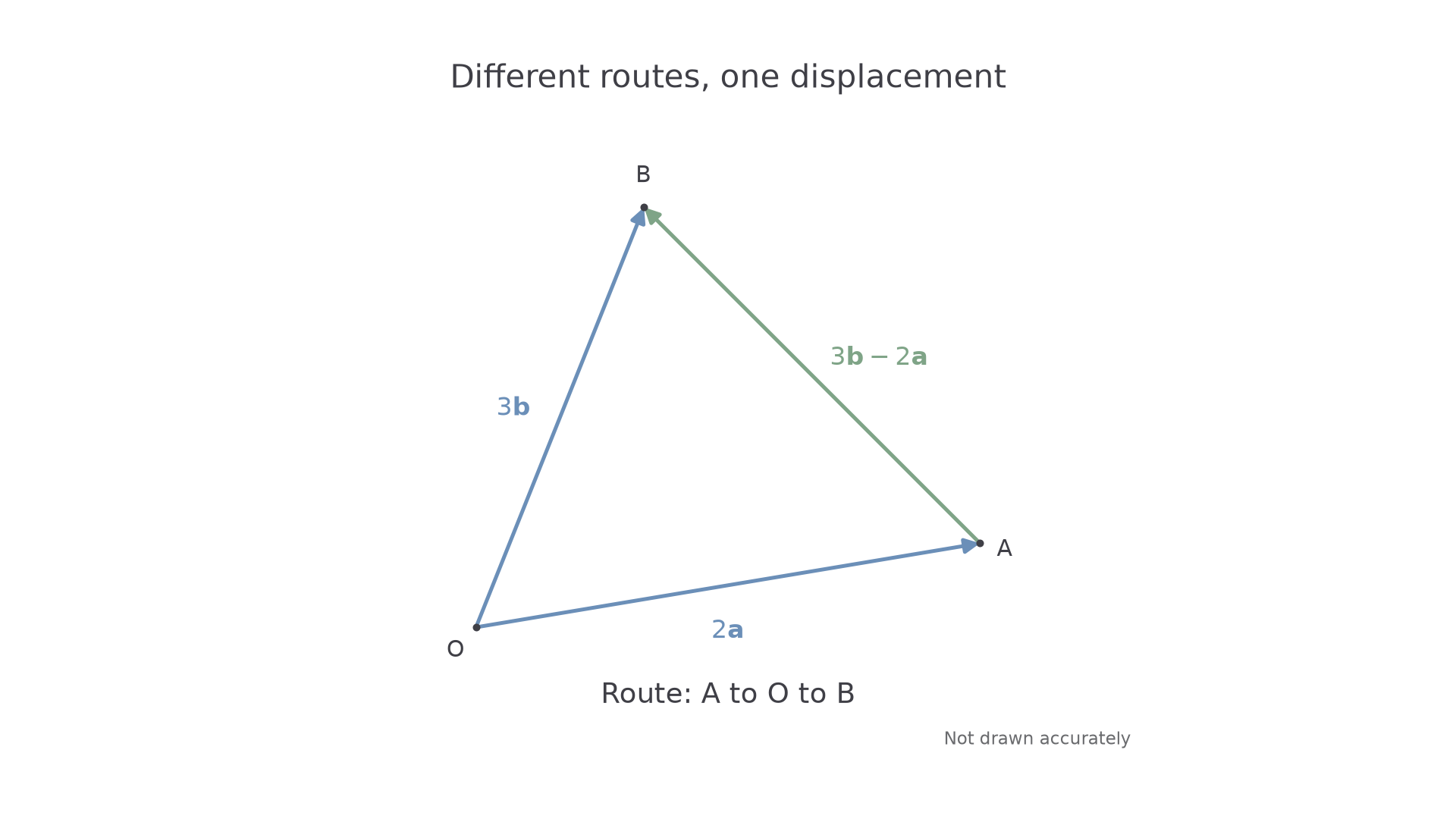
The route rule
For any points , and ,
In particular, if and ,
The arrows in a route must join head to tail.
Not on the formulae sheet: learn it.
Write a route as letters first. It is much easier to catch a reversed arrow before the diagram has become a page of algebra.
Worked example 1: a route through the origin
Question. In triangle , and . Work out in terms of and . Non-calculator.
Plan. Take the route to to .
Why this step? The known arrow is to , but our route travels to . That is where the minus sign comes from.
Answer. .
Check. Add : .
Change only the requested direction. The triangle and its given vectors stay the same.
Worked example 2: reversing the route
Question. In the same triangle, work out in terms of and . Non-calculator.
Plan. Follow to to , reversing .
Why this step? Changing the start and finish reverses the entire vector, so both terms change sign.
Answer. .
Check. , as a complete return journey should.
The symbol means the zero vector. Giving a vector as just a length, or writing when you mean , hides the direction that makes the argument work.
Watch out
Wrong: . Those arrows both start at , so they do not form the required route. Right: .
Put the same route into a new triangle.
Points dividing a line in a ratio (Higher)
If lies on and , the whole segment has three equal shares. The movement from to is one third of the movement from to , not one half.
[DIAGRAM: asset_name: A ratio gives a fraction of the whole vector; asset_slug: aqa8300_g29_ratio_point; caption: AM is one of the three shares making the whole vector AB; description: Triangle OAB has O at0comma0, A at6comma1, B at2comma5. M lies one third of the way from A to B at14over3 comma7over3. Arrows O to A and O to B are labelled a and b. A to M is sage, M to B grey, with AM to MB equals1to2 shown above the side. A sage dashed arrow O to M is labelled OM. Not drawn accurately.]
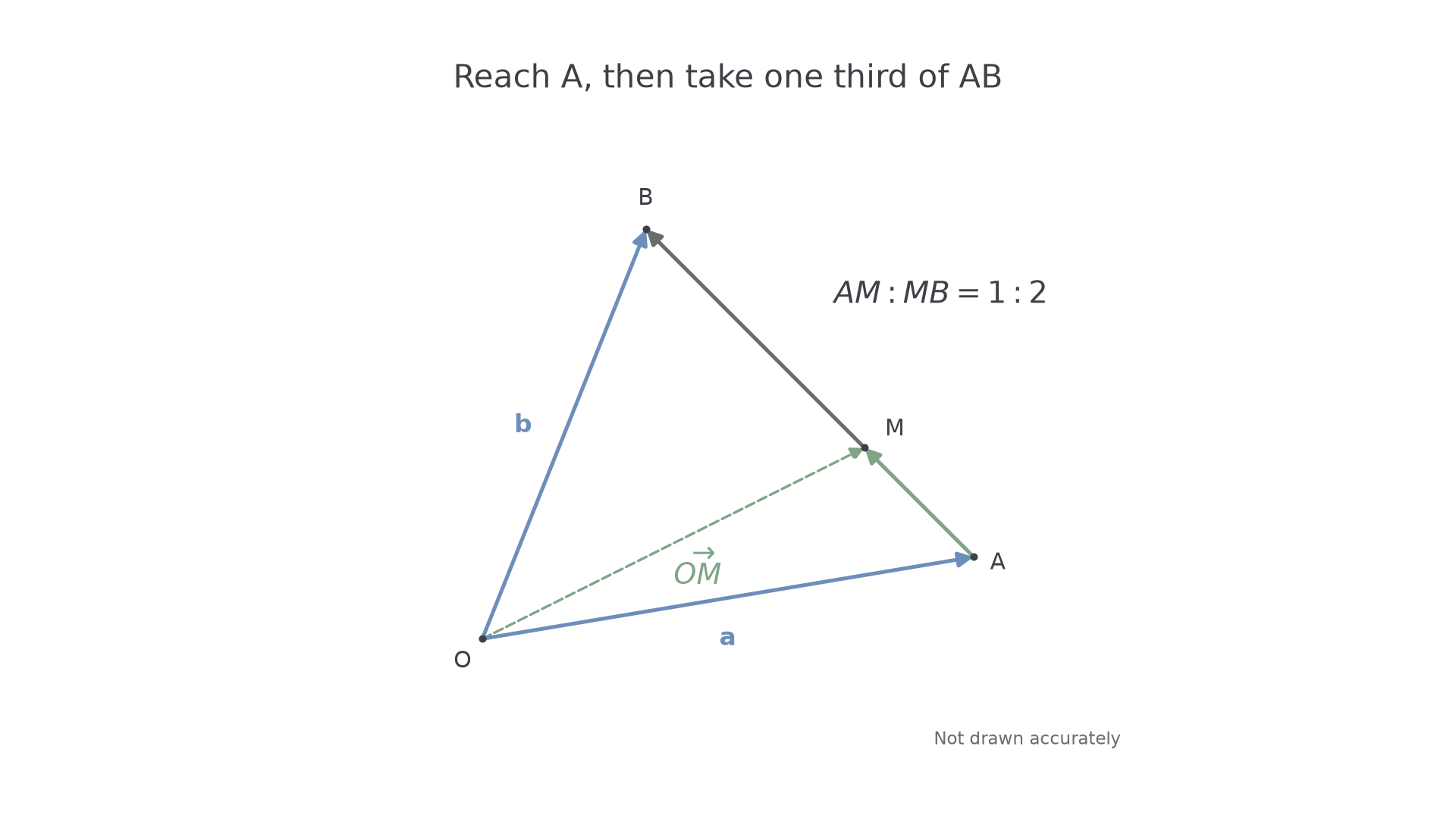
To find , first reach , then travel the required fraction of . That keeps the starting point in the calculation.
A point inside a segment
If lies between and , with , where , then
If and ,
Not on the formulae sheet: learn it.
You do not need to memorise a separate position-vector fraction. “Reach , then take the correct fraction of ” builds it each time.
Worked example 3: one share out of three
Question. , , and lies on with . Work out . Non-calculator.
Plan. Go from to , then one third of the way along .
Why this step? The fraction multiplies , which starts at . Multiplying alone would put the point on .
Answer. .
Check. and . Their lengths are in ratio .
Change only the ratio to . The new point lies nearer , so you take a larger fraction of the same arrow.
Worked example 4: two shares out of three
Question. Keep and . Point lies on , with . Work out . Non-calculator.
Plan. Go to , then take two thirds of .
Why this step? The order tells you that the first piece has two shares. Reversing the ratio would locate the earlier point .
Answer. .
Check. is the remaining one third of , half the length of , so .
A midpoint is the case : its position vector is . If a point is beyond , use the stated direction and whole length instead: gives . The multiplier exceeds because you pass .
Watch out
Wrong: , so . The denominator must count all three shares. Right: .
Use five total shares in the next question.
Proving that lines are parallel (Higher)
A non-zero vector and a non-zero scalar multiple point along the same direction or the reverse direction. Their supporting lines are parallel, or they are the very same line. That small distinction will matter when proving collinearity.
Recognising parallel directions
For non-zero vectors and , if
then they have parallel directions. A positive gives the same direction and a negative the opposite direction. Their lengths are in ratio .
Not on the formulae sheet: learn it.
Look for a common factor in the whole expression. Matching only the coefficient of , while ignoring the coefficient of , proves nothing about the direction.
Worked example 5: the midpoint line in a triangle
Question. In triangle , and . Points and are the midpoints of and . Prove that . Non-calculator.
Plan. Express both arrows from their endpoints, then compare them.
Why this step? The factor must multiply both terms. It then scales one complete arrow into the other.
Answer. , so is parallel to .
Check. The factor also says is half as long as , agreeing with similar triangles and .
Change only the fraction along each side, from one half to two thirds. The same comparison works.
Worked example 6: a different parallel cross-section
Question. In the same triangle, lies on with , and lies on with . Prove that . Non-calculator.
Plan. Subtract the position vector of from that of , then factor.
Why this step? Both points are the same fraction of the way along their sides, so the same fraction factors out.
Answer. , so .
Check. , consistent with similar triangles.
Now the opening puzzle pays off. Let be consecutive midpoints of the sides of any convex quadrilateral , with position vectors . Write the midpoint positions, then subtract:
So and are equal vectors. The same argument gives . Both pairs of opposite sides are equal and parallel: the midpoint shape is a parallelogram, however untidy the original quadrilateral looks.
Continue this lesson.
You’re previewing NovaLearn without an account. Create a free account to read the rest.
Create free account