N2 - Written methods for the four operations
Written methods turn a large calculation into small steps you can trust. You will add, subtract, multiply and divide integers and decimals, handle negative numbers, and use these skills for money and account balances. The methods work on both tiers, including Paper 1, where you cannot use a calculator.
Adding in columns
A school stall takes £186.75 and spends £128.90 on supplies. It starts with an account balance of . Is the account above zero afterwards, and by how much? Keep the three amounts separate for now: first we need reliable ways to combine them.
You already know
Line up decimal points to put ones under ones, tenths under tenths and hundredths under hundredths. Adding a zero at the end of a decimal changes its appearance but not its value: .
Imagine adding and . The ones give : write ones and exchange the other ones for ten. The tens then give . This exchange, often called carrying, is why column addition works. You never throw away a digit; you express its value in the next column.
Start at the right. When a column total reaches , exchange of that unit for of the next unit. This applies to tenths and hundredths too. Column addition is not on the formulae sheet: learn the method.
Worked example 1: carrying with whole numbers
Question. Work out . Non-calculator.
Plan. Add from the ones column, carrying into the next column where needed.
Why carry? ones are ten and ones, so the carried digit has a different column value.
Answer. .
Check. ; subtraction returns the starting amount.
The next example changes only the type of numbers: they are decimals. The same exchanges work, but the decimal points must line up first.
Worked example 2: unequal decimal lengths
Question. Work out . Non-calculator.
Plan. Write as , then add matching columns.
Why add the zero? It makes the hundredths column visible without changing .
Answer. .
Check. , so the answer is in the right range.
Column layout is part of the reasoning, not just tidy presentation.
Watch out
Wrong: placing the 8 of under the 6 of . That adds tenths to hundredths. Right: line up the decimal points, giving .
Try the same layout with different numbers. Check the carry from the tenths column carefully.
Subtracting with exchanges
Subtraction finds what is left, or the gap between two amounts. In a column calculation, exchange when the top digit is too small for the subtraction in that column.
For , write as tens and ones. You can now subtract ones, leaving , and tens, leaving . The answer is . The value has stayed fixed throughout: only its grouping changed.
Zeros need care. To exchange across a zero, first exchange from a non-zero column to its left, then pass the value along. Written subtraction is not on the formulae sheet: learn the method.
Worked example 3: exchanging across zero
Question. Work out . Non-calculator.
Plan. Exchange one thousand through the hundreds and tens until the ones column can be subtracted.
Why do both zero columns become 9? Each receives units from its left, then gives of its own units to the right.
Answer. .
Check. .
The next example changes only the scale: the numbers are decimal amounts. The exchanges still move between neighbouring columns.
Worked example 4: subtracting a decimal
Question. Work out . Non-calculator.
Plan. Align the decimal points and exchange across the zero columns.
Why keep the decimal point in the answer? Each answer digit still belongs to the column in which you found it.
Answer. .
Check. .
You must subtract each bottom value from the top value, even when an exchange is needed.
Watch out
Wrong: , from subtracting the smaller digit from the larger digit in each column. Right: exchange , giving . Swapping individual digits changes the question.
If a question asks you to show working, keep the column calculation visible. It can earn a method mark even if one subtraction goes wrong.
Multiplying integers and decimals
Long multiplication splits one factor into its place-value parts. For example, multiplying by means multiplying by , multiplying by , then adding those two products.
The row must be ten times the row. That is the reason for its final zero. For decimals, first multiply the whole-number digits, then scale the product back using place value. If both factors have been multiplied by , the temporary product is times too large. This method is not on the formulae sheet: learn it.
Worked example 5: two partial products
Question. Work out . Non-calculator.
Plan. Multiply by and by , then add the rows.
Why is the second row ? Its multiplier is , not ; must be made ten times larger.
Answer. .
Check. Splitting instead gives .
The next example changes only the place-value scale of those factors. The whole-number multiplication is already done; now decide how much smaller the answer must be.
Worked example 6: putting the decimal point back
Question. Work out . Non-calculator.
Plan. Use , then undo the two scale changes.
Why divide by ? The first factor is times smaller and the second is times smaller, so the product is times smaller.
Answer. .
Check. and . The answer lies between these.
Counting the decimal places gives the same result: two in and one in , making three in . Use this as a multiplication shortcut, with a size check.
Watch out
Wrong: . The second row has lost its tens value. Right: . A missing zero changes the answer, even when every small multiplication is correct.
Here only the first factor changes from Worked example 6. Keep the same scale reasoning.
Dividing integers and decimals
Division asks how many equal groups fit, or how much belongs in each equal share. Written division handles one place-value column at a time.
For , hundreds shared into groups gives hundred each and hundreds left. Exchange the remainder for tens, combine it with the next tens, then continue. Each remainder must be smaller than the divisor.
You may add zeros after a decimal point to keep dividing. For example, a remainder of ones becomes tenths. With a decimal divisor, first multiply both numbers by the same power of ten to make the divisor whole. These written-division methods are not on the formulae sheet: learn them.
Worked example 7: long division by a two-digit number
Question. Work out . Non-calculator.
Plan. Find how many groups of fit into , subtract, then bring down the last digit.
Why is the first quotient digit worth ? The being divided represents tens before the last ones digit is brought down.
Answer. .
Check. .
The next example changes only the scale of the same division. Make the divisor whole before starting, then use the unchanged whole-number quotient.
Worked example 8: making a decimal divisor whole
Question. Work out . Non-calculator.
Plan. Multiply both numbers by , then use the previous long division with a decimal quotient.
In written division, goes into six times, leaving ones; those become tenths. Bringing down tenths gives tenths, so the next digit is tenths.
Why scale both numbers? The number of groups is unchanged when both the total and the size of each group are made ten times larger.
Answer. .
Check. .
A zero in the quotient can matter as much as any other digit. For , write hundred, tens and ones: , not . To continue into decimals, gives remainder , then gives tenths remainder , then gives hundredths. Thus .
Watch out
Wrong: . Only the divisor has changed, so the answer becomes ten times too small. Right: .
Change the total while keeping the divisor from Worked example 8.
Calculating with negative numbers
A negative sign tells you where a number sits; an operation sign tells you what to do. Brackets help keep those jobs separate in a calculation such as .
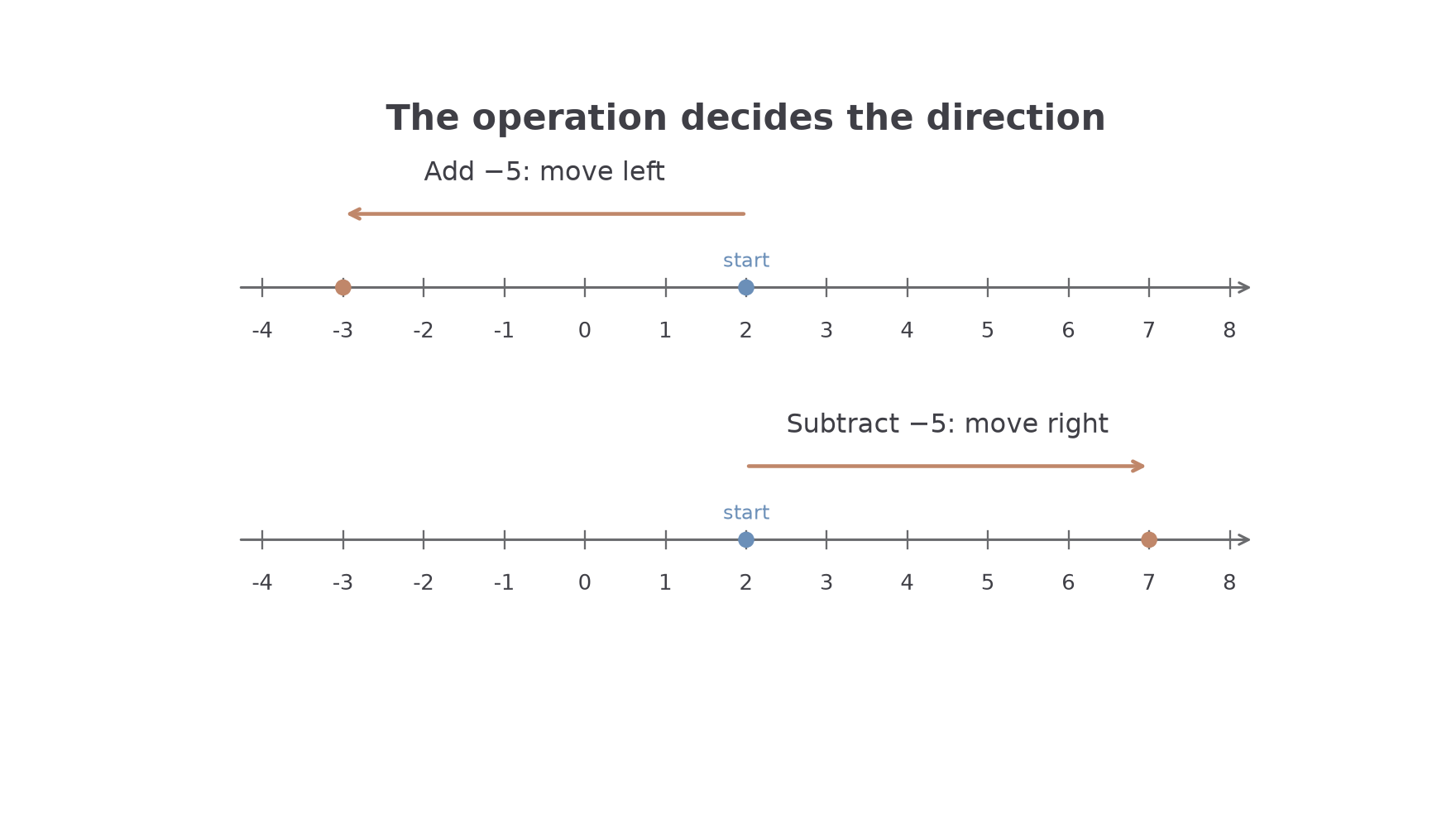
Adding moves right on a number line; adding moves left. Subtracting reverses the move you would make when adding that number. Thus subtracting moves right, while subtracting moves left.
[DIAGRAM: asset_name: Adding and subtracting a negative; asset_slug: aqa8300_n02_signed_moves; caption: From 2, adding minus 5 moves left to minus 3, while subtracting minus 5 moves right to 7; description: Two number lines from minus 4 to 8. The top line has a blue starting point at 2 and a left arrow labelled add minus 5 ending at minus 3. The lower line has a blue starting point at 2 and a right arrow labelled subtract minus 5 ending at 7. Endpoints are clay, with zero labelled on both lines.]
For multiplication, : three lots of . Reversing the sign of either factor reverses the product, so . Division follows the same rule because its answer must multiply back correctly.
Sign rules
For positive numbers and ,
For multiplication and division with non-zero numbers, matching signs give a positive answer; different signs give a negative answer. Multiplying zero by any number gives zero. Zero divided by a non-zero number is zero; division by zero is undefined.
Not on the formulae sheet: learn it.
Do the sign decision separately from the whole-number or decimal arithmetic.
Worked example 9: adding a negative decimal
Question. Work out . Non-calculator.
Plan. Add the two distances from zero, then use the direction of the moves.
Why is the answer negative? Starting below zero and moving further left cannot take you above zero.
Answer. .
Check. Moving right by from returns to .
Worked example 10 changes only the operation: subtract the same negative number. That reverses its direction.
Worked example 10: subtracting a negative decimal
Question. Work out . Non-calculator.
Plan. Replace subtracting a negative by adding its positive opposite.
Why does the answer stay negative? The move right is smaller than the starting distance below zero.
Answer. .
Check. ; adding back the subtracted number restores the start.
For the other two operations, decide the sign and then use the written methods already taught. For instance, , because the signs differ, while , because they match. The check is .
Watch out
“Two negatives make a positive” applies to multiplication and division, not to every calculation containing two minus signs. Wrong: . Right: , but .
The next check separates the operations so that the rule you choose is visible.
Profit, loss and account balances
A money problem needs the right operations as well as correct arithmetic. Read each amount as money coming in, money going out or money already held.
The cost price is what an item costs the seller. The selling price is what the customer pays. A profit is the excess of selling price over cost price; a loss is the excess of cost price over selling price. On an account, a credit adds money and a debit takes money out. The balance is the amount held; a negative balance means money is owed.
These definitions let you keep a running total. Income tax and VAT are types of tax; an interest rate sets how interest is calculated over a stated period. Here any tax or interest amount needed is already given. Percentage calculations come later.
Profit and closing balance
Use the same money unit throughout. If the selling price is smaller than the cost price, the loss is cost price minus selling price.
Not on the formulae sheet: learn it.
Track a positive balance first, then change only its starting sign.
Worked example 11: a positive opening balance
Question. An account contains £18.40. A payment of £35.75 is credited and £42.60 is debited. Work out the closing balance. Non-calculator.
Plan. Add the credit to the opening balance, then subtract the debit.
Why subtract £42.60? A debit is money leaving the account, even though the amount is written without a negative sign.
Answer. £11.55.
Check. The net change is ; reducing £18.40 by £6.85 gives £11.55.
The next example changes only the opening balance: the account starts £18.40 below zero. Keep that negative sign throughout.
Worked example 12: an overdrawn opening balance
Question. An account has balance . A payment of £35.75 is credited and £42.60 is debited. Work out the closing balance. Non-calculator.
Plan. Use the same changes, starting from a negative amount.
Why keep the initial minus sign? £18.40 owed and £18.40 held are different starting positions.
Answer. ; the account is £25.25 overdrawn.
Check. The net change is still . Starting at gives .
Now return to the school stall. Its profit is . Adding that to its opening debt gives . The account does finish above zero. Notice that its profit and its closing balance are different amounts.
Here is a small arithmetic surprise: and . Reversing the digits reverses these products too. That pattern fails for and : the reversed digits would give . Written methods let you test an attractive pattern before trusting it.
Watch out
A negative balance is not the same as a loss. The stall makes a £57.85 profit but uses £24.60 of it to clear an old debt. Its final £33.25 balance is not its profit for the day.
For a context question, finish with the amount the question actually asks for.
Quick Recap
- For addition and subtraction, line up place-value columns and exchange without changing a number's value.
- For multiplication, include the tens value of each partial-product row; for decimals, undo every scale change.
- For division, carry remainders into the next column and scale both numbers together to remove a decimal divisor.
- For negative numbers, distinguish addition or subtraction from the matching-sign rule for multiplication or division.
- Profit compares income with costs; closing balance also includes the starting amount.
The stall finishes £33.25 above zero: its £57.85 profit first clears its £24.60 debt.