A11 - Turning points by completing the square (Higher)
Completing the square rewrites a quadratic so that its turning point becomes visible. You will connect a squared bracket to a minimum or maximum, create that form from an expanded expression, and handle coefficients other than one. The result is exact, even when a plotted graph would only give an estimate.
Reading a turning point from a square (Higher)
What is the lowest possible value of ? Trying gives , but negative inputs can take the graph lower. We want the exact lowest point without a long table.
You already know
An upward-opening quadratic has a minimum and a downward-opening one has a maximum. A square of a real number is non-negative. Expanding gives .
Start with . Whatever is, the square is at least zero. Its smallest possible value is zero, reached when , so the smallest height is . You can locate a turn without differentiating, drawing, or finding any roots.
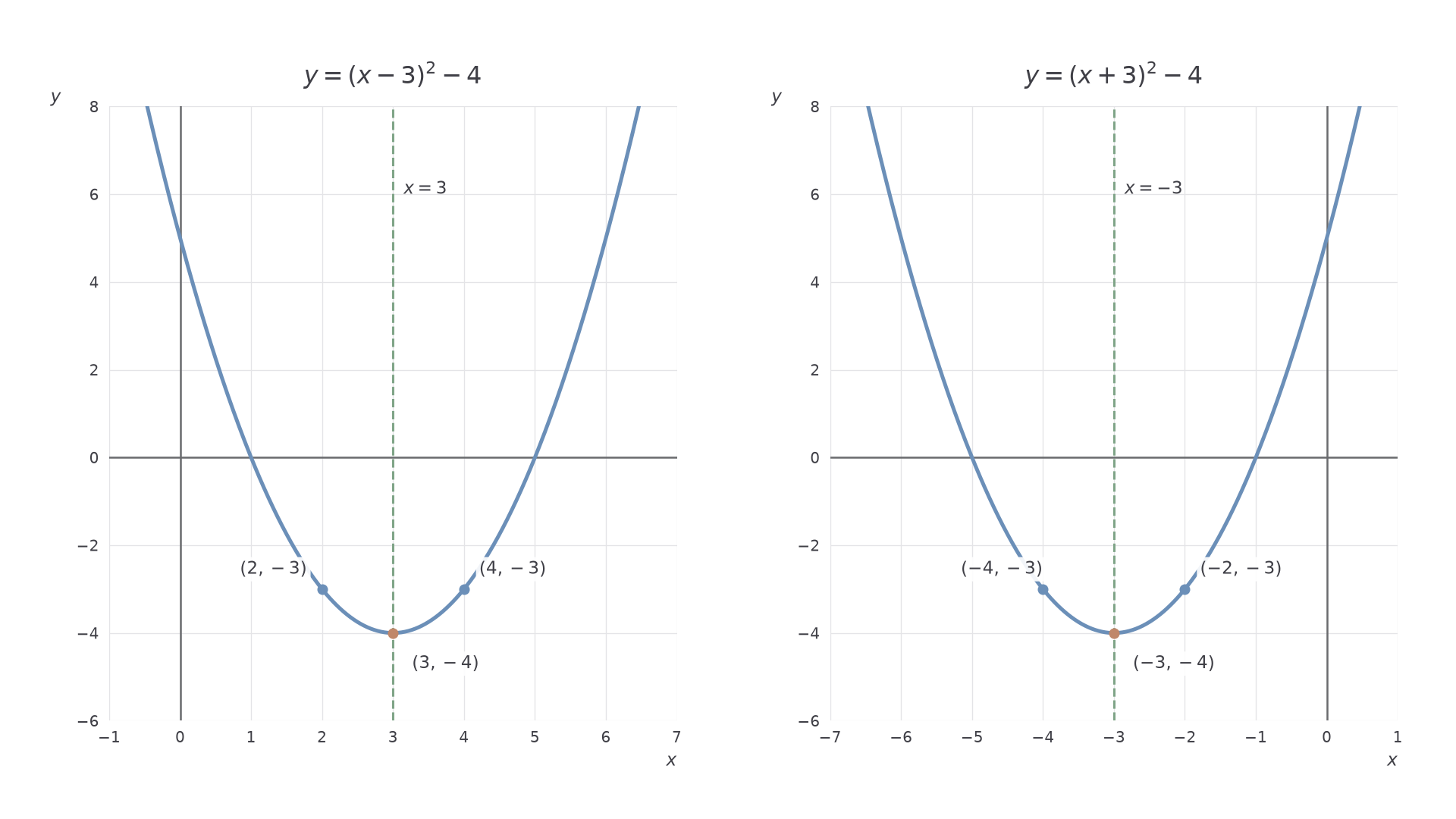
[DIAGRAM: asset_name: Turning points revealed by squared brackets; asset_slug: aqa8300_a22_square_form; caption: The bracket vanishes at the turning point, and the remaining constant gives its height; description: Two equal-scale coordinate panels showing y equals x minus 3 squared minus 4 and y equals x plus 3 squared minus 4. Minimum points 3 comma minus 4 and minus 3 comma minus 4, symmetry lines x equals 3 and x equals minus 3, and paired equal-height points one unit either side are labelled.]
Completed-square form
The turning point is and the symmetry line is . If , is a minimum; if , is a maximum. These statements concern real .
Not on the formulae sheet: learn it.
The bracket is zero at . Moving equally far left and right gives squares of opposite numbers, which are equal. That explains both the turning point and the symmetry.
Worked example 1: a minus inside the bracket
Question. Write down the turning point of . State whether it is a minimum or maximum. Non-calculator.
Plan. Make the squared bracket zero, then read the remaining height.
Why this step? The square cannot make smaller than , and it actually reaches zero at .
Answer. Turning point , a minimum.
Check. At and , , the same height on either side and above the minimum.
Change only the sign inside the bracket. The turning point moves to the opposite side of the vertical axis.
Worked example 2: a plus inside the bracket
Question. Write down the turning point of . State whether it is a minimum or maximum. Non-calculator.
Plan. Solve , then evaluate the constant height.
Why this step? The turning input is the value that makes the bracket zero, rather than the number printed after .
Answer. Turning point , a minimum.
Check. At and , the square equals , so both heights are .
A leading minus changes what “smallest square” means for the output. For , the squared term is still non-negative, but its negative is non-positive. The turning point remains , now a maximum.
Watch out
Wrong: reading the turning point of as . Right: solve to get . The sign inside the bracket is reversed when you name the turning input.
Use the same zero-bracket decision with different values.
Creating the squared bracket (Higher)
The middle term tells you what must go inside the square. Expanding gives . So is that square with taken away. You must correct the constant, because rewriting an expression must preserve its value for every .
Completing the square with leading coefficient one
For real and , halve the coefficient of , square that half, and subtract the extra constant introduced.
Not on the formulae sheet: learn it.
The correction has a reason: the bracket contributes as well as . Subtracting it again keeps the original expression unchanged. An odd middle coefficient simply gives a fractional half.
Worked example 3: an even middle coefficient
Question. Work out the turning point of by completing the square. Non-calculator.
Plan. Use half of in the bracket, correct its constant, then make the square zero.
Why this step? already contains ; subtracting prevents that extra amount changing the function.
Answer. Turning point , a minimum.
Check. Expanding gives . At , the original gives .
Change only the middle coefficient from to . The method is unchanged, but keep the half and its square as exact fractions.
Continue this lesson.
You’re previewing NovaLearn without an account. Create a free account to read the rest.
Create free account