A4 - Expanding double brackets and factorising quadratics
Multiplying two brackets creates a quadratic expression. Learn to account for every product, then work backwards to find the brackets of a quadratic. You will also use the difference of two squares, including simple exact square-root factors.
Expanding two brackets
Is equal to ? The numbers on either side of look balanced, but their product is slightly smaller. By the end you will explain the gap without long multiplication.
You already know
Expanding a single bracket multiplies every term by the factor outside. Collect only terms with the same letters and powers, keeping each sign with its term.
In , the first bracket is itself a whole factor. Multiply it by , then by . Equivalently, make a grid: each term from one bracket multiplies each term from the other. Two terms times two terms give four products before collecting.
[DIAGRAM: asset_name: Four areas in a product of two brackets; asset_slug: aqa8300_a04_binomial_area; caption: The four areas x squared, 3x, 2x and 6 add to x squared + 5x + 6; description: A rectangle has width x + 3 and height x + 2, split vertically into x and 3 and horizontally into x and 2. The large top-left region is pale blue and labelled x squared; the top-right and bottom-left regions are pale sage and labelled 3x and 2x; the bottom-right region is pale clay and labelled 6. Dimension labels sit outside the rectangle. The equality (x + 3)(x + 2) = x squared + 5x + 6 appears beneath. x is positive. Not drawn accurately.]
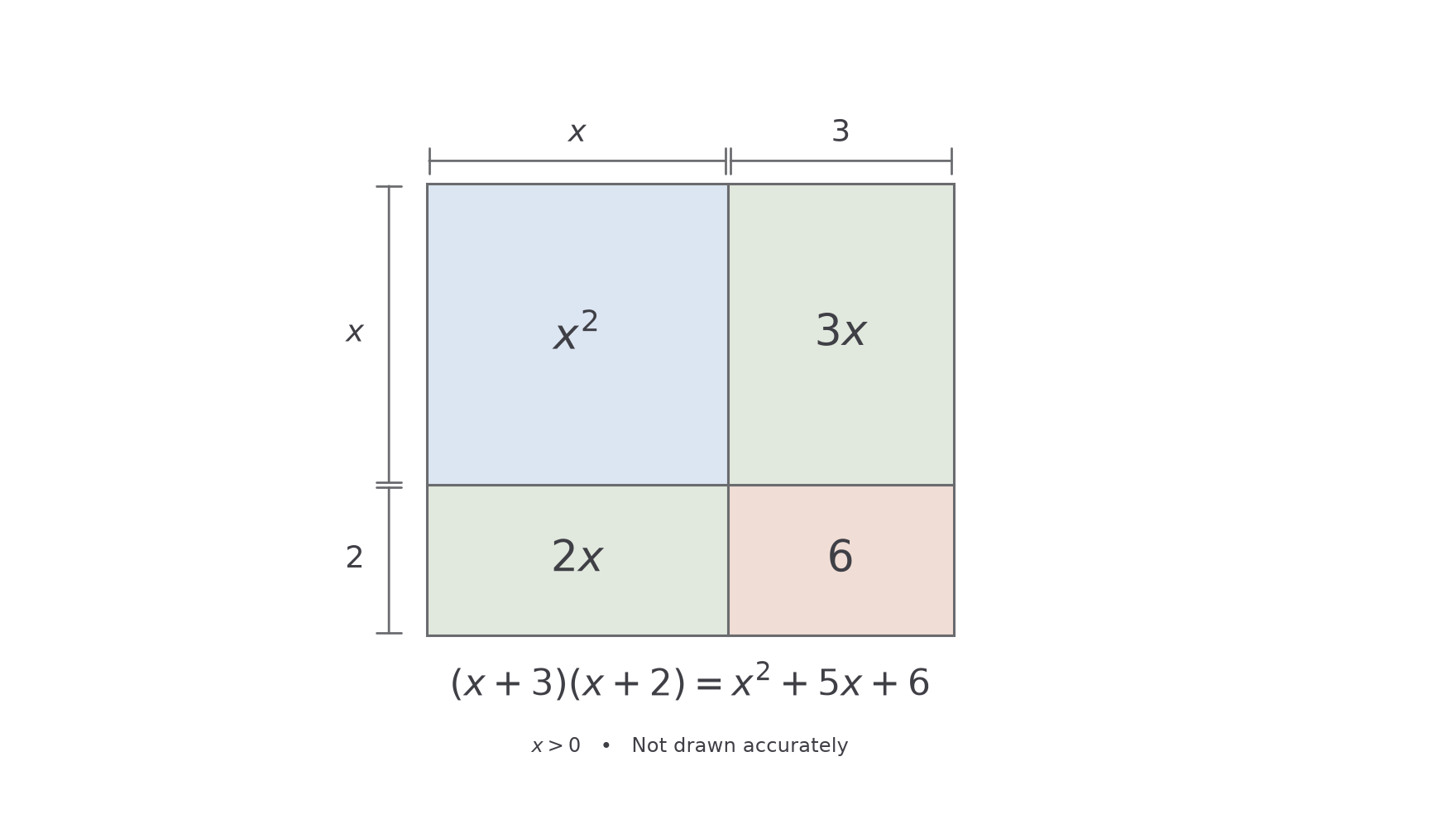
The picture uses positive lengths. The multiplication rule also works for negative values because it comes from distributing over sums, not from measuring lengths.
Binomial and quadratic expression
A binomial has two terms, such as or . A quadratic expression in has highest power , with a non-zero coefficient of that term. For example, is quadratic; is not.
To expand two binomials, show all four products, then collect like terms. This method is not on the formulae sheet: learn it. A grid is equally valid working.
Worked example 1: two positive constants
Question. Expand and simplify . Non-calculator.
Plan. Multiply each term in the first bracket by both terms in the second, then collect.
Why this step? The multiplies the whole second bracket, not just its final term.
Answer. .
Check. At , the brackets give ; the quadratic gives .
The next example changes only the sign of the . Two of the four products now change sign.
Worked example 2: a negative constant
Question. Expand and simplify . Non-calculator.
Plan. Multiply using the signed term , then collect the middle terms.
Why this step? multiplies both and , so the constant product is .
Answer. .
Check. At , the brackets give , and the quadratic gives .
The first terms need not have coefficient . For example, . Nothing changes about making all four products.
Watch out
Wrong: . That misses the two cross-products, and . Right: include all four products before collecting.
For the next pair of brackets, the negative constant has moved into the second bracket. The four-product rule stays the same.
Finding the two brackets of a quadratic
Factorising a quadratic reverses the four-product expansion: find two numbers whose sum gives the middle coefficient and whose product gives the constant.
From the first example, . The middle coefficient comes from addition, and the final constant comes from multiplication. You must meet both conditions.
Factorising a quadratic with leading coefficient 1
Choose numbers and such that
These conditions follow by expanding the two brackets. For integer factorisation, look for integer and .
Not on the formulae sheet: learn it.
List factor pairs of the constant, then test their sum. If the constant is positive, the two numbers have the same sign. If it is negative, their signs differ. For a positive constant and negative middle coefficient, both numbers are negative: , because and .
Worked example 3: a positive constant
Question. Factorise . Non-calculator.
Plan. Find a factor pair of with sum , then write the two brackets.
Why this step? A pair with the right product alone can give the wrong middle term. That is why the sum check matters.
Answer. .
Check. Expanding gives .
The next example changes only the constant from to . The factors must now have opposite signs.
Worked example 4: a negative constant
Question. Factorise . Non-calculator.
Plan. Find two signed factors of with sum .
Why this step? The larger absolute value needs the positive sign to make the sum positive.
Answer. .
Check. Expanding gives .
Not every quadratic has integer factors. No integer pair has product and sum , so cannot be factorised into brackets with integer constants. If the constant is zero, start with the common factor instead: .
Watch out
Wrong: . Here the product is right, but the sum is , not . Right: .
The order of the brackets does not matter. Their two constants must still pass both checks.
The difference of two squares
Some quadratics have no middle term because their cross-products cancel. These are differences of two squares.
Expanding gives . The constants are opposites, so their sum is zero. That cancellation is the reason for the pattern.
Difference of two squares
This holds for any real numbers or algebraic expressions and . It needs a subtraction between two squares.
Not on the formulae sheet: learn it.
Identify each square's root before writing the brackets. “Difference” means subtraction; the same pattern cannot turn into , because those brackets expand to .
Worked example 5: a missing middle term
Question. Factorise . Non-calculator.
Plan. Write both terms as squares, then use opposite signs in the brackets.
Why this step? The constants and multiply to and add to zero, so no term remains.
Answer. .
Check. The cross-products are and ; they cancel.
The next example changes only the first square, from to . Take the square root of the whole first term.
Worked example 6: a coefficient that is also a square
Question. Factorise . Non-calculator.
Plan. Recognise , then use the same pattern.
Why this step? The first entry in each bracket is , because multiplying by itself gives .
Answer. .
Check. Expansion gives .
There is a fast mental-arithmetic use too. . Consecutive whole-number squares differ by an odd number: the difference is one times their sum. Large squares can hide a very small calculation.
Watch out
Wrong: . Those first terms multiply to . Right: use in each bracket.
Check the numerical coefficient's square root as carefully as the constant's square root.
Exact square-root factors
A square root can be kept exact inside a bracket. You do not need a decimal approximation to multiply it by itself.
For example, by the definition of a square root. So the difference-of-squares pattern also handles . Treat as one constant, just as you treated in the previous part.
Surd
An exact root that is irrational, such as . Its decimal never terminates or repeats. In contrast, is rational and is not a surd.
For a positive number , . This square-root fact and the difference-of-squares identity are not on the formulae sheet: learn them. Here you only need a root multiplied by itself, not any rules for combining different roots.
Worked example 7: a square root cancels exactly
Question. Expand and simplify . Non-calculator.
Plan. Form the four products; the cross-products cancel and the root is squared.
Why this step? Keeping the root exact makes both cancellations exact. A rounded decimal would lose that precision.
Answer. .
Check. At , the original is , matching the answer.
The next example reverses only the direction: instead of expanding given brackets, find brackets for the given quadratic.
Worked example 8: factorising with an exact root
Question. Factorise . Non-calculator.
Plan. Write as and use the difference of two squares.
Why this step? A square does not need an integer root. The exact root of works perfectly well as a constant.
Answer. .
Check. The previous expansion returns .
A root outside a bracket is still a factor: . As before, every term is multiplied. Leaving a little space after the root makes it clear where the next factor starts.
Watch out
Wrong: . Squaring a square root undoes the root, so . It does not square the number under the root again.
The opening calculation now has a short explanation: . Increasing one factor by and decreasing the other by costs exactly one from the product.
Quick Recap
- Expanding two binomials produces four products before like terms are collected.
- To factorise , find two numbers with sum and product . Both conditions matter.
- A difference of squares factorises as ; the cross-products cancel.
- Keep square roots exact. , so the same pattern can give exact square-root factors.
The opening product is , exactly less than .