G24, G25 - Column vectors and vector arithmetic
Record a movement with two numbers, then combine, reverse and scale movements without losing their directions. G24 connects translations with column vectors; G25 gives you arithmetic with vectors, using both arrows and columns. A vector tells you how to move, rather than where to start.
Reading a column vector
You walk squares right and squares up, then squares left and squares down. You have walked somewhere, but have you ended up anywhere new? Vectors keep track of the change in position. By the end, two short columns will settle the question.
You already know
Coordinates give horizontal position first and vertical position second. A translation slides every point of a shape the same distance in the same direction, without turning it.
Draw an arrow from a starting point to a finishing point. Its arrowhead tells you which way to travel. For right and up, put the horizontal movement above the vertical movement, with brackets round the pair:
There is no fraction line. These are two separate movements, not .
Vector
A quantity with both magnitude (size) and direction. A displacement vector records the change from a starting point to an end point. In two dimensions, a column vector gives horizontal movement , then vertical movement . Positive means right or up; negative means left or down.
An arrow right and up represents the same vector wherever you place it. Moving the arrow on the page does not change its length or direction. An arrow of the same length pointing the other way is a different vector.
[DIAGRAM: asset_name: The same movement from two starting points; asset_slug: aqa8300_g28_equal_vectors; caption: Both arrows move four squares right and three squares up; description: A square coordinate grid shows A at minus4 comma minus2, B at 0 comma1, C at 0 comma minus2 and D at4 comma1. Equal blue arrows point from A to B and C to D. A dotted horizontal then vertical route beside AB is labelled 4 right and 3 up. Both arrows carry the same column vector 4 above3, without a fraction line.]
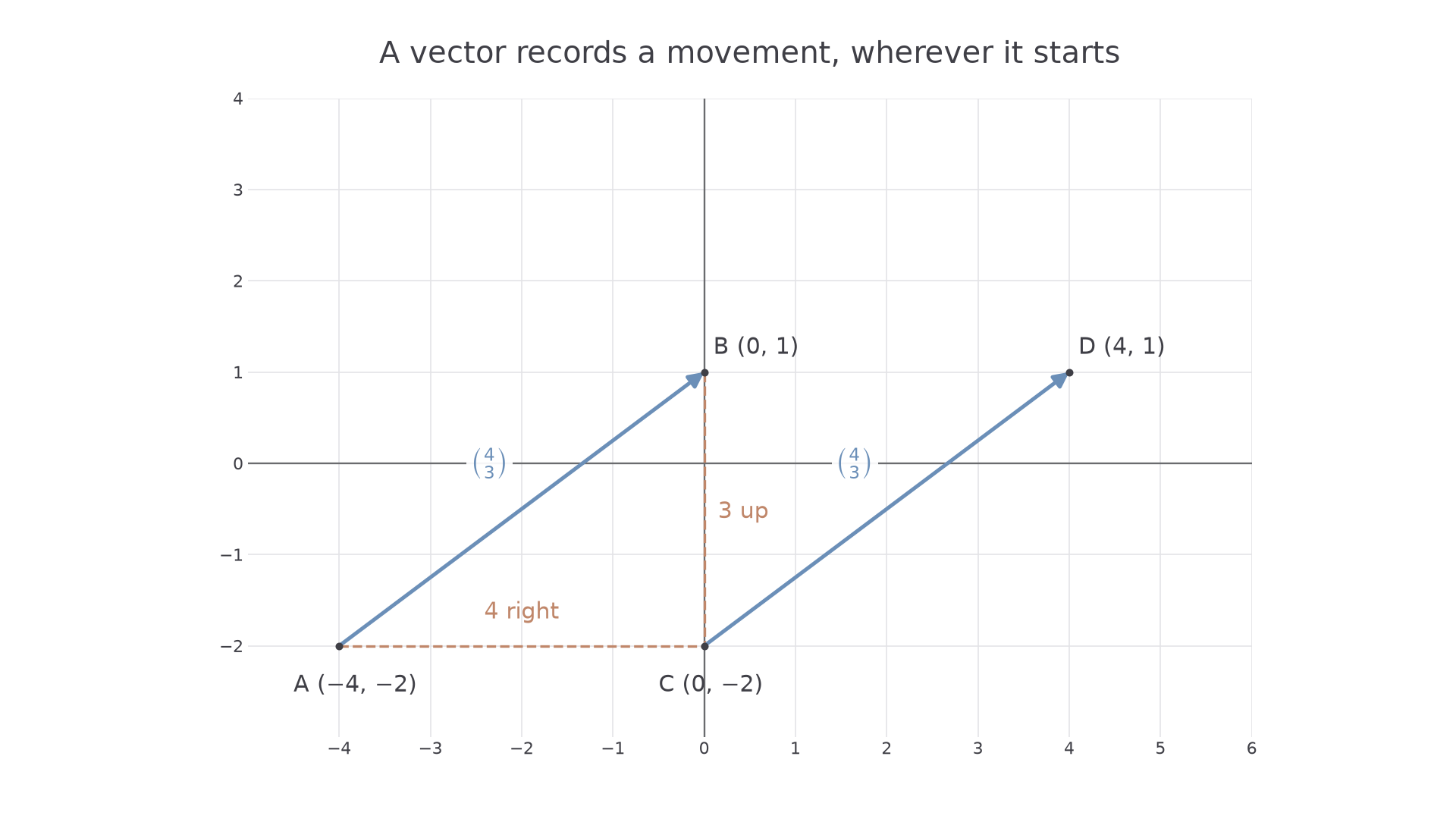
For a translation, apply that one column to every vertex. The column-translation rule is not on the formulae sheet: learn it.
Worked example 1: turning directions into a column
Question. Write down the vector for a translation units right and units down. Non-calculator.
Plan. Record horizontal movement first, then vertical movement, keeping their signs.
Why this step? Swapping the entries would describe a different movement: left and up instead of right and down.
Answer. .
Check. The top entry is positive and the bottom entry is negative, matching right and down.
Change only the horizontal direction. The distance across stays , but its sign changes.
Worked example 2: a left-and-down translation
Question. Write down the vector for a translation units left and units down. Non-calculator.
Plan. Use negative entries for both movements.
Why this step? A minus sign changes a direction. It does not tell you to swap horizontal and vertical movements.
Answer. .
Check. Both entries are negative, so the arrow points down and left.
Zero is useful too. The vector moves straight up: there is no horizontal movement. The zero vector makes no movement; it has no direction.
Watch out
Wrong: writing for a vector. That is a division. Right: , with two entries in brackets and no line between them.
Read each direction before writing the next pair of entries.
Vectors between points
The arrow , read “vector ”, starts at and ends at . The order of the letters matters. Moving from to changes the first coordinate by and the second by , so .
Coordinates name positions. A vector records the change between them. They both use two numbers, but they answer different questions.
Finding a displacement or an endpoint
If and , then
Subtract start from finish in each coordinate. If you know the start and the vector, add its entries to the starting coordinates to find the finish. Reversing a vector changes both signs:
Not on the formulae sheet: learn it.
The subtraction is just counting squares, written so it still works with negative coordinates or a grid you cannot see.
Worked example 3: from start to finish
Question. and . Work out . Non-calculator.
Plan. Subtract each coordinate of from the matching coordinate of .
Why this step? Starting at a negative coordinate does not make the movement negative. From to , you move right.
Answer. .
Check. , the required endpoint.
Change only the direction of travel. The two points stay fixed, but the starting point is now .
Worked example 4: the return journey
Question. and . Work out . Non-calculator.
Plan. Reverse the vector in example 3 by changing both signs.
Why this step? The return journey must undo both the horizontal and the vertical movement.
Answer. .
Check. , which returns to .
You can also work backwards to an unknown starting point. If is the image of under , subtract the vector: . The same movement must fit every corresponding pair when a whole shape is translated.
Watch out
Wrong: using for . That gives . Right: point the arrow from the first letter to the second, then use finish minus start.
Reverse a new displacement, rather than reversing the coordinate order.
Adding and subtracting vectors
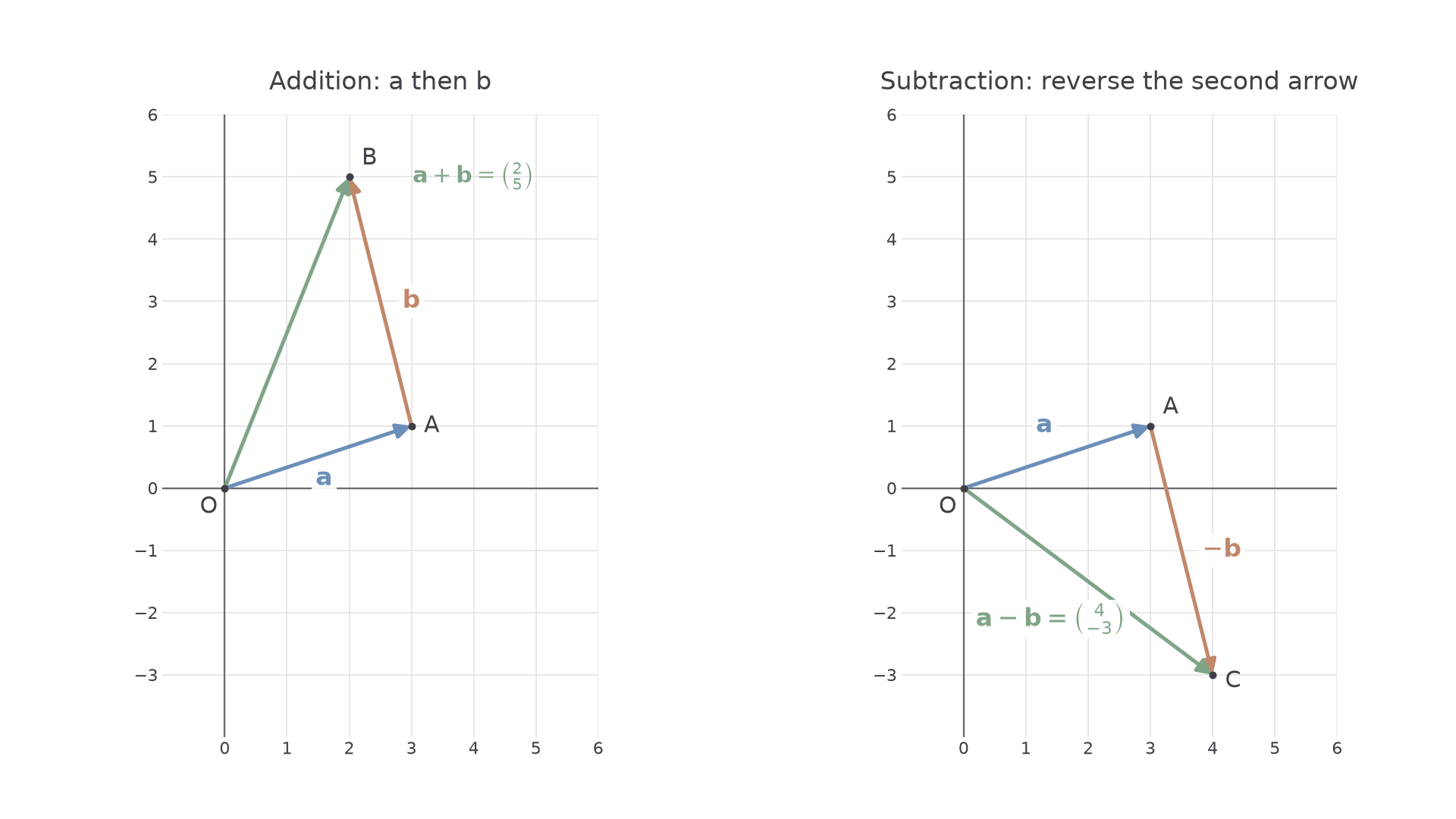
Walk right and up, then left and up. Your total movement is right and up. Adding vectors combines movements, not the lengths of the paths you walked.
To draw a sum, place the tail of the second arrow at the head of the first. The arrow from the original start to the final finish is the resultant vector.
[DIAGRAM: asset_name: Head-to-tail addition and a reversed arrow; asset_slug: aqa8300_g28_vector_addition; caption: Addition joins movements head to tail, while subtraction adds a reversed movement; description: Two square coordinate-grid panels use a equals column3comma1 and b equals column minus1comma4. Left arrows from O0comma0 to A3comma1 to B2comma5 are labelled a and b; a sage resultant runs O to B, labelled a plus b equals column2comma5. Right an arrow a runs O to A, then minus b from A to C4comma minus3; the sage resultant O to C is labelled a minus b equals column4comma minus3. Blue represents a, clay represents b or minus b, sage the resultant.]
Continue this lesson.
You’re previewing NovaLearn without an account. Create a free account to read the rest.
Create free account