R5 - Sharing in a ratio
A ratio tells you how many equal parts each person receives, rather than the value of a part. This part of R5 shows how to share a total using a part : part or part : whole ratio. You will also work backwards from two amounts to describe their division as a ratio.
Sharing a total in a part to part ratio
Asha and Ben share £84 in the ratio . Asha suggests dividing £84 by . Ben suggests dividing it by . Which starting step works, and what should each person receive?
You already know
A ratio keeps quantities in a stated order. Equivalent ratios multiply or divide every entry by the same number. For example, .
The ratio means Asha gets equal parts and Ben gets of those same-sized parts. The whole £84 must fill parts.
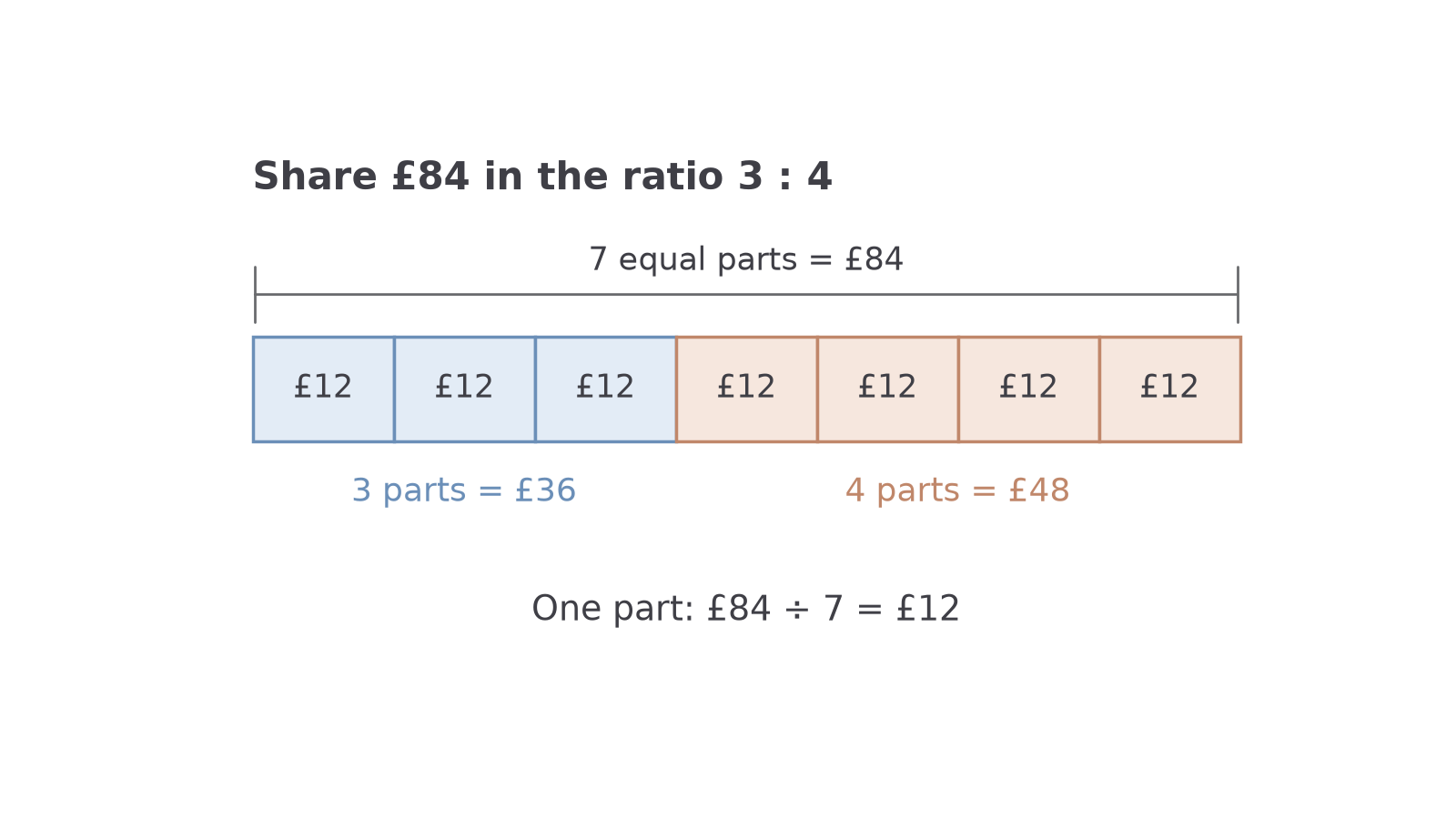
[DIAGRAM: asset_name: Sharing 84 pounds in a three to four ratio; asset_slug: aqa8300_r02_sharing_bar; caption: Seven equal parts divide 84 pounds into shares of 36 pounds and 48 pounds; description: A horizontal bar has seven equal boxes, the first three blue and the next four clay. Every box is labelled 12 pounds. A bracket over all seven says 7 equal parts equals 84 pounds. Labels below the groups show 3 parts equals 36 pounds and 4 parts equals 48 pounds. A final line shows one part equals 84 divided by 7 equals 12 pounds.]
Sharing in a part to part ratio
To share a total in the ratio , where and are positive,
The two shares must add to the original total.
Not on the formulae sheet: learn it.
The bar makes the divisor visible. There are seven parts altogether.
Worked example 1: sharing 84 pounds
Question. Asha and Ben share £84 in the ratio . Work out both shares. Non-calculator.
Plan. Find the value of one of the seven equal parts, then multiply by each person's part count.
Why divide by ? £84 is the total for both people, not the value of Asha's three parts.
Answer. Asha gets £36 and Ben gets £48. Ben chose the correct first step.
Check. , and .
Change only the total. The ratio and the number of parts stay the same, but each part becomes more valuable.
Worked example 2: the same ratio with a different total
Question. Asha and Ben share £91 in the ratio . Work out both shares. Non-calculator.
Plan. Divide the new total by seven, then use the same part counts.
Why is the divisor unchanged? The ratio still describes seven equal parts.
Answer. Asha gets £39 and Ben gets £52.
Check. , and dividing both shares by gives .
There is a neat consequence: sharing £84 in gives the same amounts as . There are twice as many parts, but each is worth half as much: , so the shares are and .
Watch out
Wrong: , then give Asha £28 and Ben £56. The resulting ratio is . Right: divide by the sum , then multiply by each entry.
Always check the total and the ratio; either check alone can miss a mistake.
Sharing with a part to whole ratio
A ratio comparing one share with the whole already includes the total part count.
If , the total has parts. Asha has , leaving for Ben. Do not add : that counts Asha's part twice.
Part to part and part to whole
A part : part ratio compares two separate shares, such as Asha : Ben. A part : whole ratio compares one share with the total, such as Asha : total. If there are two non-empty shares, the first entry of share : total must be smaller than the second.
Write the labels before the numbers. The symbols alone do not tell you which interpretation is intended. This distinction and the one-part sharing method are not on the formulae sheet: learn them.
Continue this lesson.
You’re previewing NovaLearn without an account. Create a free account to read the rest.
Create free account