G4 - Properties of triangles and quadrilaterals
Identify triangles, special quadrilaterals and named polygons from their defining properties. Use equal sides, equal angles, parallel lines, diagonals and symmetry to work out missing information, including when a shape belongs to more than one family.
Triangle names and equal angles
Can a square also be a rectangle and a rhombus? Yes. Shape names describe properties, and a shape may satisfy several definitions at once. Start with triangles, where one name can describe the sides and another the angles.
You already know
A triangle's angles total , and a quadrilateral's total . Equal-length sides carry matching ticks. A diagram's appearance alone does not establish equality.
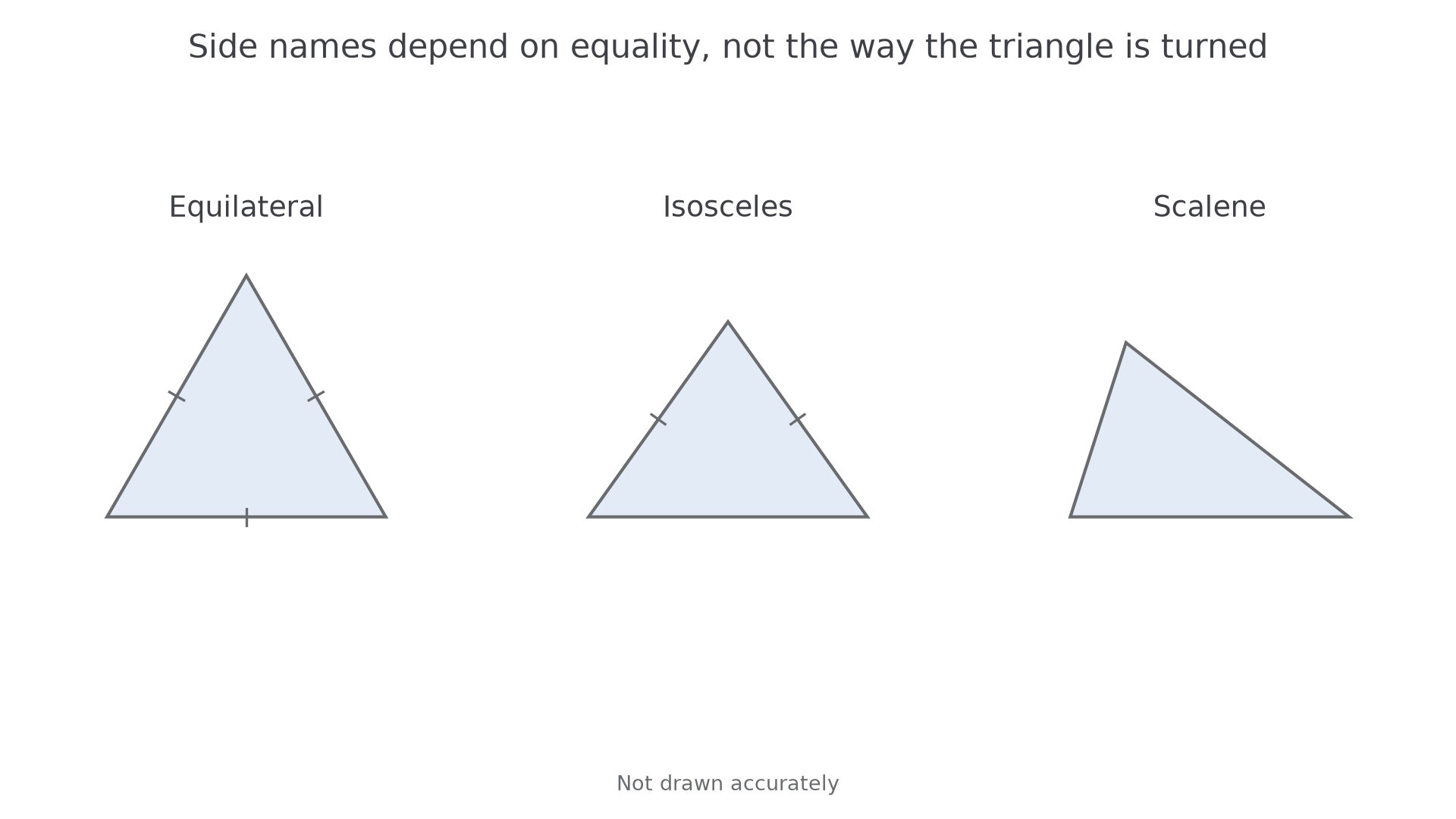
An isosceles triangle has at least two equal sides; the angles opposite those sides are equal. The vertex angle is between the equal sides, and the other two are the base angles. Imagine folding along the line from the vertex to the base's midpoint: the equal sides and base corners match, explaining the equal base angles. A formal congruence proof comes later.
[DIAGRAM: asset_name: Triangle side families; asset_slug: aqa8300_g30_triangles; caption: Triangle side names depend on equality, not orientation; description: Three pale triangles show equilateral, isosceles and scalene examples. The equilateral example has three equal sides, the isosceles example two, and the scalene example none.]
| Name by sides | Defining property | Angle consequence |
|---|---|---|
| Equilateral | Three equal sides | Three angles |
| Isosceles | At least two equal sides | Angles opposite equal sides are equal |
| Scalene | No equal sides | No equal angles |
By angles, an acute-angled triangle has three angles less than ; a right-angled triangle has one angle; an obtuse-angled triangle has one angle between and . For example, a triangle with angles , , is both isosceles and right-angled. An equilateral triangle is acute-angled and also satisfies the isosceles definition.
When asked for a shape's name, give the most specific name supported by the information. Three equal sides are best described as equilateral, even though they also meet the broader isosceles condition.
Equal-side triangle facts
In an isosceles triangle, angles opposite equal sides are equal. In an equilateral triangle,
Not on the formulae sheet: learn it.
Check which sides are equal before deciding which angles to copy. The equal angles sit opposite them, not necessarily beside the printed labels.
Worked example 1: given the vertex angle, non-calculator
Question. Triangle has and angle . Work out angles and .
Plan. Subtract the vertex angle, then share the remainder between the equal base angles.
Why this step? The equal sides meet at , so the given angle at is the vertex angle, not a base angle.
Answer. Angle and angle .
Check. .
The second example changes which angle is given: this time it is one of the equal base angles.
Worked example 2: given a base angle, non-calculator
Question. Triangle has and angle . Work out angle .
Plan. Copy the other base angle, then subtract both from .
Why this step? The equal sides meet at , so the angles at and match.
Answer. .
Check. ; the angle opposite the unequal base is allowed to differ.
The side and angle classifications answer different questions. A scalene triangle can be acute-angled, right-angled or obtuse-angled.
Watch out
Wrong: halve the given because the triangle is isosceles. Right: first locate the equal base angles. One is already , so copy it before subtracting.
Follow the letters to locate the vertex between the equal sides.
The parallelogram family
A quadrilateral is a four-sided polygon. A parallelogram has both pairs of opposite sides parallel. A rectangle adds four right angles; a rhombus adds four equal sides; a square has both additions.
These are nested definitions. Every square is a rectangle, a rhombus and a parallelogram. A non-square rectangle is not a rhombus. A sloping parallelogram need not be either.
Rectangle, rhombus and square
A rectangle is a quadrilateral with four right angles. A rhombus is a quadrilateral with four equal sides. A square is a quadrilateral with four equal sides and four right angles.
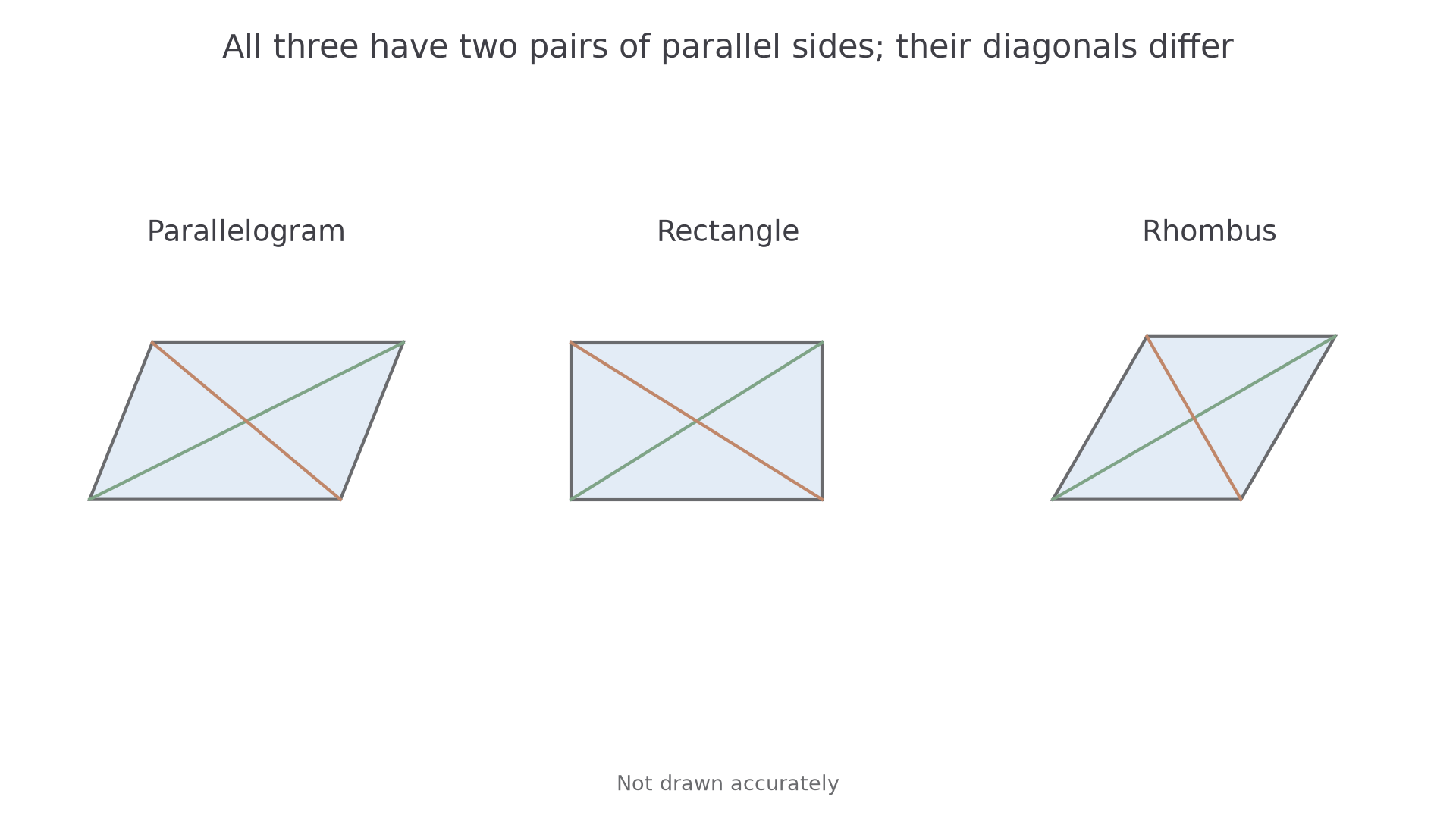
The parallel sides explain the angle properties. Adjacent angles of a parallelogram are co-interior angles and sum to ; opposite angles are equal. Its opposite sides are equal too. A half-turn about the crossing of its diagonals swaps each vertex with its opposite, showing both the equal opposite sides and the fact that each diagonal is cut in half.
[DIAGRAM: asset_name: The parallelogram family; asset_slug: aqa8300_g30_quadrilaterals; caption: Every shape shown has diagonals which bisect each other; extra conditions determine extra properties; description: A parallelogram, rectangle and rhombus each have both diagonals drawn. The rectangle's diagonals are equal; the rhombus's diagonals are perpendicular. All three have two pairs of parallel sides.]
| Shape | Sides and angles | Diagonals | Reflection lines; rotation order |
|---|---|---|---|
| General parallelogram | Opposite sides equal; opposite angles equal; adjacent angles sum to | Bisect each other | Usually none; |
| Non-square rectangle | Opposite sides equal; four right angles | Equal and bisect each other | ; |
| Non-square rhombus | Four equal sides; opposite angles equal | Perpendicular bisectors of each other; bisect opposite angles | ; |
| Square | Four equal sides; four right angles | Equal perpendicular bisectors of each other; bisect opposite angles | ; |
In a rectangle, reflecting across a line through the midpoints of opposite sides swaps the two diagonals, so their lengths match. In a rhombus, each diagonal is a fold line: it swaps two equal sides, bisects the angles at its ends and crosses the other diagonal perpendicularly. A square has both sets of properties. These results are not on the formulae sheet: learn them.
“Bisect each other” means that the crossing is the midpoint of each diagonal. It does not mean that the two diagonals have the same total length.
Key idea
A shape inherits every property of a family it belongs to. A square keeps all rectangle and rhombus properties; turning it onto a corner does not change its name.
Use a counterexample to test an “always” statement: a long, narrow rectangle disproves a claim that every rectangle has four equal sides.
Use angles and diagonals
A property becomes useful when it turns one stated measurement into another. First identify what is guaranteed by the shape's name; then choose the equality or angle total you need.
Continue this lesson.
You’re previewing NovaLearn without an account. Create a free account to read the rest.
Create free account