N9 - Standard form
Standard form writes a very large or very small number with a manageable coefficient and a power of ten. You will convert, compare and calculate in this form, both by hand and with a calculator. You will also learn to read a calculator display without losing the exponent.
Writing large and small numbers in standard form
A tiny component has mass . A bag contains of them. Is the total mass less than ? The powers look far apart, but standard form will make the calculation short.
First, consider a single number. . The coefficient is easy to read, while the power records the scale.
You already know
Multiplying or dividing by powers of ten changes place value. Also, , , and .
For a small number, the power is negative. . The negative index makes a small positive value; it does not make the value negative.
Standard form
A positive number in the form , where and is an integer. For example, is in standard form. has the same value, but its coefficient is too large to be standard form.
A coefficient of is allowed; a coefficient of is not. The number itself has standard form . Zero has no representation satisfying the definition above.
Standard form and place value
Choose the power that restores the original value after writing the coefficient between and .
Not on the formulae sheet: learn it.
Count place-value steps, then check their direction. Large numbers need a positive index; positive numbers below need a negative one.
Worked example 1: a large number
Question. Write in standard form. Non-calculator.
Plan. Use coefficient , then count how many powers of ten restore the original number.
Why is the index positive? We must enlarge to get the original large number.
Answer. .
Check. Multiplying by gives .
Change only the scale: keep coefficient , but place the original number below .
Worked example 2: a small number
Question. Write in standard form. Non-calculator.
Plan. Find the power that makes ten thousand times smaller.
Why count four steps rather than the zeros? The first non-zero digit moves from the ten-thousandths column to the ones column. Counting only visible zeros can miss a step.
Answer. .
Check. , and .
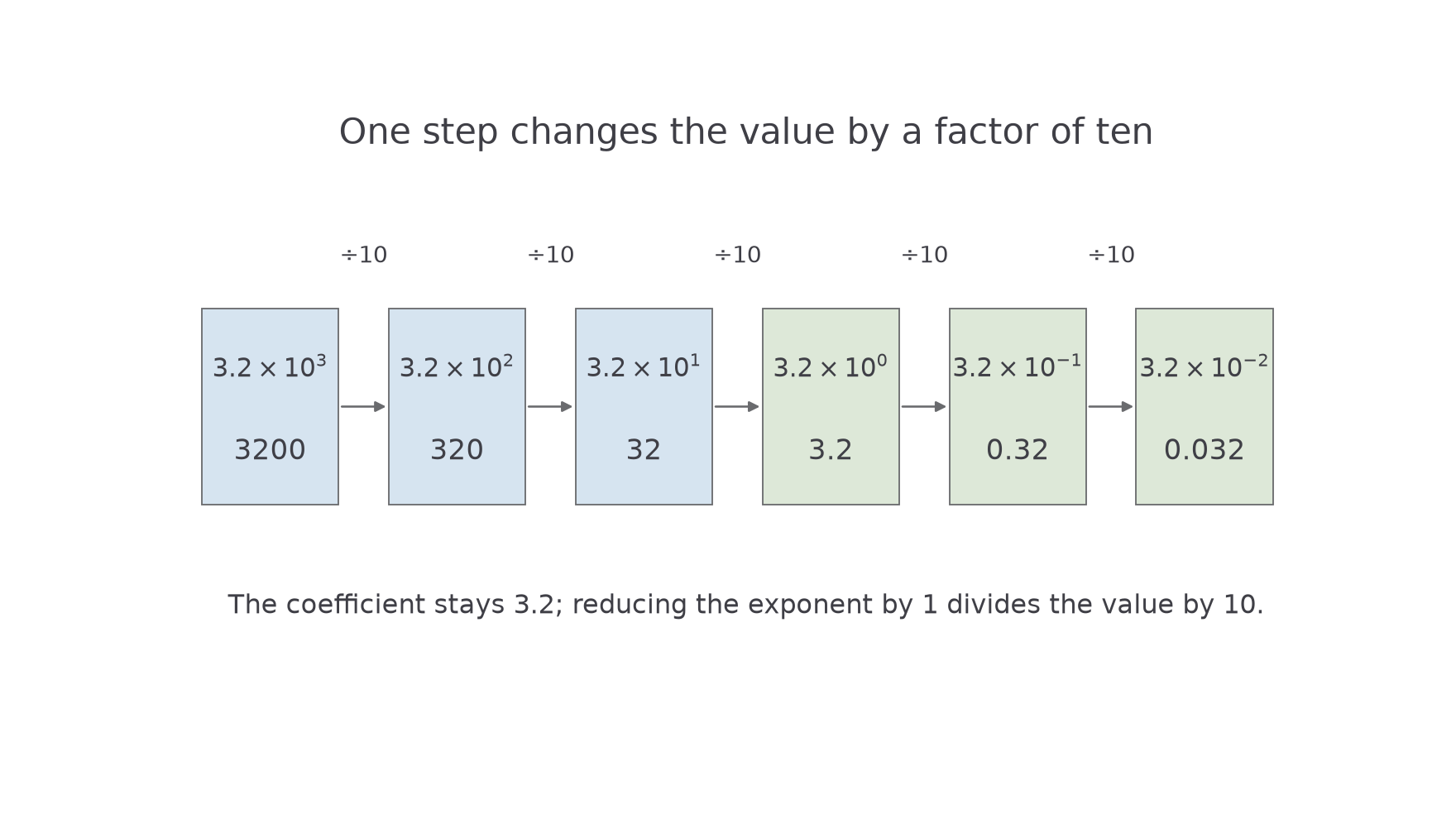
The same scale pattern continues through index zero.
[DIAGRAM: asset_name: Standard form power-of-ten ladder; asset_slug: aqa8300_n12_power_ladder; caption: Reducing the exponent by one divides the value by ten, even across zero; description: Six boxes keep coefficient 3.2 while the exponent falls from 3 to minus 2. Their ordinary values are 3200, 320, 32, 3.2, 0.32 and 0.032. Arrows between boxes show division by ten.]
Watch out
Wrong: . This makes , a large number. Right: . Check the size after choosing the sign.
Converting back is the same place-value operation in reverse.
Comparing standard-form numbers
For positive numbers already in standard form, compare the powers of ten first, then the coefficients if the powers match.
For example, is less than . The larger coefficient does not win against a whole extra power of ten. This works because every coefficient is at least and less than .
With the same exponent, coefficients decide: . With different negative exponents, remember their order: . A more negative exponent means a smaller positive value.
Coefficient
The number multiplying the power of ten. In , the coefficient is , and the exponent is . The exponent is not part of the coefficient.
Check that each number is normalised before using the exponent shortcut. is not in standard form: rewrite it as .
Key idea
For positive standard-form numbers, a larger exponent means a larger number; only equal exponents require a coefficient comparison.
Standard form also makes enormous exact numbers easy to name. A googol is followed by one hundred zeros. Writing its standard form, , avoids writing all digits. The exponent describes scale, not the number of digits needed to write the coefficient.
Multiplying and dividing in standard form
Separate the ordinary coefficients from the powers of ten, then put the final answer back into standard form.
For multiplication, multiply the coefficients and add the indices. For division, divide the coefficients and subtract the denominator's index. These are the same index laws you already know, applied to base .
Products and quotients in standard form
Here , are positive, and , are integers. Adjust the result so its coefficient is at least and less than .
Not on the formulae sheet: learn it.
That final adjustment preserves value. For example, : dividing the coefficient by means multiplying the power of ten by .
Worked example 3: multiplying and normalising
Question. Work out . Give your answer in standard form. Non-calculator.
Plan. Multiply the coefficients, combine the powers and adjust the coefficient.
Why increase the exponent? Changing to divides by , so the power must supply an extra factor of .
Answer. .
Check. .
Change only multiplication to division. The same coefficients now divide, and the indices subtract.
Worked example 4: dividing by a small number
Question. Work out . Give your answer in standard form. Non-calculator.
Plan. Divide the coefficients and subtract the complete denominator index.
Why is the result so large? Dividing by , a number below , makes the original value larger.
Answer. .
Check. .
A division may instead produce a coefficient below . For example, : multiplying the coefficient by requires reducing the exponent by .
Watch out
Wrong: . Right: subtract the denominator's whole index, , so the power is . Brackets around a negative index prevent this slip.
When a question asks for standard form, an intermediate form such as has the right value but is not yet the requested answer.
Adding and subtracting in standard form
Addition needs matching powers of ten before you can collect coefficients.
Think of money: you would not add a number of pounds to a number of pence without first matching the units. Likewise, . Rewriting one term puts both terms on the same scale.
Adding and subtracting with matching powers
For numbers , and an integer ,
First rewrite the numbers with the same power of ten. If the result is positive, normalise it afterwards. If the result is zero, write .
Not on the formulae sheet: learn it.
On Paper 1, matching a nearby power usually takes less writing than converting everything to ordinary numbers.
Worked example 5: adding different scales
Question. Work out . Give your answer in standard form. Non-calculator.
Plan. Rewrite the smaller term using , then add coefficients.
Why use ? Each unit of is ten times as large as a unit of , so we need one tenth as many.
Answer. .
Check. .
Change only the plus sign to minus. The scale conversion stays exactly the same.
Worked example 6: subtracting different scales
Question. Work out . Give your answer in standard form. Non-calculator.
Plan. Use the same matching powers, then subtract coefficients.
Why not subtract the indices? Subtracting indices is a division rule. Here we are subtracting two values.
Answer. .
Check. .
Even when the original powers match, check the final coefficient. .
Watch out
Wrong: . That confuses addition with multiplication. Right: .
The same method works for small decimals. Matching exponents keeps the zeros out of the working.
Calculator entry and displays
A calculator's short scientific display is another way of showing a coefficient times a power of ten.
A display such as means , not . Similarly, means . Some calculators show a small raised exponent instead of the letter .
You already know
Calculator papers allow powers and brackets. Enter the whole numerator and denominator separately when dividing expressions; a negative exponent belongs inside the exponent field.
Many calculators have a key labelled , EXP or EE for entering the power of ten. That key already supplies “times ten to the power”; do not type an extra factor of . It is different from the exponential function key .
For a check that works on any scientific calculator, use the ordinary power key and brackets. Keep every digit from the display until the final accuracy is requested. The display conventions and entry rules are not on the formulae sheet: learn them.
Worked example 7: reading a large display
Question. Work out . Give your answer in standard form. Calculator allowed.
Plan. Enter both bracketed factors, then interpret the complete scientific display.
Why copy the exponent too? The displayed gives only the coefficient; the exponent carries almost all of this number's size.
Answer. .
Check. By hand, and .
Change only the sign of the second exponent. This gives the component masses from the opening question.
Worked example 8: interpreting a small total
Question. Each component has mass . A bag contains components. Work out the total mass and decide whether it is less than . Calculator allowed.
Plan. Multiply the number of components by the mass of each one, then read the exponent.
Why multiply? Each of the components contributes the same mass.
Answer. , which is less than .
Check. By hand, , so the total is .
The opening answer is small even though there are many components. The positive exponent for the count and the negative exponent for the mass combine, rather than compete.
Watch out
Wrong: copying as . Right: keep the minus sign, . A missing sign changes the value by a factor of .
Read the display as a number, then carry out any operation the question requests.
Quick Recap
- Standard form is , with and integer .
- Multiply or divide the coefficients and use the index laws for the powers of ten.
- For addition and subtraction, match the powers first, then collect coefficients.
- Normalise the final coefficient and read a calculator's exponent, including its sign.
The opening bag has total mass , so it is lighter than .