G9, G10 - Circle parts and angle theorems
Name the lines and regions in a circle accurately. Then use the angle theorems in the Higher parts, explain why they work and give clear reasons in geometric arguments.
Centre, radius, diameter and chord
A straight line joins two points on the edge of a circle. Must it be a diameter? No: passing through the centre is the extra condition that makes the difference.
You already know
A line segment has two endpoints. Equal lengths can be marked with matching ticks. An isosceles triangle has two equal sides and two equal base angles.
A circle is built around one fixed point, its centre. Every point on the circle is the same distance from that centre. That distance is the radius, so two radii of one circle are always equal.
[DIAGRAM: asset_name: Lines in a circle; asset_slug: aqa8300_g25_circle_lines; caption: A diameter is a chord through the centre. Other chords need not pass through the centre; description: Two panels show a circle centred at O. Left panel has a horizontal diameter AB, a sloping radius OC and a separate chord DE above the centre. Right panel shows two equal radii to the ends of a chord, making an isosceles triangle. Labels sit outside the circle.]
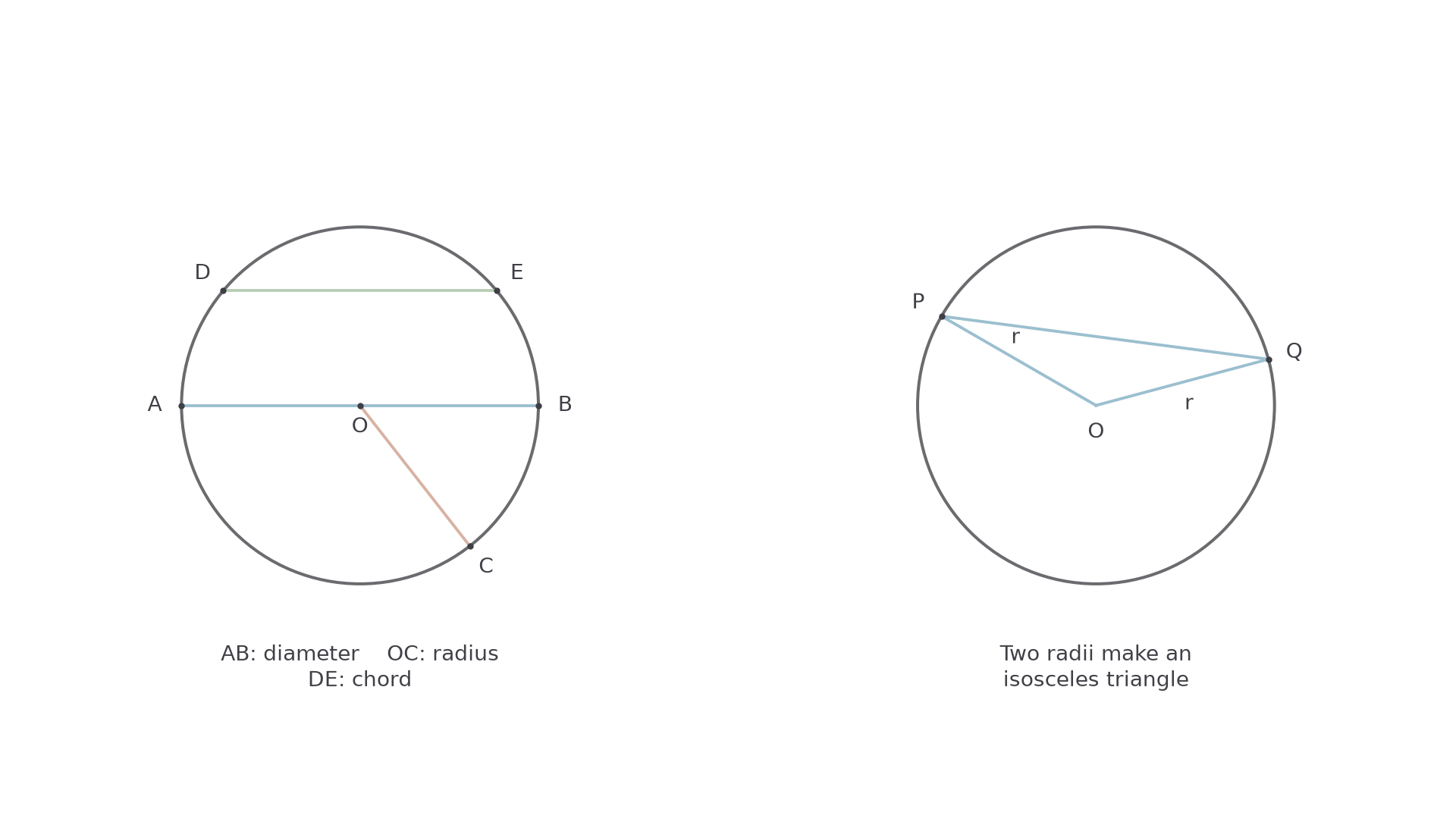
Circle vocabulary
The circumference is the boundary of a circle, or the distance around it. A radius joins the centre to the circumference. A chord is a straight line segment joining two points on the circumference. A diameter is a chord through the centre.
A diameter contains two radii placed end to end. If a radius is , the diameter is . A shorter chord is still a chord; its endpoints, rather than its length or direction, decide that name. A radius is not a chord because its centre endpoint is not on the circumference.
Diameter and radius
For a circle with radius and diameter ,
Not on the formulae sheet: learn it.
Here is a useful surprise: any triangle formed by two radii and their joining chord is isosceles. You get equal sides without measuring anything. This simple observation will explain several circle theorems later.
Key idea
Every diameter is a chord. A chord is a diameter only when it passes through the centre.
Use the endpoints and the centre condition to settle the opening question.
Arcs, sectors, segments and tangents
A curved piece of the boundary and a shaded piece of the interior are different objects. The words tell you which boundaries to look for.
[DIAGRAM: asset_name: Four more circle terms; asset_slug: aqa8300_g25_circle_regions; caption: An arc is a curve, a sector lies between two radii, a segment lies between a chord and an arc, and a tangent touches at one point; description: Four labelled circle panels show a highlighted minor arc AB, a blue sector between two radii and their arc, a sage segment between a chord and its arc, and a clay tangent touching a circle at T. No right-angle theorem is shown in these shared vocabulary diagrams.]
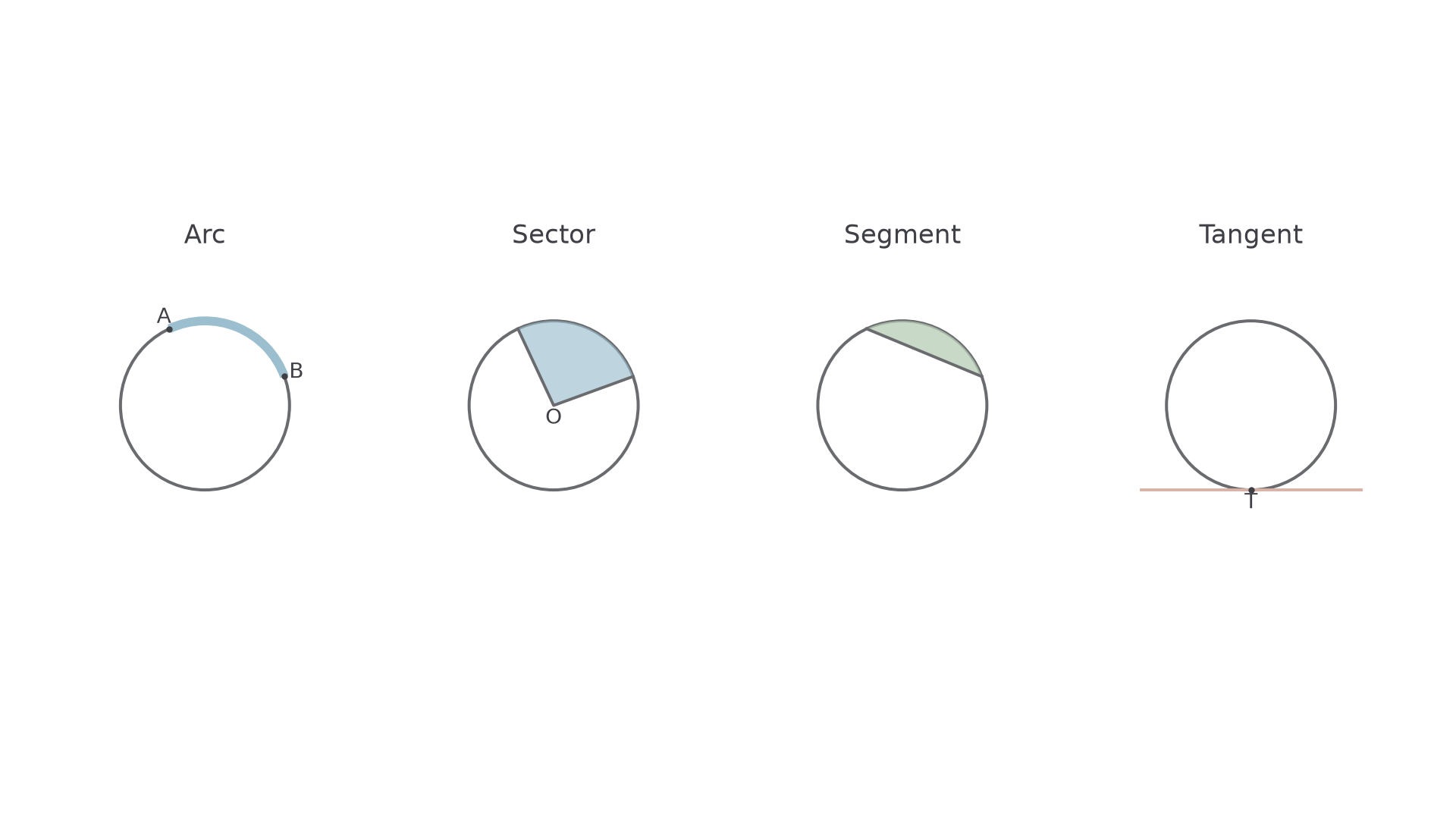
Arc, sector, segment and tangent
An arc is part of the circumference. A sector is a region bounded by two radii and an arc. A segment is a region bounded by a chord and an arc. A tangent is a straight line that touches a circle at exactly one point.
The smaller arc between two points is the minor arc; the longer one is the major arc. The same minor/major words distinguish the smaller and larger sectors or segments. A semicircle is half a circle, cut off by a diameter. Its straight boundary is both a diameter and a chord.
A chord normally cuts off two segments. It does not cut off two sectors unless it is a diameter: sectors need their straight edges to meet at the centre. A line passing through the circle at two distinct points is not a tangent.
Watch out
Wrong: “The shaded region between a chord and an arc is an arc.” Right: the curve is the arc; the whole shaded region is a segment. A sector has two radii as its straight boundaries.
When a question gives a list of words, check the boundaries before choosing one. You do not need a calculation to identify a region.
Angles at the centre and circumference (Higher)
Fix two points and on a circle. The angle they make at the centre is twice the angle they make at a point on the other arc. The same arc must be used for both angles.
[DIAGRAM: asset_name: The double-angle theorem and its proof; asset_slug: aqa8300_g25_double_angle; caption: Join the centre to the circumference point. Two isosceles triangles explain why the centre angle is twice the circumference angle; description: Left panel shows points A and B on a lower minor arc and C on the opposite arc, with centre angle AOB labelled 2 theta and ACB labelled theta. Right panel shows O joined to A B C, with CO extended to D on the circumference; angles ACO and OCB are labelled x and y. The relevant external centre angles AOD and DOB are labelled 2x and 2y.]
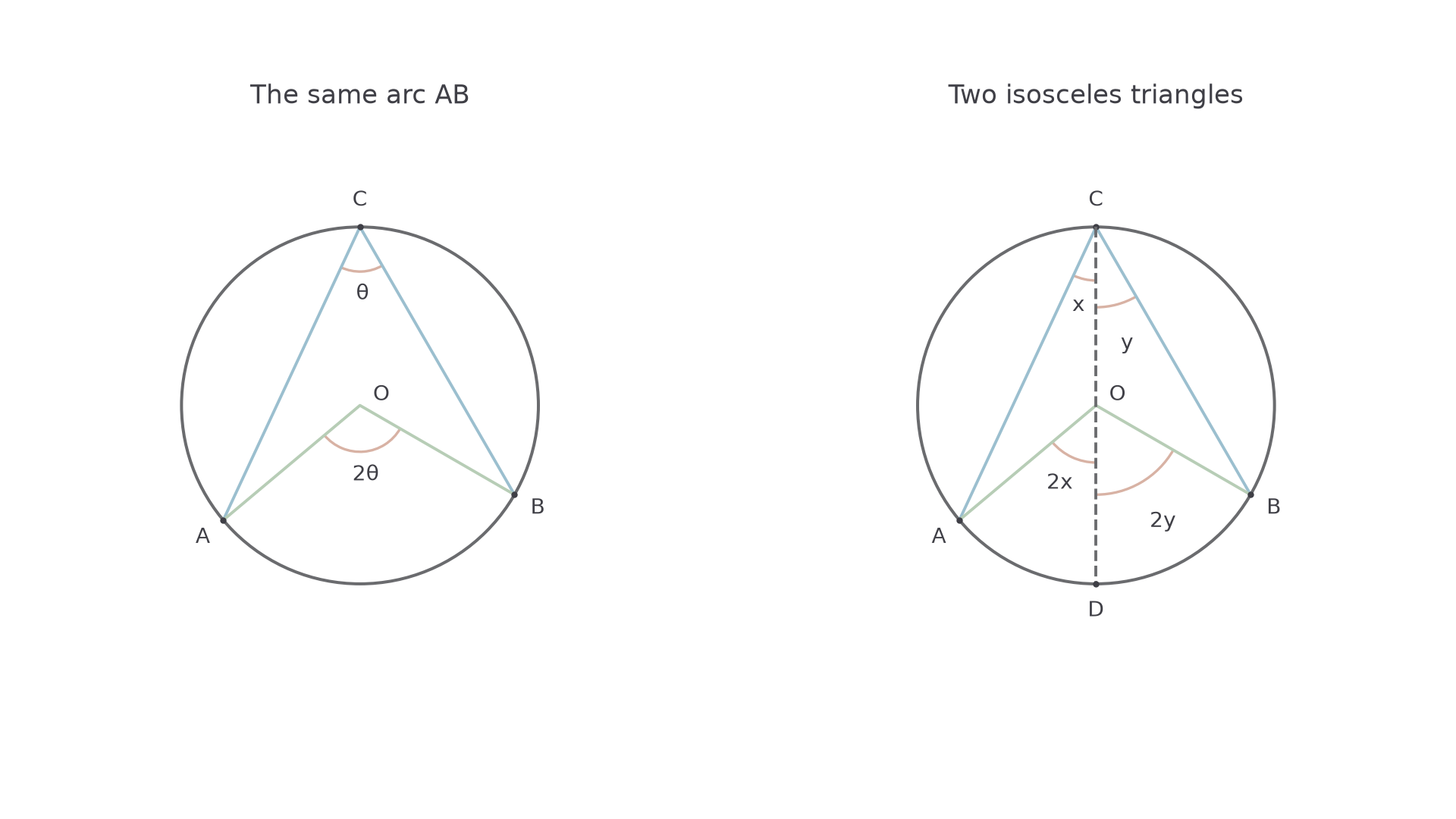
Angle at the centre
For angles standing on the same arc , with the centre and on the remaining arc,
Use the centre angle facing the arc that does not contain . This may be a reflex angle.
Not on the formulae sheet: learn it.
To prove it, draw and extend it to . Write and . In isosceles triangle , the base angles at and are . The external angle is therefore . Similarly, . Adding gives
If lies outside , subtract the two external angles instead: . If the relevant centre angle is reflex, the added angles give that reflex angle. These cases prove the same rule without assuming the centre is inside the triangle.
Worked example 1: from the centre to the edge
Question. , and lie on a circle with centre . The minor angle is . Point lies on the major arc . Work out . Non-calculator.
Plan. Match the minor arc , then halve its centre angle.
Why this step? Point is on the major arc, so its angle faces the minor arc and uses the minor centre angle.
Answer. , because the angle at the centre is twice the angle at the circumference.
Check. .
The second example changes the position of the circumference point. The angle now faces the major arc, so the reflex centre angle matters.
Worked example 2: choosing the reflex angle
Question. The minor angle is . Point is on the minor arc . Work out . Non-calculator.
Plan. Work out the reflex angle at , then halve it.
Why this step? The arc seen from is the arc not containing , which is the major arc.
Answer. .
Check. The major arc is more than half the circle, so its circumference angle is greater than .
The numerical ratio is easy; choosing which angle to double or halve is the real decision.
Watch out
Wrong: halve the smaller centre angle every time. Right: trace the arc between the endpoints that does not contain the circumference point. Use the centre angle facing that arc.
Try the same choice with a new minor centre angle.
The angle in a semicircle (Higher)
A diameter fixes a right angle anywhere on either semicircle. Move the third vertex along the curve: the triangle changes shape, but that angle stays put.
[DIAGRAM: asset_name: A right angle from a diameter; asset_slug: aqa8300_g25_semicircle; caption: The endpoints of a diameter make a right angle at any other point on the circle; description: A circle has diameter AB and an off-centre point C on the upper arc. AC and BC meet at a marked right angle at C. A second small panel shows a different point D on the same upper arc and its right angle ADB. The centre O is marked on AB.]
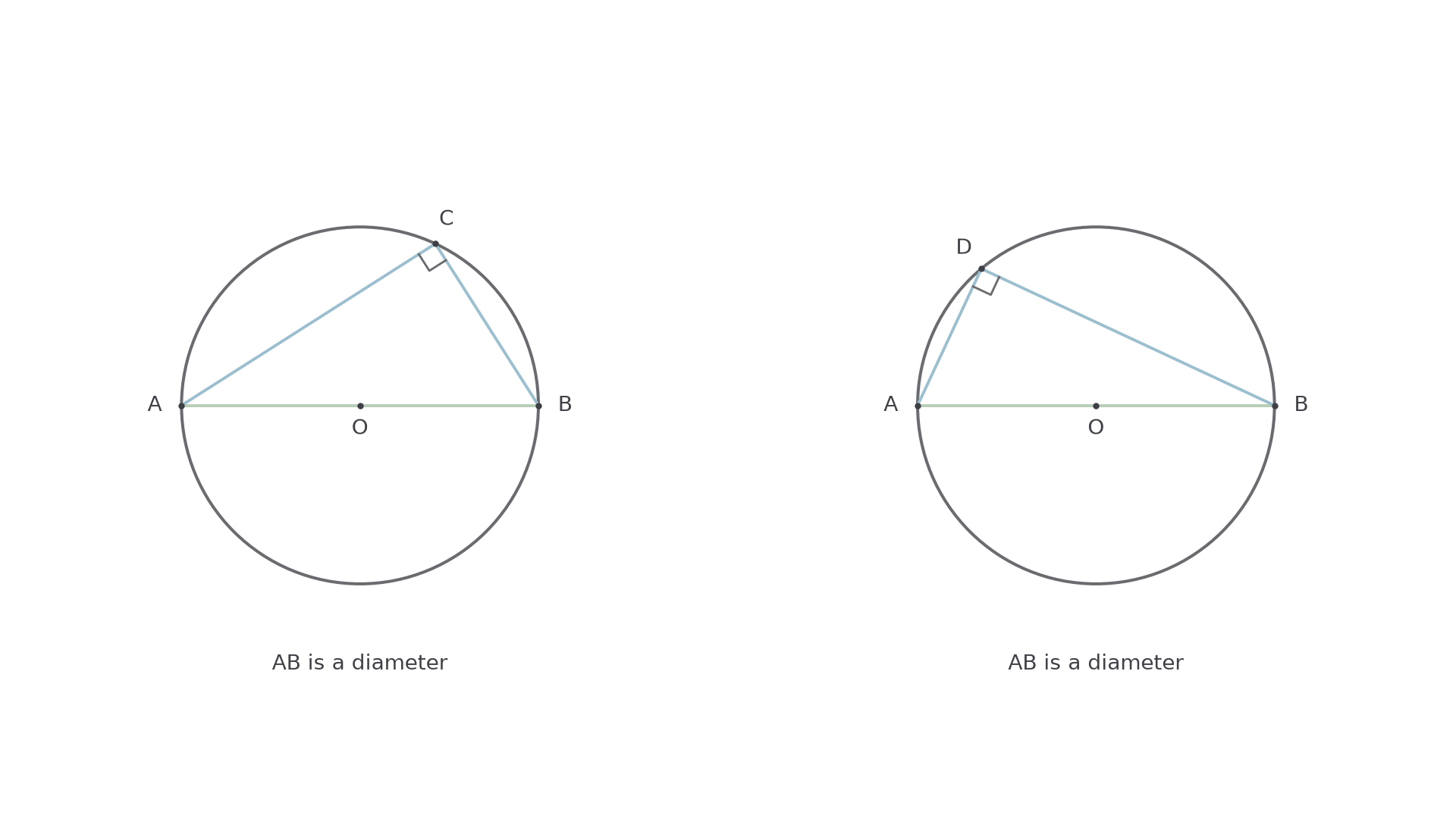
Angle in a semicircle
If is a diameter and is another point on the circle,
Not on the formulae sheet: learn it.
The proof is short. The straight angle is , so the angle at the circumference on the same semicircular arc is . That also explains the condition: the longest-looking side is not enough; it must be a diameter.
Continue this lesson.
You’re previewing NovaLearn without an account. Create a free account to read the rest.
Create free account