A7 - Functions, composites and inverses
A function turns an input into one output by following a rule. You will interpret simple expressions as function machines. The Higher parts introduce function notation, combine functions in a chosen order, and find an inverse rule that reverses a process.
Functions with inputs and outputs
A machine doubles a number, then adds . Feed in and it gives . Swap the steps and it gives . How can the same two operations produce different answers? Their order is part of the rule.
You already know
An expression such as means multiply by , then add . Brackets change the order: adds first.
Think of the input as a number arriving at the machine and the output as the number leaving it. For , each input has one definite output. Inputs do not have to be positive whole numbers unless the question says so.
[DIAGRAM: asset_name: Why the order of function-machine steps matters; asset_slug: aqa8300_a08_machine_order; caption: Doubling then adding 3 gives a different output from adding 3 then doubling; description: Two horizontal function-machine rows. Top row shows input 5, multiply by 2, intermediate value 10, add 3, output 13. Bottom row shows input 5, add 3, intermediate value 8, multiply by 2, output 16. Blue boxes consistently mean multiply by 2 and green boxes mean add 3. Arrows run left to right.]
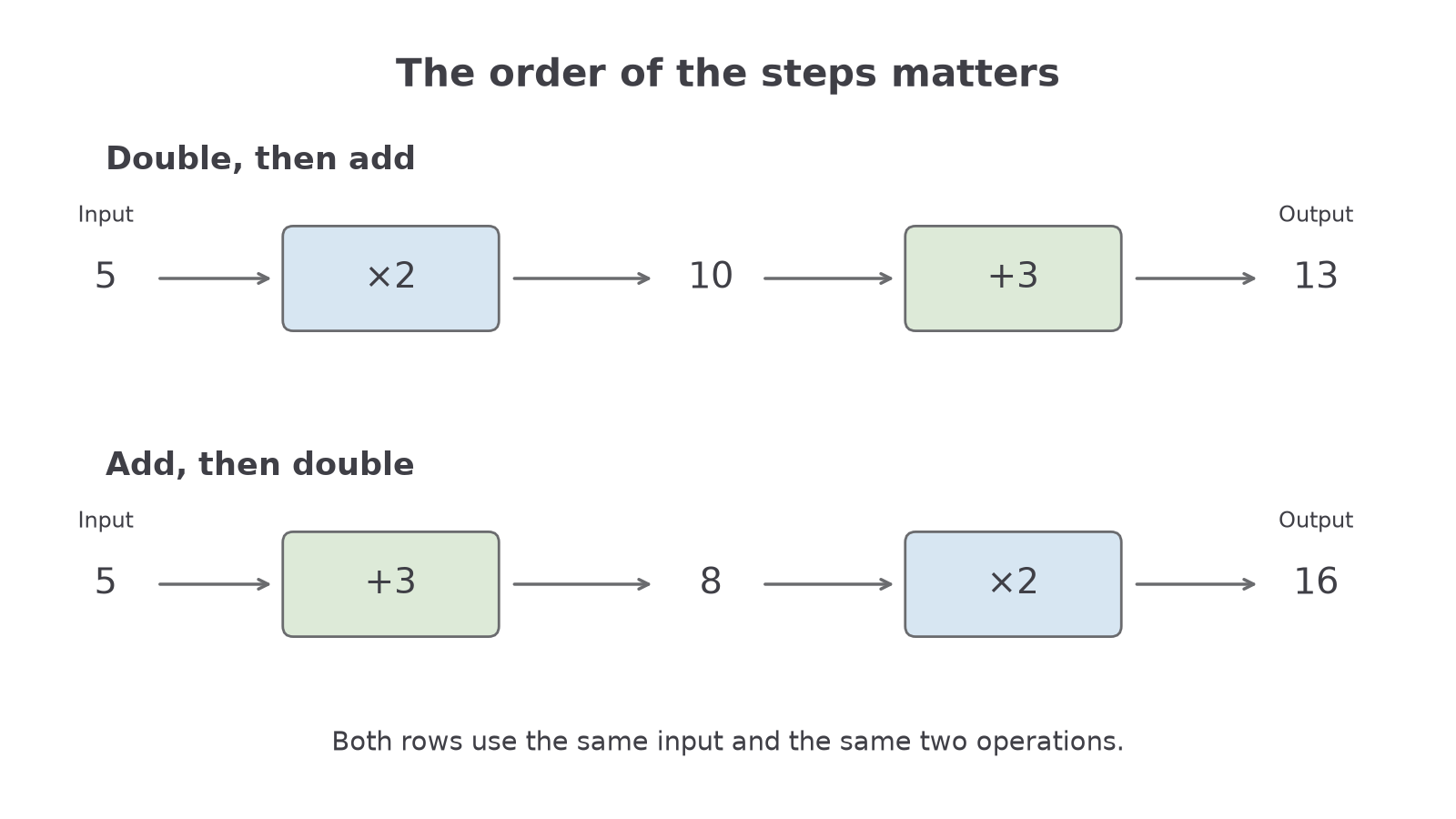
The two rows start with the same number. The bottom row doubles the added as well as doubling the input, so its output is larger.
Function
A rule that assigns exactly one output to each allowed input. For example, “square the input” is a function: input gives output . Different inputs may share an output: also gives . A rule that gives both and as separate outputs for the same input is not a function.
The expression specifies the machine. This interpretation of an expression is not on the formulae sheet: learn it. Both examples are non-calculator.
Worked example 1: double then add
Question. A function has rule . Work out the output when the input is .
Plan. Double the input, then add .
Why this step? The rule says , so only the input is doubled. The added is outside that multiplication.
Answer. .
Check. The output is more than twice , as the rule requires.
Change only the input to a negative number. Keep exactly the same operations.
Worked example 2: a negative input
Question. A function has rule . Work out the output when the input is .
Plan. Put the negative input in brackets, multiply, then add.
Why this step? The input is the whole number . Brackets keep its minus sign attached during multiplication.
Answer. .
Check. Increasing the input from to adds , so the output should increase by . Indeed, .
An output can be negative. A function does not promise a positive answer; it promises one answer for each allowed input.
Watch out
Wrong: , obtained by adding before doubling. Right: multiply first to get . If the rule were , the bracket would tell you to add first.
Try a new negative input with the same machine.
Function notation (Higher)
Writing gives a function a name and shows its input. If , the letter names the rule; it does not multiply .
Read as “the output of function f when the input is ”. For an algebraic input such as , replace every in the rule by the whole expression , using brackets: .
Function notation
In , the expression inside the brackets is the input and is the output. For example, if , then . It does not mean .
Function notation is not on the formulae sheet: learn it. In both non-calculator examples, keep the whole negative input inside brackets.
Worked example 3: evaluating a named function
Question. . Work out .
Plan. Replace by , then follow the order of operations.
Why this step? The number inside the function brackets tells you the input to substitute; it is not an extra factor.
Answer. .
Check. The rule triples the input, then moves lower. Tripling gives , so has the correct sign and size.
Now change only the rule by squaring its input before multiplying by . The input stays .
Worked example 4: the input is squared
Question. . Work out .
Plan. Square the whole input before multiplying by and subtracting .
Why this step? . Squaring only the while leaving a minus outside would change the input's meaning.
Answer. .
Check. Inputs and have the same square, so .
The name may be f, g or h. It labels the chosen rule and does not change the substitution method.
Watch out
Wrong: . The brackets make the whole negative number the base of the power. Right: .
Use the same squared-input method with a new rule and input.
Composite functions (Higher)
A composite function feeds the output from one function into another. The opening machine puzzle showed why the order matters.
If you square an input and then double it and add , that differs from doubling and adding before squaring. Function notation records exactly which process comes first.
Composite function
A function formed by applying one function and then another. In AQA notation, : apply first, then . It does not mean multiply the two outputs.
Continue this lesson.
You’re previewing NovaLearn without an account. Create a free account to read the rest.
Create free account