N15, N16 - Error intervals and limits of accuracy
A rounded measurement describes a range of possible values. In N15 you will write this range using inequality symbols, for both rounding and truncation. In N16 you will use the limits of accuracy to decide which measurements and claims are possible.
Error intervals from rounding
Two rods are both labelled , correct to the nearest centimetre. Must they be exactly the same length? A label hides some detail, so we need to work backwards from the rounded value.
You already know
Positive halfway values round upwards. The symbol includes equality, while excludes it. For example, includes but excludes .
Numbers such as , and all round to at the nearest whole number. The halfway values are and . The first rounds to , but the second rounds to , so only the first endpoint is included.
Error interval
A range containing every possible original value consistent with a stated rounding or truncation. For a positive length rounded to at the nearest centimetre, the interval is , with measured in centimetres. The word “error” describes lost accuracy, not a calculation mistake.
The two limits sit half a rounding unit below and above the rounded number. On a number line, a filled circle includes an endpoint and a hollow circle excludes it.
Rounding interval for a positive quantity
If a positive quantity is rounded to , to the nearest unit , then
Use the same units for , and . For example, rounding to the nearest uses half a unit of .
Not on the formulae sheet: learn it.
First find the interval for the rods in the opening question.
Worked example 1: a whole-unit measurement
Question. A rod has length , correct to the nearest centimetre. Write the error interval for its length in centimetres. Non-calculator.
Plan. Find half the rounding unit, subtract and add it, then choose the endpoint symbols.
Why exclude ? It rounds to , so it cannot produce the stated label.
Answer. .
Check. rounds to ; also rounds to ; does not.
Change only the accuracy: the label is now , correct to one decimal place. The rounding unit becomes ten times smaller.
Worked example 2: a decimal-unit measurement
Question. A rod has length , correct to the nearest . Write the error interval for its length in centimetres. Non-calculator.
Plan. Use half of , rather than half of .
Why use ? It is halfway between successive tenths.
Answer. .
Check. The interval has width , matching the rounding unit.
Do not replace an excluded endpoint with the largest two-decimal-place number you can think of.
Watch out
Wrong: . A length of also rounds to . Right: . There is no greatest decimal below ; the strict inequality handles them all.
For significant figures, first find the place value of the last kept digit. A length of to two significant figures was rounded to the nearest , giving . The half-unit is , not .
Error intervals from truncation
Truncation removes digits without making a nearest-value decision.
For example, truncated to one decimal place is , although it rounds to . Any positive number beginning has that same truncated value.
Truncation
Cutting off every digit after a stated place without changing the retained digits. For example, truncated to one decimal place is . For a negative number, truncated to one decimal place is : cutting off digits moves its value towards zero.
For a positive number, start at the truncated value and continue up to, but not including, the next step. This interval is not centred on the written value.
[DIAGRAM: asset_name: Rounding and truncation give different intervals; asset_slug: aqa8300_n15_rounding_truncation; caption: Rounding to 4.6 uses the interval from 4.55 to 4.65, while positive truncation to 4.6 uses 4.6 to 4.7; description: Two aligned number lines from 4.50 to 4.75. The top line, rounded to one decimal place, has a filled blue endpoint at 4.55 and hollow blue endpoint at 4.65 joined by a thick line. The bottom line, truncated to one decimal place, has a filled sage endpoint at 4.60 and hollow sage endpoint at 4.70. Both display 4.6 above the relevant label.]
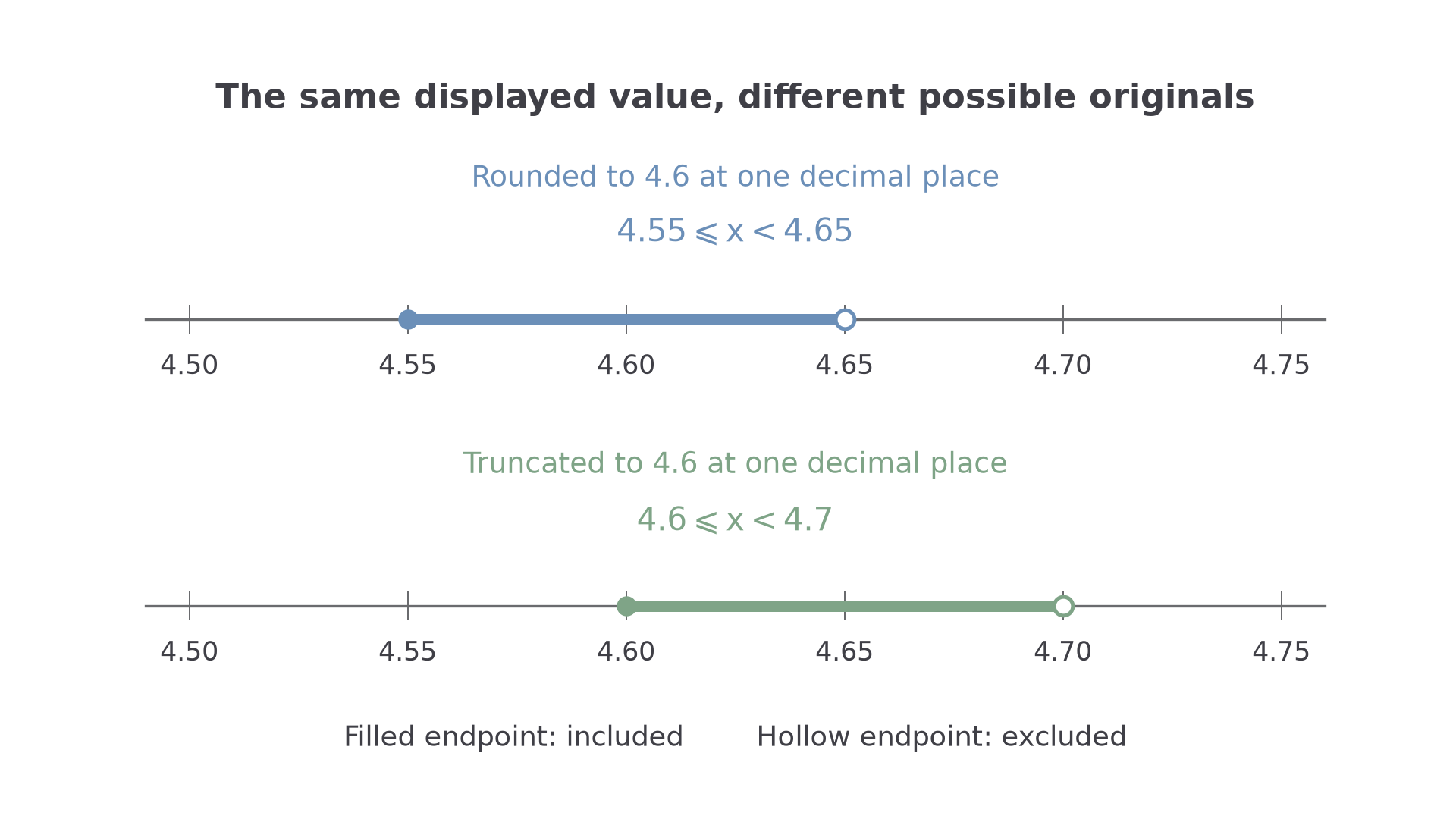
Positive truncation interval
If a positive number is truncated to , retaining a final place of size , then
For a negative number, inspect what cutting off its digits does: the interval lies towards more negative values instead, with the truncated endpoint included.
Not on the formulae sheet: learn it.
The first example uses a positive value.
Worked example 3: positive truncation
Question. A positive number is truncated to one decimal place. The result is . Write the error interval. Non-calculator.
Plan. Keep all numbers beginning , stopping at the next tenth.
Why not subtract ? That is the rule for rounding, a different operation.
Answer. .
Check. Both and truncate to ; does not.
Change only the sign. Cutting digits from a negative number moves it right on the number line, towards zero.
Worked example 4: negative truncation
Question. A number is truncated to one decimal place. The result is . Write the error interval. Non-calculator.
Plan. Find the negative numbers whose digits begin , then order their endpoints.
Why does the included endpoint move to the right? On a number line, is greater than .
Answer. .
Check. lies inside the interval and truncates to .
Both rounding and truncation lose information, but the possible lost digits are different.
Watch out
Wrong: a positive number truncated to has interval . That is the rounding interval. Right: . For negative truncation, check the order and endpoint symbols separately.
Use the negative example's reasoning with new digits.
What a rounded measurement guarantees
The limits tell you what must be true, what may be true and what cannot be true.
The two opening rods need not be equal: and both round to . They differ by , nearly a whole centimetre. Equal labels do not guarantee equal measurements.
More precision gives a narrower interval. For a positive measurement rounded to the nearest unit , its difference from the rounded value is at most half of . This limit-of-accuracy rule is not on the formulae sheet: learn it. An exact count, such as three strips, is different from a rounded measurement: the count has no rounding uncertainty.
If a count itself is rounded, remember that counts are whole numbers. An attendance of , to the nearest , gives . The least possible attendance is and the greatest is , since there cannot be a fraction of a person. A measured length, by contrast, is not restricted to integers.
Worked example 5: a guaranteed claim
Question. Three strips each have length , correct to the nearest . Show that their total length must be less than . Non-calculator.
Plan. Find a limit that each strip stays below, then use it three times.
Why use , not ? The actual lengths may be greater than their rounded labels.
Answer. The total is less than , so it must be less than .
Check. The comparison uses metres throughout. Even lengths very close to cannot reach in total.
Now change only the proposed total to . A claim can fail even when it sounds very close to the first one.
Worked example 6: a claim that is not guaranteed
Question. Three strips each have length , correct to the nearest . Sam says their total must be less than . Is Sam correct? Show working to support your answer. Non-calculator.
Plan. Try an allowed length near the top of the interval to test the word “must”.
Why is one example enough? A statement using “must” fails if even one allowed case breaks it.
Answer. No. All three strips could be , giving .
Check. Each rounds to the stated .
Keep the limit of the interval distinct from a largest possible measured value.
Watch out
Wrong: the greatest strip length is . Lengths such as are possible too. Right: every length is below , and is the excluded limit.
When AQA asks you to show that a claim is correct, write the comparison that establishes it. Merely multiplying the rounded labels ignores the lost accuracy.
Quick Recap
- Work backwards from a rounded value using half the rounding unit on each side.
- For a positive rounded measurement, include the lower limit and exclude the upper limit.
- Positive truncation starts at the written value and ends just before the next step; negative truncation needs its endpoints checked on the number line.
- Test a “must” claim against all allowed values; one allowed counterexample can disprove it.
The opening rods can have different lengths: the same rounded label describes a whole interval.