G5, G6 - Congruent triangles and geometric proof
Decide when triangle measurements force exactly one shape. G5 supplies four congruence tests; G6 uses them, angle facts, quadrilateral properties and similarity to build proofs. You will finish by explaining why the squares on the two shorter sides of a right-angled triangle add to the square on its longest side.
Congruence from sides and included angles
Four identical right-angled triangles fit inside a square of side . Each has shorter sides and . What is the area of the tilted square left in the middle? By the end, this little packing puzzle will explain a famous theorem.
You already know
Angles in a triangle add to . An isosceles triangle has two equal sides; a parallelogram has two pairs of parallel opposite sides. Corresponding points on a coordinate grid keep their labels when a shape moves.
First we need to recognise identical triangles, even when one is turned over. Matching the longest side to the longest side is a useful start, but the positions of the angles matter too.
Congruent triangles
Triangles with exactly the same shape and size. Corresponding sides and corresponding angles are equal. A rotation, reflection or translation can place one exactly on the other. A larger copy is similar, but is not congruent.
You do not need to measure all six features. A small set of matching measurements can force the rest.
SSS and SAS congruence
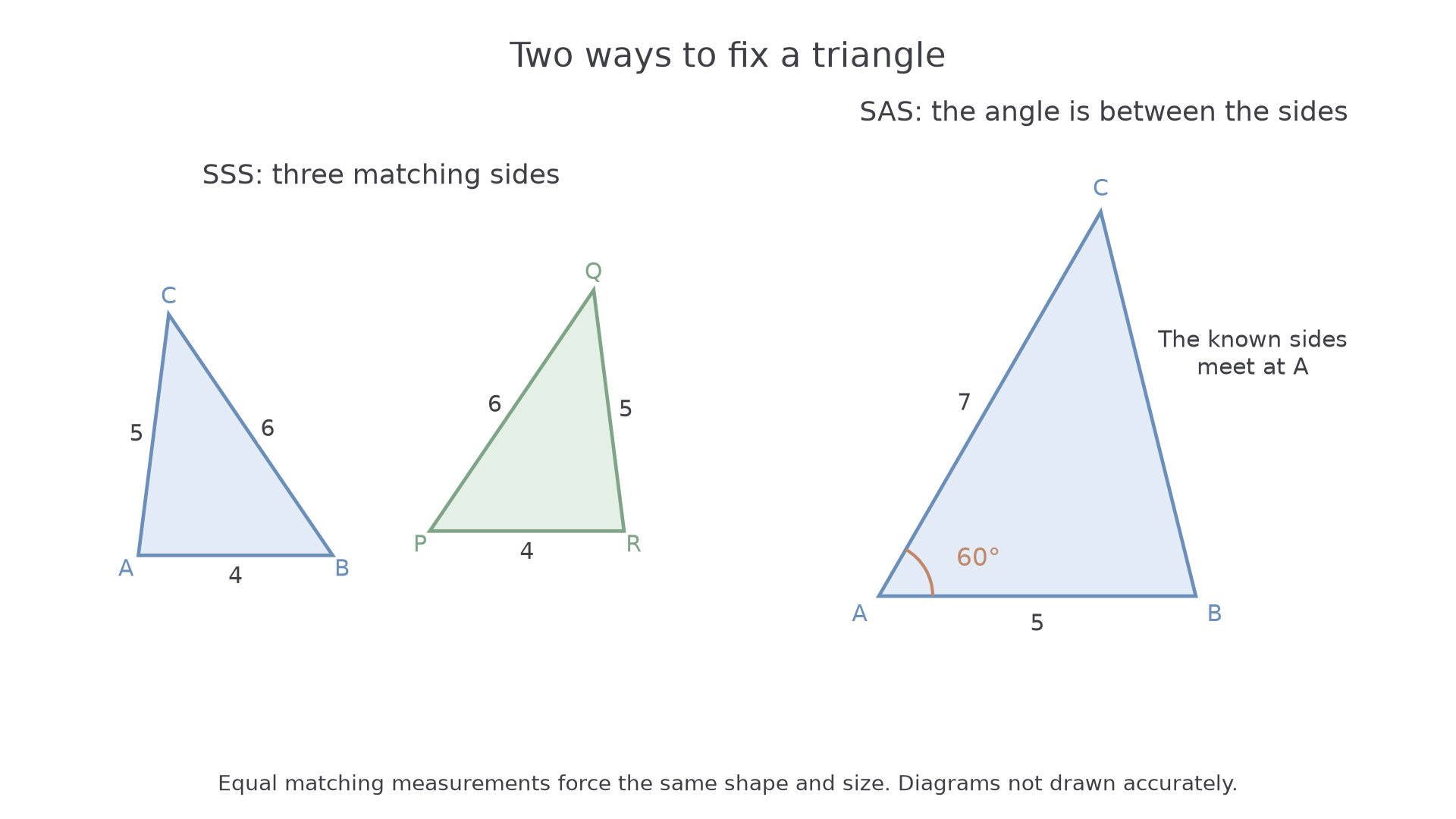
SSS: three pairs of corresponding sides are equal.
SAS: two pairs of corresponding sides and the included angle, between those sides, are equal.
These tests apply to triangles with positive area. For SSS, the longest side must be shorter than the sum of the other two.
Not on the formulae sheet: learn it.
With SSS, once one side is fixed, the third vertex is where two circles meet. The two possible positions are mirror images, so they still give congruent triangles. With SAS, the included angle fixes the opening before the two side lengths are marked.
[DIAGRAM: asset_name: Three sides or two sides and their included angle; asset_slug: aqa8300_g05_sss_sas; caption: SSS fixes three side lengths and SAS fixes the angle between the two known sides; description: Two panels. The first has a pair of triangles with corresponding sides 4 5 6 in different orientations. The second has a triangle with sides 5 and 7 and the included angle 60 degrees marked. A note says the known sides meet at A. Diagrams not drawn accurately.]
Worked example 1: matching three sides
Question. Triangle has , , . Triangle has , , . Explain why the triangles are congruent and write their vertices in corresponding order. Non-calculator.
Plan. Match all three sides, then use the sides meeting at each vertex.
Why this step? Vertex joins the sides of lengths and , so it matches , not .
Answer. is congruent to , by SSS.
Check. The order gives , , , which matches every side.
Change only the evidence: instead of the third side, the next example gives the angle between the first two sides.
Worked example 2: using the included angle
Question. , , and . Explain why and are congruent. Non-calculator.
Plan. Check that the equal angles lie between the two equal side pairs.
Why this step? The middle letters and are where the two known sides meet. This is SAS, rather than two sides and an unrelated angle.
Answer. is congruent to , by SAS.
Check. Both angle statements use the vertex between the sides of lengths and .
Two sides and a different angle may allow two different triangles. This is why the position of an angle must be stated precisely.
Watch out
Wrong: “Two sides and any equal angle give SAS.” Right: the equal angle must be between the two equal sides. SSA is not a general congruence test.
Use the named vertices to check the included angle in this new pair.
Congruence from angles and right triangles
Two angles fix a triangle's shape, but not its size. Adding a corresponding side fixes the size as well.
ASA and RHS congruence
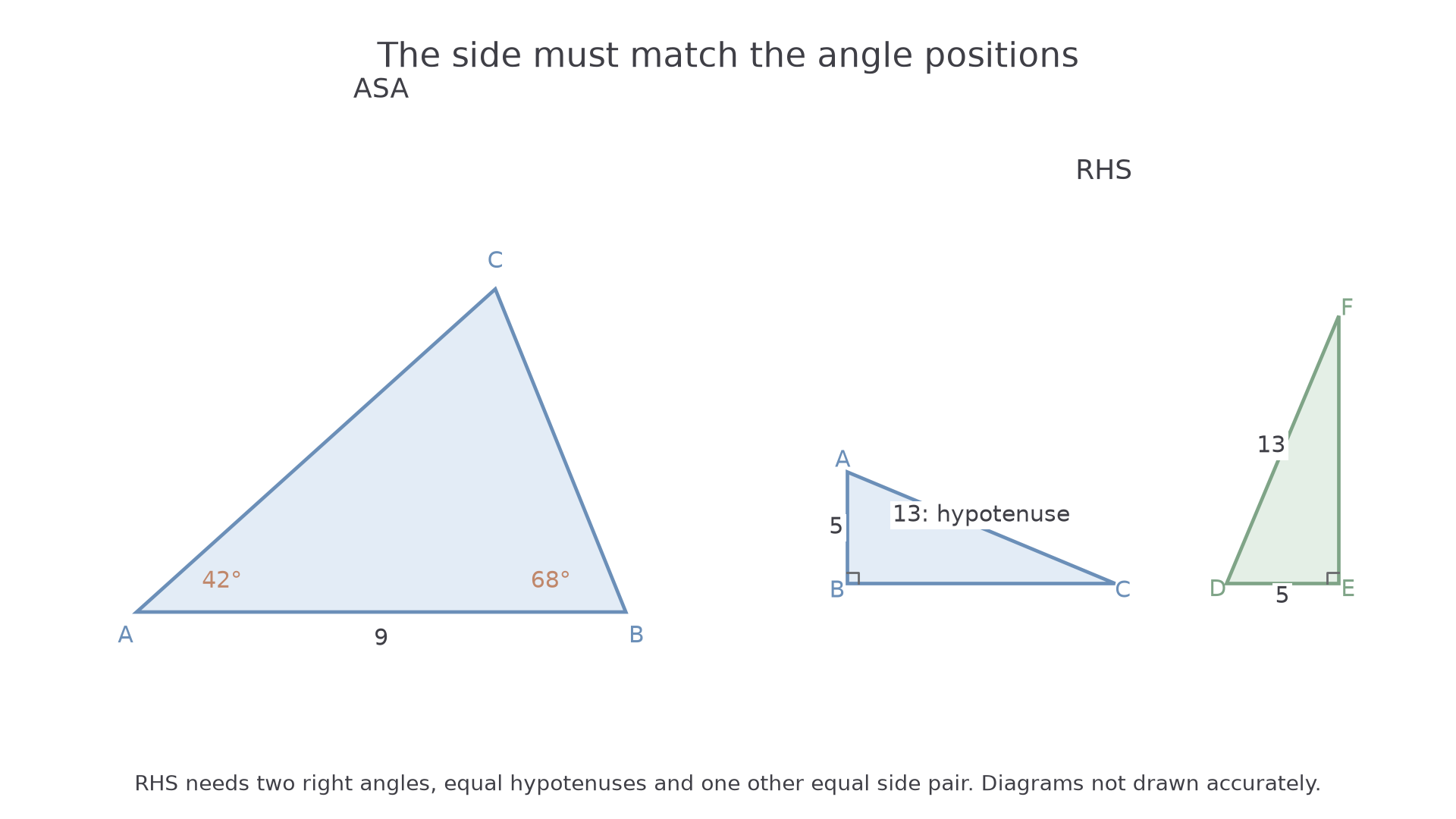
ASA: two corresponding angles and the included side are equal. If the known side is not included, first find the third angle using ; this gives an ASA arrangement.
RHS: both triangles are right-angled, their hypotenuses are equal, and one other corresponding side is equal. The hypotenuse is the side opposite the right angle.
Not on the formulae sheet: learn it.
AAA is a useful test for similarity, but not for congruence: an equilateral triangle can have side or side . RHS is a special right-triangle test; it does not make SSA valid for other triangles.
[DIAGRAM: asset_name: Angle side angle and right angle hypotenuse side; asset_slug: aqa8300_g05_asa_rhs; caption: ASA uses corresponding angles and a side while RHS requires two right angles and equal hypotenuses; description: Two panels. The first shows a triangle with angles 42 and 68 degrees at the ends of a side of length 9. The second shows two right-angled triangles with hypotenuse 13 and one shorter side 5, in different orientations. Right-angle squares and hypotenuse labels are clear. Diagrams not drawn accurately.]
Worked example 3: finding the angle needed for ASA
Question. In , , , . In , , , . Explain why the triangles are congruent. Non-calculator.
Plan. Find , then compare the angles at the ends of the equal sides.
Why this step? The new angle puts the equal side between the two equal angles in each triangle.
Answer. is congruent to , by ASA.
Check. Each third angle is ; all three angle pairs match.
Change the triangle type to right-angled. The right angle and hypotenuse now let you use RHS directly.
Worked example 4: recognising the hypotenuse
Question. is right-angled at , with and . is right-angled at , with and . Explain why the triangles are congruent. Non-calculator.
Plan. Identify the hypotenuses from the right-angle positions, then match the other given side.
Why this step? A hypotenuse is identified by being opposite the right angle, not by how a drawing is tilted.
Answer. is congruent to , by RHS.
Check. matches the right angles, and matches the ends of the sides of length .
In a proof, name the criterion after listing the matching information. “They look the same” is not mathematical evidence.
Watch out
Wrong: “The longest-looking sides are equal, so RHS.” Right: establish a right angle in each triangle, identify their hypotenuses and give one more equal side pair. A sketch alone establishes none of these facts.
The next pair has the same right-triangle structure, with new lengths and a different vertex order.
Proving angle and side properties
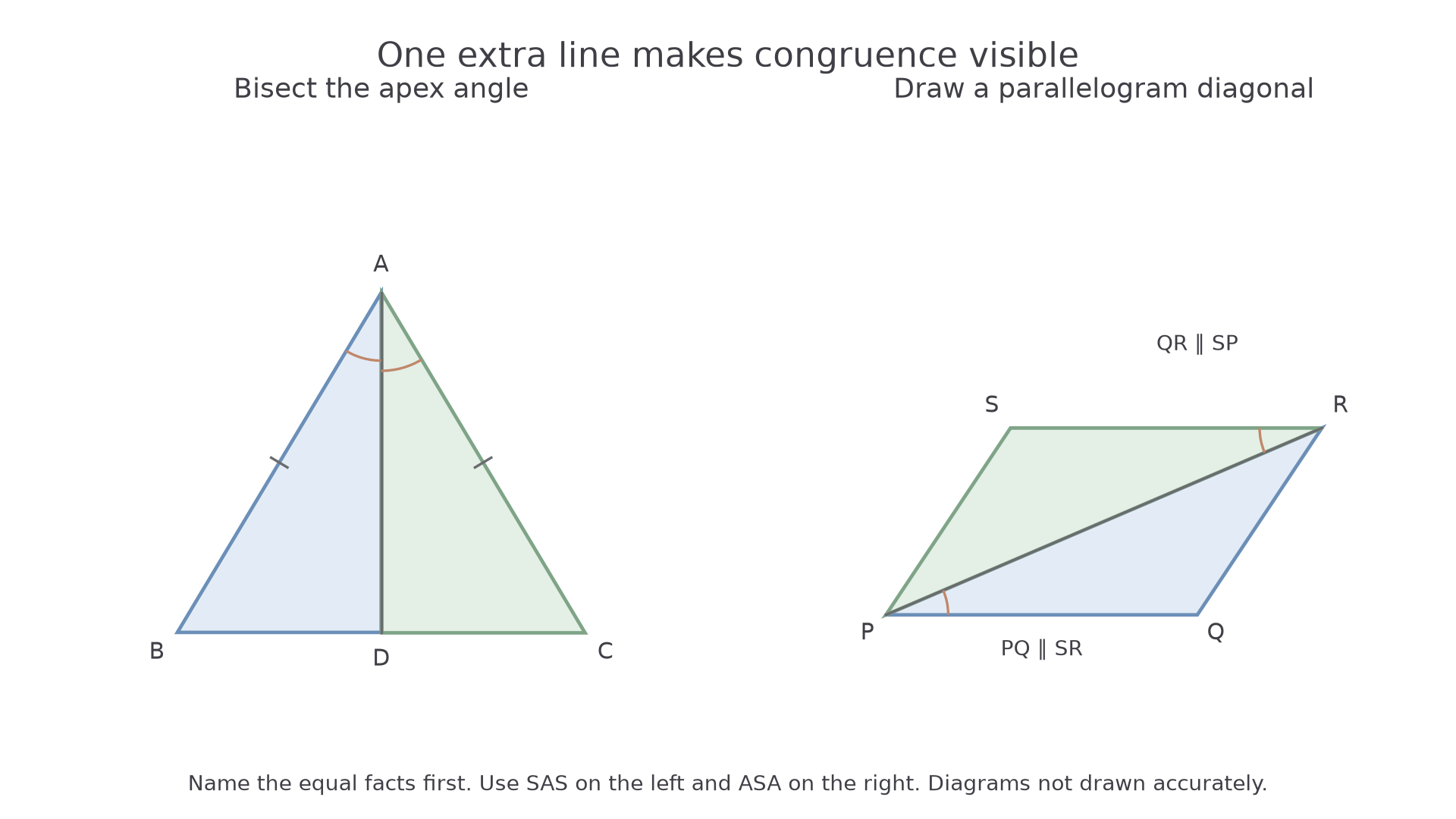
A useful proof often begins by drawing one extra line. It splits a familiar shape into triangles whose matching facts can be explained.
A conjecture is a statement you think may be true. A diagram can suggest one, but measuring several examples cannot prove it for every shape. Begin with the facts given, name a reason for each new fact, and reach the claim without using it along the way.
Geometric proof
A chain of deductions from given information and established results. For example, “these sides are equal because the triangles are congruent” is a valid step after congruence has been proved. “These triangles are congruent because the sides I want to prove equal are equal” is circular.
We will derive a triangle property, then use the same strategy inside a quadrilateral. These proof methods are not on the formulae sheet: learn them.
[DIAGRAM: asset_name: Extra lines reveal matching triangles; asset_slug: aqa8300_g05_proof_triangles; caption: An angle bisector in an isosceles triangle and a diagonal in a parallelogram create congruent triangles; description: Left an isosceles triangle ABC with apex A, AB and AC marked equal, and AD bisecting the apex angle to a point D on BC. Right a general parallelogram PQRS with diagonal PR, parallel side arrow marks and corresponding alternate angles shaded. Diagrams not drawn accurately.]
Worked example 5: why isosceles base angles are equal
Question. . Point lies on , and bisects . Prove that .
Plan. Prove the two triangles either side of congruent, then match their base angles.
So and are congruent by SAS. Their corresponding angles at and are equal.
Why this step? The common side is genuine evidence. There is no need to assume that is a midpoint or that is perpendicular to .
Answer. : the base angles of an isosceles triangle are equal.
Check. Congruence also gives and equal adjacent angles at . Those angles add to , so each is , consistent with the symmetry.
Continue this lesson.
You’re previewing NovaLearn without an account. Create a free account to read the rest.
Create free account