P9 - Conditional probability (Higher)
New information changes which outcomes are still possible. You will calculate and interpret conditional probabilities using two-way tables, Venn diagrams, probability trees and expected frequencies. The key is choosing the right group as the whole.
Conditions in two-way tables (Higher)
A detector sounds for of faulty components. Does an alarm mean that a component is probably faulty? Not necessarily: we also need to know how common faults are and how often good components trigger alarms. We will settle this with counts at the end.
You already know
A two-way table separates a group using two classifications. A cell counts people with both descriptions. A probability is a fraction of the group from which the choice is made.
Suppose of cyclists wear helmets. If you know a randomly selected pupil is a cyclist, only those cyclists remain possible. The probability of a helmet is , even if the school has many more pupils.
Conditional probability
The probability of an event when another event is known to have happened. means “the probability of , given ”. The condition restricts the possible outcomes. For a finite group of equally likely individuals, divide the number satisfying both and by the number satisfying .
Read the condition first. In , the group becomes the denominator. The notation means nothing in this calculation if has probability zero: there is no possible selected member of that group.
Worked example 1: a known cyclist
Question. The table describes pupils. A pupil is chosen at random. Given that the pupil cycles, work out the probability that the pupil wears a helmet. Non-calculator.
| Wears a helmet | Does not wear a helmet | Total | |
|---|---|---|---|
| Cycles | |||
| Does not cycle | |||
| Total |
Plan. Restrict attention to the cycling row, then use its helmet cell over its row total.
Why not divide by ? The condition has ruled out the pupils who do not cycle.
Answer. .
Check. Within the cycling row, .
The next example changes only the direction of the condition. The numerator stays the same, but the denominator changes.
Worked example 2: a known helmet wearer
Question. Using the same table, given that the pupil wears a helmet, work out the probability that the pupil cycles. Non-calculator.
Plan. Restrict attention to the helmet column, then use its cycling cell over its column total.
Why is this different from ? “Among cyclists, how many wear helmets?” and “Among helmet wearers, how many cycle?” use different whole groups.
Answer. .
Check. Only of the helmet wearers do not cycle, giving the complement .
Conditional probabilities in opposite directions are not generally equal. The count-based rule used here is not printed separately on the formulae sheet; learn it. The Higher sheet gives an equivalent multiplication identity, used with trees later in this lesson.
Watch out
Wrong: because both use the overlap. Right: their numerators agree, but their denominators are the sizes of and , which may differ.
Read the condition carefully in this new table.
Conditions in Venn diagrams (Higher)
A condition on a Venn diagram selects a region that becomes your new whole.
In a group of pupils, attend art only, attend both art and badminton, attend badminton only, and attend neither. Let mean art and mean badminton.
[DIAGRAM: asset_name: Conditional club membership Venn diagram; asset_slug: aqa8300_p04_conditional_venn; caption: Given badminton, use the 15 pupils in circle B as the whole; description: The universal-set rectangle contains 30 pupils. Art-only has 12, the intersection of art and badminton has 8, badminton-only has 7 and neither has 3. Circle A has total 20 and circle B total 15.]
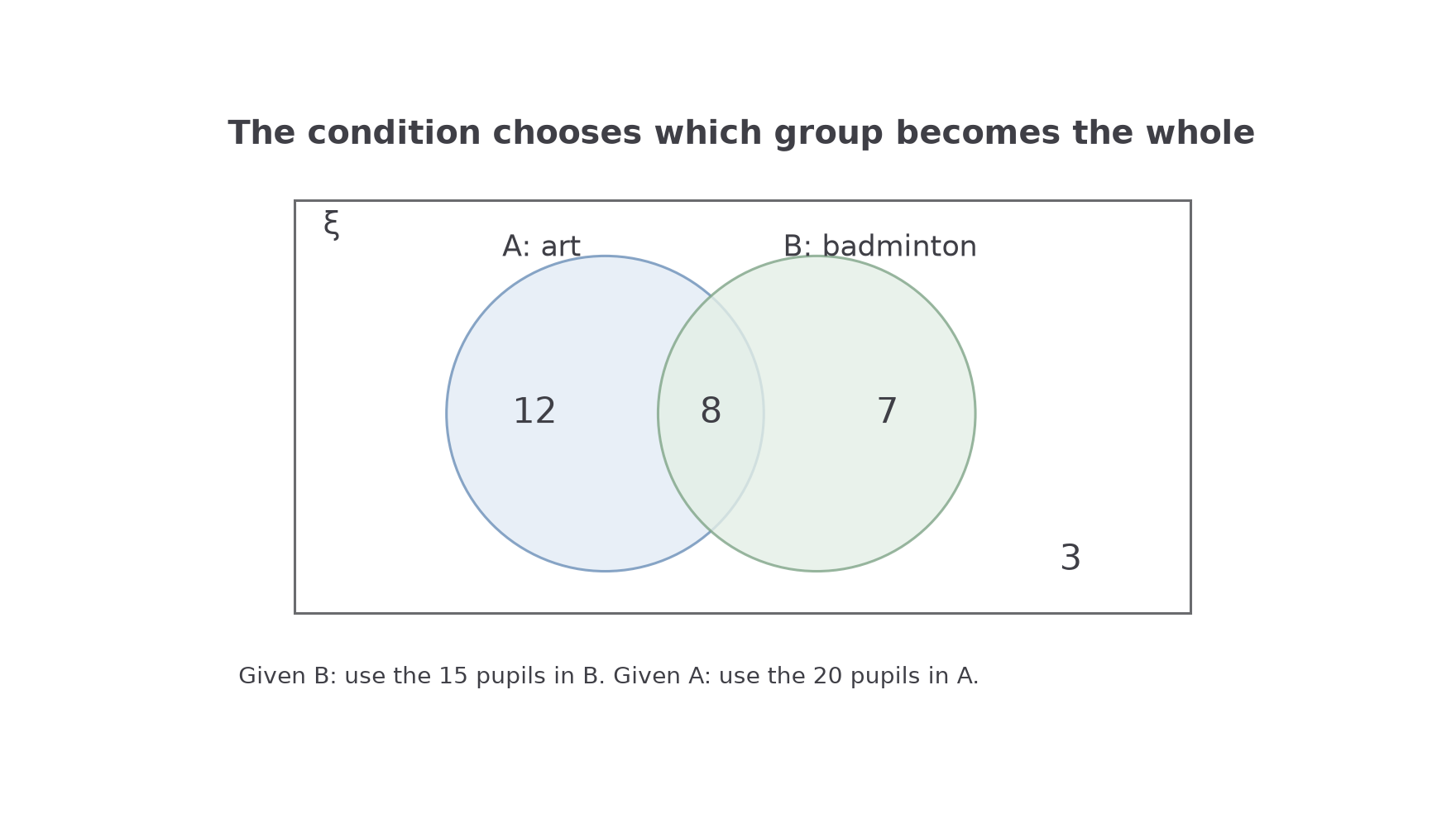
Given , ignore everything outside circle . Given , do the opposite: use the art-only and neither regions. A complement is always taken within the universal set before applying the condition. The notation and counting rule are not printed on the formulae sheet: learn them.
Worked example 3: the intersection inside the condition
Question. A pupil is chosen at random from the group described above. Work out . Non-calculator.
Plan. Count all pupils in , then count those also in .
Why include both regions of in the denominator? The condition says badminton, not badminton only.
Answer. .
Check. This is greater than the unconditional probability , because the same pupils are being compared with a smaller whole.
The next example keeps the condition and changes only the requested event to not art.
Worked example 4: a complement inside the condition
Question. For the same group, work out . Non-calculator.
Plan. Keep the badminton pupils as the whole, then select those outside art.
Why not include the in neither? They are outside art, but they do not satisfy the given condition .
Answer. .
Check. .
A different condition creates a different denominator. For example, . The art-only region is the favourable count, and the entire outside-badminton region is the possible count.
Watch out
Wrong: use the universal-set total for every Venn probability. Right: for a conditional probability, shade the given group mentally and use only that group's total.
Try a new pair of clubs, with the condition on the first set instead.
Conditions in probability trees (Higher)
Second-stage tree branches already describe probabilities given the first-stage result.
A pupil travels by bus with probability . Given bus travel, the probability of being late is . Given no bus travel, it is . These are different second-stage probabilities, so bus travel and lateness are dependent in this model.
[DIAGRAM: asset_name: Bus travel and lateness probability tree; asset_slug: aqa8300_p04_bus_tree; caption: The late branches give probabilities within different first-stage groups; description: The first split is bus 0.6 and no bus 0.4. After bus, late is 0.2 and not late 0.8. After no bus, late is 0.05 and not late 0.95. End path probabilities are bus and late 0.12, bus and not late 0.48, no bus and late 0.02, no bus and not late 0.38.]
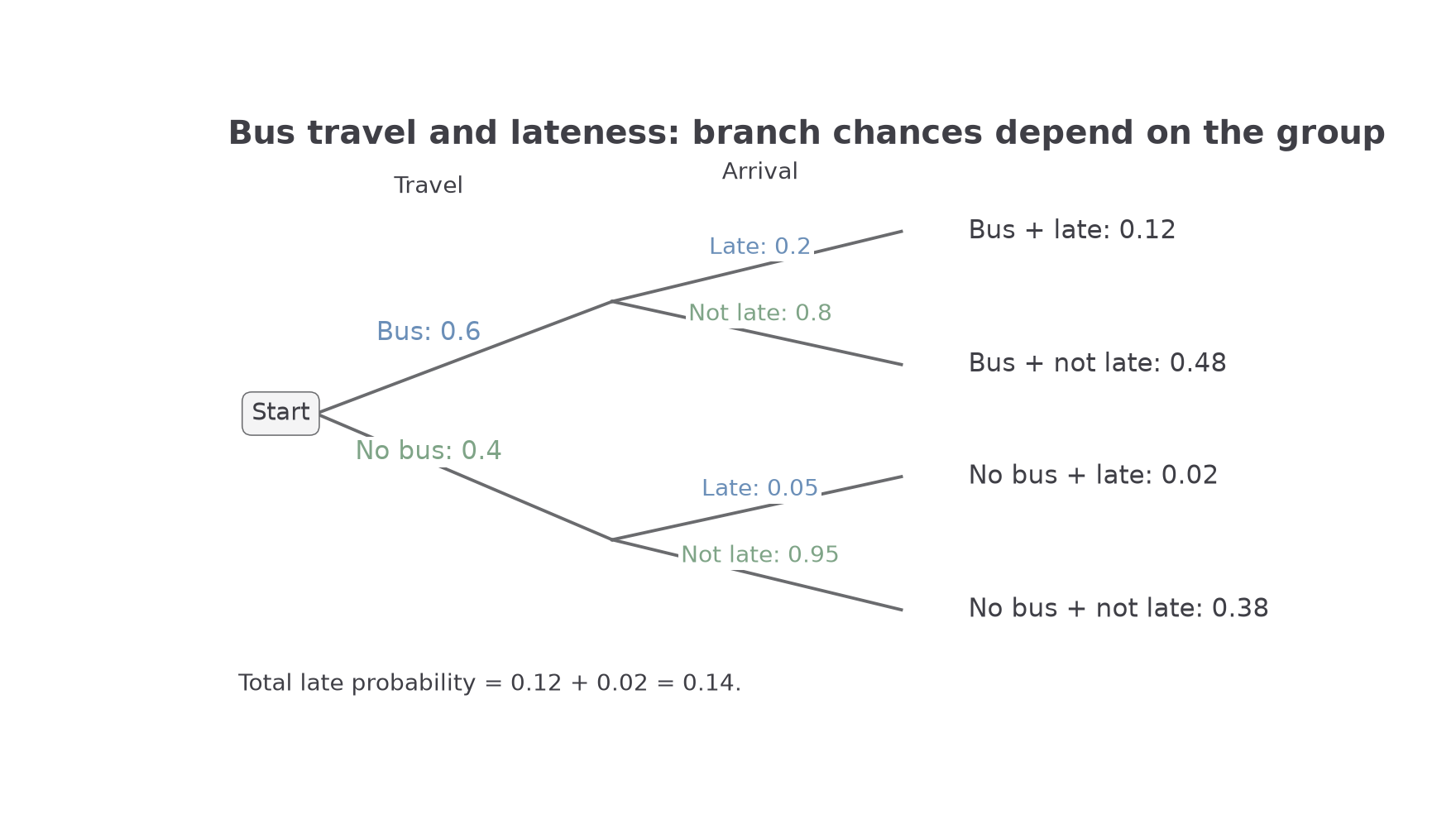
A branch is a fraction of its parent group. A complete path is a fraction of the starting whole. Multiplying converts the conditional branch chance into a joint chance.
Continue this lesson.
You’re previewing NovaLearn without an account. Create a free account to read the rest.
Create free account