G22, G23 - Sine rule, cosine rule and triangle area (Higher)
A triangle does not need a right angle for its sides and angles to be connected. G22 gives the sine and cosine rules for missing lengths and angles; G23 gives an area formula using two sides and the angle between them. You will choose a rule from the information available and recognise when an angle could have two possible values.
Using the sine rule for lengths
Two triangles each have sides and . One has an angle of between those sides; the other has . Could their areas be equal? They look very different, but a shared height will settle this by the end.
You already know
Angles in a triangle add to . In a right triangle, sine is opposite divided by hypotenuse. Use degree mode and keep unrounded values until the final answer.
For a general triangle, give each side the lower-case letter matching its opposite angle: side faces angle , side faces , and side faces . Opposite means across the triangle, not touching that vertex.
[DIAGRAM: asset_name: Match every side to its opposite angle; asset_slug: aqa8300_g21_opposites; caption: Lower-case side letters face their matching capital-letter angles; description: A non-right scalene triangle ABC. Side BC is labelled a and matches a blue angle arc A. Side AC is labelled b and matches a sage angle arc B. Side AB is labelled c and matches a clay angle arc C. A perpendicular height from C to AB is dashed and marked h, with a right-angle square at its foot.]
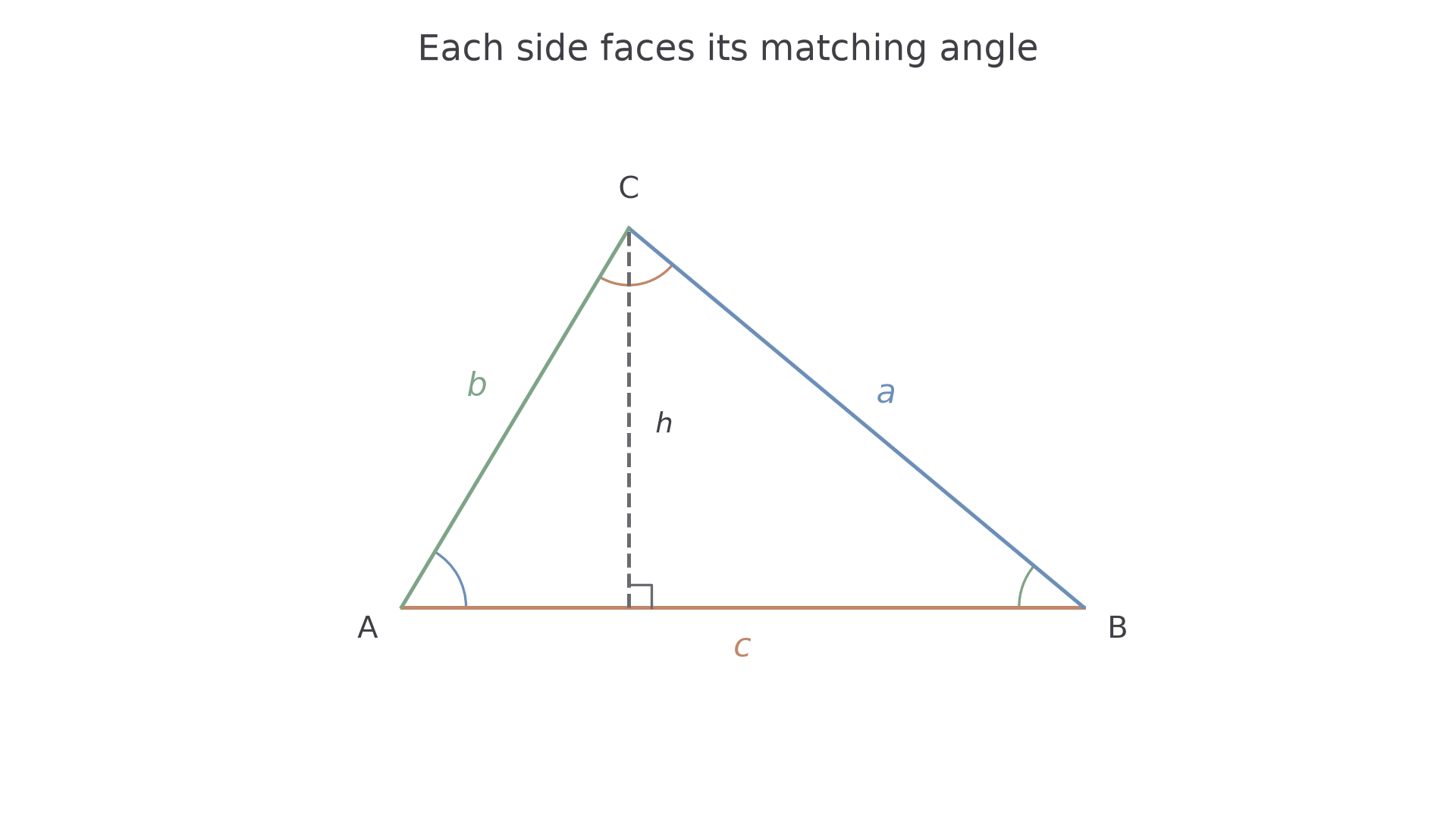
Drop a perpendicular height onto side . In an acute triangle, . Therefore . Repeating the argument with another height brings in . The rule also holds for obtuse triangles, using a height outside the triangle.
Sine rule
In any triangle, with each side opposite its matching angle,
Use two fractions at a time. For a missing side, you need a known side with its opposite angle, plus the angle opposite the wanted side.
On the 2027 Higher formulae sheet.
The known opposite pair is your starting point. If the third angle is missing, work it out before substituting.
Worked example 1: two matching pairs
Question. Calculator allowed. In triangle , , and . Work out to significant figures.
Plan. Match with , then use the sine rule for .
Why this step? A larger angle faces a longer side. Putting on top would reverse that relationship.
Answer. .
Check. , and , as expected.
Change the information given: the known side is now opposite the angle you must find first.
Worked example 2: find the third angle first
Question. Calculator allowed. In triangle , , and . Work out to significant figures.
Plan. Find using the angle sum, then match side with it.
Why this step? The belongs with , not whichever angle happens to be written next to it in the question.
Answer. .
Check. , so , as found.
Mark matching letters on a sketch if the fraction arrangement feels slippery.
Watch out
Wrong: pair side with angle because they touch. Right: pair a side with the angle opposite it. The sine rule compares opposite pairs.
Try a different known opposite pair.
Using the sine rule for angles
When the angle is unknown, putting the sine terms on top often makes rearranging easier. The reciprocal form is the same sine rule, not a second result to memorise.
An important boundary appears here. Sine gives the same value for supplementary angles: for example, . A height above a base can be the same when a side leans forwards or backwards. So an inverse-sine answer may not be the only possible triangle angle. This supplementary-angle fact is not on the formulae sheet: learn it.
Worked example 3: an acute angle is specified
Question. Calculator allowed. Triangle has , , , and acute angle . Work out to decimal place.
Plan. Rearrange the sine rule for , then take inverse sine.
Why this step? The question states that is acute, so the calculator's acute answer is the required one.
Answer. .
Check. , consistent with . The remaining angle is positive.
Change one condition: the wanted angle is obtuse. The calculator still returns its acute partner first.
Worked example 4: choosing the obtuse angle
Question. Calculator allowed. Triangle has , , , and obtuse angle . Work out to decimal place.
Plan. Find the acute inverse-sine angle, then subtract it from .
Why this step? Sine cannot distinguish these two supplementary angles. “Obtuse” chooses the one above .
Answer. .
Check. , so a positive third angle remains. Both partners have sine .
If no acute/obtuse condition is given, check both candidates against the triangle's other angles and stated geometry. There may be two possible triangles. If , there is no possible triangle; if the candidate angles make the angle sum at least , reject them.
Watch out
Wrong: “Inverse sine always gives the triangle's angle.” Right: inverse sine gives the acute partner for a positive ratio. Check whether an obtuse supplementary angle also fits the question.
The next question removes the ambiguity by specifying an acute angle.
Using the cosine rule for lengths
Suppose you know two sides and the angle between them. There is no known opposite side-angle pair, so the sine rule cannot start. The included angle is the angle between the two known sides.
Cosine rule
In any triangle,
Angle is between sides and , and side is opposite . Relabel the triangle to suit the wanted side.
On the 2027 Higher formulae sheet.
When , , so this becomes Pythagoras. When is acute, the correction is subtracted; when it is obtuse, cosine is negative and the opposite side becomes longer. The cosine rule extends the right-triangle relationship rather than replacing it.
Worked example 5: an acute included angle
Question. Calculator allowed. Two sides of a triangle are and . The angle between them is . Work out the third side to significant figures.
Plan. Use the cosine rule with opposite the given angle, then take the square root.
Why this step? The result before the square root is . The angle must be the one between and .
Answer. .
Check. , so the triangle inequality is satisfied.
Change only the included angle to . A wider opening should produce a longer opposite side.
Worked example 6: an obtuse included angle
Question. Calculator allowed. Two sides are and , with included angle . Work out the opposite side to significant figures.
Plan. Keep the full signed cosine term inside the square root.
Why this step? Subtracting a negative adds. The obtuse triangle's longest side must be opposite .
Answer. .
Check. It is longer than but shorter than , as required.
Use brackets around a negative cosine value if entering it separately.
Watch out
Wrong: . Right: the correction in the cosine rule uses cosine. Sine belongs in the sine rule and the area formula, not in this correction.
Apply the same rule to a new obtuse angle.
Continue this lesson.
You’re previewing NovaLearn without an account. Create a free account to read the rest.
Create free account